Summary Advanced Molecular Gastronomy – Physics part
1. Basic physical concepts in food matrices
Solid states in food systems
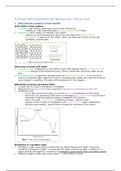
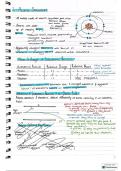
• Crystalline: fast cooling, atoms have time to order themselves
o Heating up: order state falls apart (melting temperature) → liquid
• Amorphous: slow cooling, no ordering in the system
o Heating up: the arrangement of atoms can rearrange at the glass transition
temperature → glass turns into rubber. When you heat even further you can get
crystalline, ordered state.
Interaction of water with solids
• Crystalline solids → adsorption on the surface of the solid because there is no space for water
on the inside because of the ordered structure. When crystals have impurities, water can go
here.
• Amorphous solids → absorption because water can fill up the open spaces in the structure.
Amount of absorbed water depends on amount of binding sites. Water can make the structure
more ordered = crystalline. The water will be pushed out if this happens…
Differential scanning calorimetry (DSC)
• To determine if a solid is amorphous or crystalline
• Measures the amount of heat that is required to increase the temperature of the solid
• Amorphous solid:
o If you add an amount of heat, you will see a raise in temperature of the product.
o More heat: the amorphous state starts to rearrange (glass transition) → you will see a
decrease in heat flow because energy is needed for the transition.
o Even more heat: crystallization (exothermic process = delivers heat)
o Because of the increase in temperature, the crystals will melt again. Endothermic
process (costs energy) because heat is needed for movement of the atoms.
Amorphous or crystalline sugar
• Amorphous sugar has a reactive surface that can absorb flavours and water → becomes
crystalline in presence of water → cannot hold the water anymore so water is pushed out →
sugar particles stick together, undesired! So amorphous sugar should have a low water content
• Melting of sugar crystals costs energy (heat) = cooling effect in mouth
,Sugars and sweeteners
• Provides taste, crust colour, softness, shelf life
• Coarse sugar spreads less in the product → sugar can recrystallize → surface cracking
• Invert syrup: sucrose syrup with additional glucose and fructose (monomers)
• Fondant: crystallized sugar syrup
• Brown sugar: contains added caramel
• Molasses: concentrated sugar cane juice with different sugars, acid and moisture
• Fructose: sweeter than sucrose, larger effect on water activity
• Starch hydrolysates: low DE = starch, high DE = more glucose like
• Honey: glucose and fructose
Sugar confections
• When sugars are heated above their glass transition temperature, they can get a more ordered
structure → crystalline
• Hard candies: highly saturated sugar solutions in their glassy state
• Fondant: partially crystalline by beating the sugar solution (much contact = spreading of
nuclei). Invertase is added to split sucrose into glucose and fructose → more water can be
bound = lower water activity
• Marshmallows: air bubbles surrounding by sugar syrup and proteins
• Some candies will take up water (cotton candy, hard candies) and other will loose water
(caramel, fudge, fondant) and become soft.
Emulsifiers
• Emulsion properties depend on distribution of hydrophobic and hydrophilic patches
• Packing parameter (how do the surfactants assembly = tails together?)
o For instance micelles, cylindrical micelles, bilayers, inversed micelle
o P = v / (lc*a0)
o V = volume occupied by the tail (m3)
o A0 = optimal area per head group (m2)
o Lc = critical tail length (m)
• Lecithin: small hydrophilic head with two large hydrophobic tails → can form inversed micelles
→ very suitable for W/O emulsion
Hydrophilic-lipophilic balance (HLB)
• Affinity of surfactant for hydrophilic or hydrophobic phase
• Higher number = more hydrophilic groups = more affinity for water = O/W emulsion
• Low number = more hydrophobic groups = more affinity for oil = W/O emulsion
2. Ice cream
Ice crystals and air bubbles surrounded by an unfrozen, continuous matrix of sugar, proteins and
water. 30% ice, 50% air, 5% fat and 15% matrix.
Freezing point depression
• You only want 30% instead of 60-70% ice crystals in ice cream → lower the freezing point by
adding solutes that interfere with the formation of ice crystals
• Salt or sugar molecules get in the way for the water molecules to form a crystal → more
energy (cooling) is needed to form a crystal
• Freezing point depression = ΔTf = Kk* (msolute/Msolute) * i
o Kk = cryoscopic constant (-1.86)
o msolute = grams solids per kg of water
o Msolute = number of g/mol
o I = degree of dissociation
, • Smaller molecules are more effective as there are
more molecules per weight
• Freezing point factor: if 0.53, you need less
material for the same freezing point depression
compared to when the freezing point factor is 1.
Phase diagram
• A → B: water becomes ice
• B → C: more ice means less water so the
concentration of sugar becomes higher (freeze
concentration) = lower freezing point
• No more ice will be formed when the temperature
of the ice cream reaches the freezing point
temperature. Only sugar crystals can form below
this temperature.
• D: maximum sugar content that the solution can
hold before sugar crystals are formed.
• E: very viscous solution without ordering →
glassy state
How much ice is formed?
• msolute = amount of solids added to 1 kg of water!
• Gives ice curve: how much ice at a certain temperature?
Ice formation
• Nuclei have to be formed before crystals can grow
• Nuclei form upon collision of molecules
• Forming crystals delivers energy, melting crystals costs energy
• The formation of crystals is favourable because more ordering. Forming interface is not
favourable..
Nucleation and growth
• Super cooling: temperature below melting temperature
• When nuclei are big enough (critical radius), they will grow further
• Energy gain (by forming crystals) should be larger than the costs for creating interface
• Critical radius
o Y = surface tension
o Tm0 = melting/freezing point
o ΔfH= enthalpy of fusion
o ΔT = difference in temperature Tmelt and Tfreezer
o Low melting point and large temperature difference = very small critical radius…
▪ For instance melts/freezes at -25 degrees and the temperature of the freezer is
-75 → small crystals will form.
▪ If you mix melts/freezes at -25 degrees and the temperature of your freezer is
only -30 → larger ice crystals will form
Ice cream / sorbet ingredients
• Sorbet: no fat
• 28-40% solids (of which half is sugar), 60-72% water
Microstructure of ice cream
• Air bubbles are stabilized by fat and proteins
• Serum contains sugar, milk proteins, stabilizers, flavour, colour
• Milk protein: 80% casein (attaches to fat = negative because less coalescence of fat globules),
20% whey (stabilizes air bubbles) → both give dairy flavour
1. Basic physical concepts in food matrices
Solid states in food systems
• Crystalline: fast cooling, atoms have time to order themselves
o Heating up: order state falls apart (melting temperature) → liquid
• Amorphous: slow cooling, no ordering in the system
o Heating up: the arrangement of atoms can rearrange at the glass transition
temperature → glass turns into rubber. When you heat even further you can get
crystalline, ordered state.
Interaction of water with solids
• Crystalline solids → adsorption on the surface of the solid because there is no space for water
on the inside because of the ordered structure. When crystals have impurities, water can go
here.
• Amorphous solids → absorption because water can fill up the open spaces in the structure.
Amount of absorbed water depends on amount of binding sites. Water can make the structure
more ordered = crystalline. The water will be pushed out if this happens…
Differential scanning calorimetry (DSC)
• To determine if a solid is amorphous or crystalline
• Measures the amount of heat that is required to increase the temperature of the solid
• Amorphous solid:
o If you add an amount of heat, you will see a raise in temperature of the product.
o More heat: the amorphous state starts to rearrange (glass transition) → you will see a
decrease in heat flow because energy is needed for the transition.
o Even more heat: crystallization (exothermic process = delivers heat)
o Because of the increase in temperature, the crystals will melt again. Endothermic
process (costs energy) because heat is needed for movement of the atoms.
Amorphous or crystalline sugar
• Amorphous sugar has a reactive surface that can absorb flavours and water → becomes
crystalline in presence of water → cannot hold the water anymore so water is pushed out →
sugar particles stick together, undesired! So amorphous sugar should have a low water content
• Melting of sugar crystals costs energy (heat) = cooling effect in mouth
,Sugars and sweeteners
• Provides taste, crust colour, softness, shelf life
• Coarse sugar spreads less in the product → sugar can recrystallize → surface cracking
• Invert syrup: sucrose syrup with additional glucose and fructose (monomers)
• Fondant: crystallized sugar syrup
• Brown sugar: contains added caramel
• Molasses: concentrated sugar cane juice with different sugars, acid and moisture
• Fructose: sweeter than sucrose, larger effect on water activity
• Starch hydrolysates: low DE = starch, high DE = more glucose like
• Honey: glucose and fructose
Sugar confections
• When sugars are heated above their glass transition temperature, they can get a more ordered
structure → crystalline
• Hard candies: highly saturated sugar solutions in their glassy state
• Fondant: partially crystalline by beating the sugar solution (much contact = spreading of
nuclei). Invertase is added to split sucrose into glucose and fructose → more water can be
bound = lower water activity
• Marshmallows: air bubbles surrounding by sugar syrup and proteins
• Some candies will take up water (cotton candy, hard candies) and other will loose water
(caramel, fudge, fondant) and become soft.
Emulsifiers
• Emulsion properties depend on distribution of hydrophobic and hydrophilic patches
• Packing parameter (how do the surfactants assembly = tails together?)
o For instance micelles, cylindrical micelles, bilayers, inversed micelle
o P = v / (lc*a0)
o V = volume occupied by the tail (m3)
o A0 = optimal area per head group (m2)
o Lc = critical tail length (m)
• Lecithin: small hydrophilic head with two large hydrophobic tails → can form inversed micelles
→ very suitable for W/O emulsion
Hydrophilic-lipophilic balance (HLB)
• Affinity of surfactant for hydrophilic or hydrophobic phase
• Higher number = more hydrophilic groups = more affinity for water = O/W emulsion
• Low number = more hydrophobic groups = more affinity for oil = W/O emulsion
2. Ice cream
Ice crystals and air bubbles surrounded by an unfrozen, continuous matrix of sugar, proteins and
water. 30% ice, 50% air, 5% fat and 15% matrix.
Freezing point depression
• You only want 30% instead of 60-70% ice crystals in ice cream → lower the freezing point by
adding solutes that interfere with the formation of ice crystals
• Salt or sugar molecules get in the way for the water molecules to form a crystal → more
energy (cooling) is needed to form a crystal
• Freezing point depression = ΔTf = Kk* (msolute/Msolute) * i
o Kk = cryoscopic constant (-1.86)
o msolute = grams solids per kg of water
o Msolute = number of g/mol
o I = degree of dissociation
, • Smaller molecules are more effective as there are
more molecules per weight
• Freezing point factor: if 0.53, you need less
material for the same freezing point depression
compared to when the freezing point factor is 1.
Phase diagram
• A → B: water becomes ice
• B → C: more ice means less water so the
concentration of sugar becomes higher (freeze
concentration) = lower freezing point
• No more ice will be formed when the temperature
of the ice cream reaches the freezing point
temperature. Only sugar crystals can form below
this temperature.
• D: maximum sugar content that the solution can
hold before sugar crystals are formed.
• E: very viscous solution without ordering →
glassy state
How much ice is formed?
• msolute = amount of solids added to 1 kg of water!
• Gives ice curve: how much ice at a certain temperature?
Ice formation
• Nuclei have to be formed before crystals can grow
• Nuclei form upon collision of molecules
• Forming crystals delivers energy, melting crystals costs energy
• The formation of crystals is favourable because more ordering. Forming interface is not
favourable..
Nucleation and growth
• Super cooling: temperature below melting temperature
• When nuclei are big enough (critical radius), they will grow further
• Energy gain (by forming crystals) should be larger than the costs for creating interface
• Critical radius
o Y = surface tension
o Tm0 = melting/freezing point
o ΔfH= enthalpy of fusion
o ΔT = difference in temperature Tmelt and Tfreezer
o Low melting point and large temperature difference = very small critical radius…
▪ For instance melts/freezes at -25 degrees and the temperature of the freezer is
-75 → small crystals will form.
▪ If you mix melts/freezes at -25 degrees and the temperature of your freezer is
only -30 → larger ice crystals will form
Ice cream / sorbet ingredients
• Sorbet: no fat
• 28-40% solids (of which half is sugar), 60-72% water
Microstructure of ice cream
• Air bubbles are stabilized by fat and proteins
• Serum contains sugar, milk proteins, stabilizers, flavour, colour
• Milk protein: 80% casein (attaches to fat = negative because less coalescence of fat globules),
20% whey (stabilizes air bubbles) → both give dairy flavour