Week 17
1. the structure of the skin (including the structure of different kinds of
epithelia and connective tissue)
Epithelium
- Intercellular connection epithelium
1) tight junctions 2) anchoring molecules and desmosomes 3) gab junctions
- Surface specialisation of epithelium
= skin = stratified keratinized squamous epithelium
1) stratum basale: melanocytes and Merkel cells. Much mitosis. Desmosomes bind this to the dermis
2) stratum spinosum: Thickest! Langerhans cells. Much desmosomes, keratinocytes bind these. The
desmosomes also prevent H2O loss.
3) stratum granulosum: keratinization starts. =basophilic. Has lamellar granules that secrete lipids for
barrier function and prevention of H2O. very active cells clear nucleus.
4) stratum lucidum: only in thick skin. =eosinophilic. No nuclei and organelles.
5) stratum corneum: completely keratinized. ONLY keratin here.
- different kind of epithelia
stratified keratinized squamous epithelium, stratified squamous epithelium, transitional epithelium,
columnar epithelium, pseudostratified epithelium.
- excretion by exocrine glands
Via ducts
Connective tissue: cellular/extracellular components (cells, extracellular matrix, fiber)
Cellular: permanent = fibroblasts, mast cells
free cells = T, B, macrophages and neutrophils.
Extracellular: fibers, ground substance and interstitial fluid
- different types of connective tissue
Function of the connective tissue depends on the ECM.
- Loose (proper) connective tissue: most. Not much
collagen fibers. Important is filling spaces. They allow
movement. And are highly vascularized. (i.e. submucosa or
mesentery)
- Dense connective tissue: more fibers, less ground
substance
regular = fibers arranged in 1 direction
irregular = fibers randomly organized, can stand
against forces of multiple directions
- specialized connective tissue:
elastic connective tissue: much elastic fibers,
fibrillin is an important component
reticular connective tissue: collagen III, in lymph nodes, bone marrow, spleen, liver
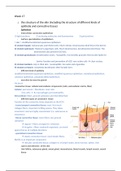
Layers and elements of the skin
Hair follicle, sebaceous gland, sweat gland, mesenchyma, blood vessels, lymph vessels, neural
tissue
, 2. the three main groups of skin tumours
- Melanoma, basal cell carcinoma, squamous cell carcinoma
Melanoma Basel cell carcinoma Squamous cell carcinoma
Morphology
ABCDE
Age and risk 40 years old MOST COMMON. More in white More in man. Highly associated
factors - Albino - UV, blistering sun burn males. Upper part of face (UV with UV. But can also be caused
- Red/blond, freckles on back, exposed). by immune suppression. Poorly
blue eyes treated burns.
Genetics and -P16/INK4a: fast cell cycle -Mutations that lead to Hedgehog -TP53
pathology dysplastic nevi syndrome signalling (PTCH1). - Xeroderma pigmentosum
- BRAF/RAS: pro-growth - NBCCS/Gorlin syndrome role UV repair
- TERT: turns on telomerase - Xeroderma pigmentosa - Actinic keratosis: hyper-
- 10-15% is inherited keratosis, bulges outward
Clinical -Also possible on mucosal surface Locally aggressive but slow Also on mucous membranes.
features - Itch, can ulcerate growing. Rarely metastasizes. Rarely metastasizes, but deeply
- Early spread to lymph nodes Only on skin. invasive: involves subcutis.
Satellite lesions
Management Excision if small. Also lymph node Local excision. Topical chemothe- Local radiotherapy or excision
dissection. Adjuvant: BRAFi (vem- rapy. Mohs micrographic surgery. via Mohs micrographic surgery.
urafenib) imitinub + radiotharpy. Radio-therapy or photodynamic Chemo has not a big role.
Chemo only i.c.o. spread therapy.
Prognosis Breslow-thickness Worse i.c.o. >2cm or recurrence
3. an overview of the epidemiology, risk groups and options for the
prevention of skin tumours
- Recognition melanoma, ABCDE rule:
Asymmetrical, Borders uneven, Colors variation, Diameter,
Evolving
- Melanoma incidence, mortality
Incidence: 7100, mortality:
- Types melanoma: superficial spreading, nodular, lentigo maligna, acrolentiginous
Superficial spreading: 80%, grow slow and arise from pigmented nevi
Nodular spreading: vertical spread, more in men. More aggressive and arise in normal skin
Lentigo maligna: uncommon. <3cm. face/neck of elderly women. Locally invasive
acrolentiginous: on palmes/soles/nails. 60 years. ONLY type in dark individuals
1. the structure of the skin (including the structure of different kinds of
epithelia and connective tissue)
Epithelium
- Intercellular connection epithelium
1) tight junctions 2) anchoring molecules and desmosomes 3) gab junctions
- Surface specialisation of epithelium
= skin = stratified keratinized squamous epithelium
1) stratum basale: melanocytes and Merkel cells. Much mitosis. Desmosomes bind this to the dermis
2) stratum spinosum: Thickest! Langerhans cells. Much desmosomes, keratinocytes bind these. The
desmosomes also prevent H2O loss.
3) stratum granulosum: keratinization starts. =basophilic. Has lamellar granules that secrete lipids for
barrier function and prevention of H2O. very active cells clear nucleus.
4) stratum lucidum: only in thick skin. =eosinophilic. No nuclei and organelles.
5) stratum corneum: completely keratinized. ONLY keratin here.
- different kind of epithelia
stratified keratinized squamous epithelium, stratified squamous epithelium, transitional epithelium,
columnar epithelium, pseudostratified epithelium.
- excretion by exocrine glands
Via ducts
Connective tissue: cellular/extracellular components (cells, extracellular matrix, fiber)
Cellular: permanent = fibroblasts, mast cells
free cells = T, B, macrophages and neutrophils.
Extracellular: fibers, ground substance and interstitial fluid
- different types of connective tissue
Function of the connective tissue depends on the ECM.
- Loose (proper) connective tissue: most. Not much
collagen fibers. Important is filling spaces. They allow
movement. And are highly vascularized. (i.e. submucosa or
mesentery)
- Dense connective tissue: more fibers, less ground
substance
regular = fibers arranged in 1 direction
irregular = fibers randomly organized, can stand
against forces of multiple directions
- specialized connective tissue:
elastic connective tissue: much elastic fibers,
fibrillin is an important component
reticular connective tissue: collagen III, in lymph nodes, bone marrow, spleen, liver
Layers and elements of the skin
Hair follicle, sebaceous gland, sweat gland, mesenchyma, blood vessels, lymph vessels, neural
tissue
, 2. the three main groups of skin tumours
- Melanoma, basal cell carcinoma, squamous cell carcinoma
Melanoma Basel cell carcinoma Squamous cell carcinoma
Morphology
ABCDE
Age and risk 40 years old MOST COMMON. More in white More in man. Highly associated
factors - Albino - UV, blistering sun burn males. Upper part of face (UV with UV. But can also be caused
- Red/blond, freckles on back, exposed). by immune suppression. Poorly
blue eyes treated burns.
Genetics and -P16/INK4a: fast cell cycle -Mutations that lead to Hedgehog -TP53
pathology dysplastic nevi syndrome signalling (PTCH1). - Xeroderma pigmentosum
- BRAF/RAS: pro-growth - NBCCS/Gorlin syndrome role UV repair
- TERT: turns on telomerase - Xeroderma pigmentosa - Actinic keratosis: hyper-
- 10-15% is inherited keratosis, bulges outward
Clinical -Also possible on mucosal surface Locally aggressive but slow Also on mucous membranes.
features - Itch, can ulcerate growing. Rarely metastasizes. Rarely metastasizes, but deeply
- Early spread to lymph nodes Only on skin. invasive: involves subcutis.
Satellite lesions
Management Excision if small. Also lymph node Local excision. Topical chemothe- Local radiotherapy or excision
dissection. Adjuvant: BRAFi (vem- rapy. Mohs micrographic surgery. via Mohs micrographic surgery.
urafenib) imitinub + radiotharpy. Radio-therapy or photodynamic Chemo has not a big role.
Chemo only i.c.o. spread therapy.
Prognosis Breslow-thickness Worse i.c.o. >2cm or recurrence
3. an overview of the epidemiology, risk groups and options for the
prevention of skin tumours
- Recognition melanoma, ABCDE rule:
Asymmetrical, Borders uneven, Colors variation, Diameter,
Evolving
- Melanoma incidence, mortality
Incidence: 7100, mortality:
- Types melanoma: superficial spreading, nodular, lentigo maligna, acrolentiginous
Superficial spreading: 80%, grow slow and arise from pigmented nevi
Nodular spreading: vertical spread, more in men. More aggressive and arise in normal skin
Lentigo maligna: uncommon. <3cm. face/neck of elderly women. Locally invasive
acrolentiginous: on palmes/soles/nails. 60 years. ONLY type in dark individuals