Health Assessment Practice Questions (Test 1)good
Study online at https://quizlet.com/_4bl3t3
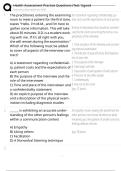
1. The practitioner, entering the examining A) A statement regarding confedentiality, pa-
room to meet a patient for the first time, tient costs and the expectations of each person
states "Hello, I'm M.M., and I'm here to
gather some information. This will take 8 items of information that should be commini-
about 30 minutes. D.D. is a student work- cated to the client concerning the terms or ex-
ing with me. If it's all right with you, pectations of the interview:
she will remain during the examination."
1. Time and place of the interview and succeed-
Which of the following must be added
ing physical examination
to cover all aspects of the interview con-
2. Introduction of yourself and a breif explana-
tract?
tion of your role
A) A statement regarding confedentiali- 3. The purpose of the interview
ty, patient costs and the expectations of 4. How long it will take
each person 5. Expectation of participation of each person
B) the purpose of the interview and the 6. Presence of any other people
role of the interviewer 7. Confidentiality
C) Time and place of the interviewer and 8. Any cost to the client
a confedentiality statement (pg. 27 Jarvis)
D) An explicit purpose of the interview
and a description of the physical exam-
ination including diagnostic studies
2. ______ is exhibiting an accurate under- A) Empathy: means viewing the world from the
standing of the other person's feelings other persons inner frame of reference while
within a communication context remaining you. Recognition of another persons
feelings without criticism.
A) Empathy
B) Liking others (pg. 28 Jarvis)
C) Facilitation
D) A Nonverbal listening technique
3.
, Health Assessment Practice Questions (Test 1)good
Study online at https://quizlet.com/_4bl3t3
You conduct an admission interview. Be- B) Have someone answer the phone so you can
cause you are expecting a phone call, sit facing the patient
you stand near the door. Which would be
a more appropriate approach? Refuse Interruptions: Inform support staff of
your interview and ask them not to interupt you
A) Arrange to have someone page you so during this time. Any interuption can destroy
you can sit on the side of the bed any rapport you had previously built.
B) Have someone answer the phone so Sit eye level with patient and avoid barriers such
you can sit facing the patient as desks, and avoid standing, standing assumes
C) Use this approach given the circum- superiority and takes away control from the pa-
stances tient. Keep a distance of 4 to 5 feet for personal
D) Arrange for time free of interuptions space.
after the initial physical examination is
complete (pg.29 Jarvis)
4. A patient asks the nurse, "May I ask you C) A closed question: elicits a "yes" or "no" an-
a question?" This is an example of: swer or a forced choice.
A) An open-ended question **Avoid Double-barreled questions are ques-
B) A reflective question tions that ask more than one question, to where
C) A closed question a "yes" or "no" answer would not fully satisfy the
D) A double-barreled question question
(pg. 32 Jarvis)
5. Which statement best describes inter- D) interpretation is based on the interviewer's
pretation as a communication tech- inference from the data that have been present-
nique? ed
A) interpretation is the same as clarifica- Interpretation links events, makes associations
tion and implies cause, not based on directly obser-
B) interpretation is a summary of a state- vations but instead on inference or conclusion,
ment made by the patient you interpretation may be incorrect but helps
C) interpretation is used to focus on a promt further discussion
, Health Assessment Practice Questions (Test 1)good
Study online at https://quizlet.com/_4bl3t3
particular aspect of what the patient has
just said (pg. 33 Jarvis)
D) interpretation is based on the inter-
viewer's inference from the data that
have been presented
6. Which demonstrates a good under- B) the nurse spends more time listening to the
standing of the interview process? patient than talking
A) the nurse stops the patient each time #8 on Ten Traps of Interviewing: Talking too
something is said that is not under- much
stood (pg. 34 Jarvis)
B) the nurse spends more time listening
to the patient than talking
C) the nurse is consistently thinking of
his or her next response so the patient
will know he or she is understood
D) the nurse uses "why" questions to
seek clarification of unusual symptoms
or behaviors
7. During an interview, a patient denies A) Use confrontation to bring the discrepency
having anxiety. The patient frequently between verbal and nonverbal behavior to the
changes positions in the chair, hold his patients attention
arms folded tight against his chest, and
has little eye contact with the interview- Confrontation is used to clarify inconsistent in-
er. The interviewer should: formation and focus the clients attention on an
observed behavior, action or feeling
A) Use confrontation to bring the dis-
crepency between verbal and nonverbal (pg. 33 Jarvis)
behavior to the patients attention
B) Proceed with the interview. Patients
Study online at https://quizlet.com/_4bl3t3
1. The practitioner, entering the examining A) A statement regarding confedentiality, pa-
room to meet a patient for the first time, tient costs and the expectations of each person
states "Hello, I'm M.M., and I'm here to
gather some information. This will take 8 items of information that should be commini-
about 30 minutes. D.D. is a student work- cated to the client concerning the terms or ex-
ing with me. If it's all right with you, pectations of the interview:
she will remain during the examination."
1. Time and place of the interview and succeed-
Which of the following must be added
ing physical examination
to cover all aspects of the interview con-
2. Introduction of yourself and a breif explana-
tract?
tion of your role
A) A statement regarding confedentiali- 3. The purpose of the interview
ty, patient costs and the expectations of 4. How long it will take
each person 5. Expectation of participation of each person
B) the purpose of the interview and the 6. Presence of any other people
role of the interviewer 7. Confidentiality
C) Time and place of the interviewer and 8. Any cost to the client
a confedentiality statement (pg. 27 Jarvis)
D) An explicit purpose of the interview
and a description of the physical exam-
ination including diagnostic studies
2. ______ is exhibiting an accurate under- A) Empathy: means viewing the world from the
standing of the other person's feelings other persons inner frame of reference while
within a communication context remaining you. Recognition of another persons
feelings without criticism.
A) Empathy
B) Liking others (pg. 28 Jarvis)
C) Facilitation
D) A Nonverbal listening technique
3.
, Health Assessment Practice Questions (Test 1)good
Study online at https://quizlet.com/_4bl3t3
You conduct an admission interview. Be- B) Have someone answer the phone so you can
cause you are expecting a phone call, sit facing the patient
you stand near the door. Which would be
a more appropriate approach? Refuse Interruptions: Inform support staff of
your interview and ask them not to interupt you
A) Arrange to have someone page you so during this time. Any interuption can destroy
you can sit on the side of the bed any rapport you had previously built.
B) Have someone answer the phone so Sit eye level with patient and avoid barriers such
you can sit facing the patient as desks, and avoid standing, standing assumes
C) Use this approach given the circum- superiority and takes away control from the pa-
stances tient. Keep a distance of 4 to 5 feet for personal
D) Arrange for time free of interuptions space.
after the initial physical examination is
complete (pg.29 Jarvis)
4. A patient asks the nurse, "May I ask you C) A closed question: elicits a "yes" or "no" an-
a question?" This is an example of: swer or a forced choice.
A) An open-ended question **Avoid Double-barreled questions are ques-
B) A reflective question tions that ask more than one question, to where
C) A closed question a "yes" or "no" answer would not fully satisfy the
D) A double-barreled question question
(pg. 32 Jarvis)
5. Which statement best describes inter- D) interpretation is based on the interviewer's
pretation as a communication tech- inference from the data that have been present-
nique? ed
A) interpretation is the same as clarifica- Interpretation links events, makes associations
tion and implies cause, not based on directly obser-
B) interpretation is a summary of a state- vations but instead on inference or conclusion,
ment made by the patient you interpretation may be incorrect but helps
C) interpretation is used to focus on a promt further discussion
, Health Assessment Practice Questions (Test 1)good
Study online at https://quizlet.com/_4bl3t3
particular aspect of what the patient has
just said (pg. 33 Jarvis)
D) interpretation is based on the inter-
viewer's inference from the data that
have been presented
6. Which demonstrates a good under- B) the nurse spends more time listening to the
standing of the interview process? patient than talking
A) the nurse stops the patient each time #8 on Ten Traps of Interviewing: Talking too
something is said that is not under- much
stood (pg. 34 Jarvis)
B) the nurse spends more time listening
to the patient than talking
C) the nurse is consistently thinking of
his or her next response so the patient
will know he or she is understood
D) the nurse uses "why" questions to
seek clarification of unusual symptoms
or behaviors
7. During an interview, a patient denies A) Use confrontation to bring the discrepency
having anxiety. The patient frequently between verbal and nonverbal behavior to the
changes positions in the chair, hold his patients attention
arms folded tight against his chest, and
has little eye contact with the interview- Confrontation is used to clarify inconsistent in-
er. The interviewer should: formation and focus the clients attention on an
observed behavior, action or feeling
A) Use confrontation to bring the dis-
crepency between verbal and nonverbal (pg. 33 Jarvis)
behavior to the patients attention
B) Proceed with the interview. Patients