Portage BIOD 101 Module 6 Exam – Accurate
Answers To All Questions
Save
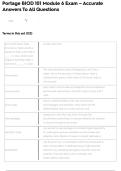
Terms in this set (123)
During the Gram-stain purple; pink/red
procedure, Gram-positive
bacteria retain a dye that is
_______ in color, while Gram-
negative bacteria retain a
dye that is _________ in color.
The most abundant type of phagocytic cell. Play a
major role in the process of inflammation. Have a
Neutrophils
characteristic grainy, multi-lobes (2-5) nuceli under a
microscope.
play roles in both innate and adaptive immune defenses
Lymphocytes and include natural killer cells (NK cells), B cells, and T
cells.
Naive, undifferentiated cells that will become
Monocytes Macrophages and dendritic cells, these are the
differentiated versions of this immune cell.
phagocytic cells that may travel through the
Macrophages bloodstream patrolling or may permanently be located
in tissues throughout the body.
Are similar to macrophages but exhibit higher specificity
Dendritic Cells for pathogens and are classified as both innate and
adaptive cells. Reside in tissues to engulf pathogens.
Are found in low concentration within the blood and in
high concentration in epithelial tissue. Fight parasitic
Eosinophils infections by releasing damaging enzymes onto the
parasite. They also play a role in allergic and
inflammatory responses.
, Barrier defenses fall under False: Barrier defenses fall under the innate arm of the
the adaptive arm of the immune system.
immune system
Which of the following A
statements is/are true of
Eukaryotic cells? (select all
that apply)
A) DNA is housed in a
membrane-bound nucleus
B) They are always single
celled
C) Bacteria are examples
D) All of the above
statements are true
List the THREE common Cocci, Bacilli, and Spiral
bacterial shapes
Pathogens can sometimes form protective capsules that
are thick enough to mask surface antigens. Not only are
Explain how pathogens use
the pathogens difficult to recognize, but the capsule
capsules to evade host cell
provides the additional benefit of protecting the
detection
microorganisms from degradation by host antimicrobial
proteins.
Where is lysozyme found? Lysozyme is a secreted enzyme found in mucus, tears
Describe how lysozyme and saliva that interferes with the peptidoglycan walls
destroys pathogens that of some bacteria and can thus destroy potential
have entered the body. invaders.
Answers To All Questions
Save
Terms in this set (123)
During the Gram-stain purple; pink/red
procedure, Gram-positive
bacteria retain a dye that is
_______ in color, while Gram-
negative bacteria retain a
dye that is _________ in color.
The most abundant type of phagocytic cell. Play a
major role in the process of inflammation. Have a
Neutrophils
characteristic grainy, multi-lobes (2-5) nuceli under a
microscope.
play roles in both innate and adaptive immune defenses
Lymphocytes and include natural killer cells (NK cells), B cells, and T
cells.
Naive, undifferentiated cells that will become
Monocytes Macrophages and dendritic cells, these are the
differentiated versions of this immune cell.
phagocytic cells that may travel through the
Macrophages bloodstream patrolling or may permanently be located
in tissues throughout the body.
Are similar to macrophages but exhibit higher specificity
Dendritic Cells for pathogens and are classified as both innate and
adaptive cells. Reside in tissues to engulf pathogens.
Are found in low concentration within the blood and in
high concentration in epithelial tissue. Fight parasitic
Eosinophils infections by releasing damaging enzymes onto the
parasite. They also play a role in allergic and
inflammatory responses.
, Barrier defenses fall under False: Barrier defenses fall under the innate arm of the
the adaptive arm of the immune system.
immune system
Which of the following A
statements is/are true of
Eukaryotic cells? (select all
that apply)
A) DNA is housed in a
membrane-bound nucleus
B) They are always single
celled
C) Bacteria are examples
D) All of the above
statements are true
List the THREE common Cocci, Bacilli, and Spiral
bacterial shapes
Pathogens can sometimes form protective capsules that
are thick enough to mask surface antigens. Not only are
Explain how pathogens use
the pathogens difficult to recognize, but the capsule
capsules to evade host cell
provides the additional benefit of protecting the
detection
microorganisms from degradation by host antimicrobial
proteins.
Where is lysozyme found? Lysozyme is a secreted enzyme found in mucus, tears
Describe how lysozyme and saliva that interferes with the peptidoglycan walls
destroys pathogens that of some bacteria and can thus destroy potential
have entered the body. invaders.