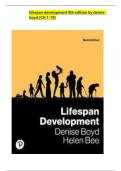
Lifespan Development, 9th Edition by
Denise Boyd, Helen Bee
TEST BANK
ALL CHAPTERS COVERED 1-19| EXPERT
VERIFIED Q&As FOR EXAM PRACTICE
TB
Ac
1
er
, Table of Contents
Chapter 1: Basic Concepts and Methods
Chapter 2: Theories of Development
Chapter 3: Prenatal Development and Birth
Chapter 4: Physical, Sensory, and Perceptual Development in Infancy
Chapter 5: Cognitive Development in Infancy
Chapter 6: Social and Personality Development in Infancy
Chapter 7: Physical and Cognitive Development in Early Childhood
Chapter 8: Social and Personality Development in Early Childhood
Chapter 9: Physical and Cognitive Development in Middle Childhood
Chapter 10: Social and Personality Development in Middle Childhood
Chapter 11: Physical and Cognitive Development in Adolescence
Chapter 12: Social and Personality Development in Adolescence
Chapter 13: Physical and Cognitive Development in Early Adulthood
Chapter 14: Social and Personality Development in Early Adulthood
Chapter 15: Physical and Cognitive Development in Middle Adulthood
Chapter 16: Social and Personality Development in Middle Adulthood
Chapter 17: Physical and Cognitive Development in Late Adulthood
Chapter 18: Social and Personality Development in Late Adulthood
Chapter 19: Death, Dying, and Bereavement
TB
Ac
2
er
, CHAPTER 1: BASIC CONCEPTS AND METHODS
Multiple-Choice Questions
TB_01_01_An Introduction to Human Development
The field of is the scientific study of age-related changes in behavior, thinking, emotion, and
personality.
A) neuroscience
B) psychology
C) human development
D) social psychology Correct Answer: C
Level: Easy
Topic: An Introduction to Human Development Skill: Understand the Concepts
LO 1.1.1: Recall the ideas about human development proposed by early philosophers and scientists
TB_01_02_Philosophical and Scientific Roots
The Christian doctrine of argues that human development occurs as a result of how well or how
poorly someone does at overcoming the inborn tendency to act immorally.
A) original sin
B) empiricism
C) behaviorism
D) innate goodness Correct Answer: A
Level: Easy
Topic: Philosophical and Scientific Roots Skill: Understand the Concepts
LO 1.1.1: Recall the ideas about human development proposed by early philosophers and scientists
TB_01_03_Philosophical and Scientific Roots
Which thinker argued that children are born with a mind that is a blank slate?
TB
A) Augustine of Hippo
Ac
3
er
, B) Charles Darwin
C) Jean-Jacques Rousseau
D) John Locke Correct Answer: D Level: Easy
Topic: Philosophical and Scientific Roots Skill: Understand the Concepts
LO 1.1.1: Recall the ideas about human development proposed by early philosophers and scientists
TB_01_04_Philosophical and Scientific Roots
Jean-Jacques Rousseau proposed that all human beings are naturally good and seek out experiences that
help them grow, a concept that came to be known as
A) maturation.
B) innate goodness.
C) the blank slate.
D) original sin. Correct Answer: B Level: Easy
Topic: Philosophical and Scientific Roots Skill: Understand the Concepts
LO 1.1.1: Recall the ideas about human development proposed by early philosophers and scientists
TB_01_05_Philosophical and Scientific Roots
Dr. Sardonicus believes that humans possess no inborn abilities and that parents can mold their children
into whatever they want them to be. Which doctrine would best describe Dr. Sardonicus‘ views?
A) Empiricism
B) Innate goodness
C) Original sin
D) Darwinism Correct Answer: A Level: Difficult
Topic: Philosophical and Scientific Roots Skill: Apply What You Know
LO 1.1.1: Recall the ideas about human development proposed by early philosophers and scientists
TB
Ac
4
er
Denise Boyd, Helen Bee
TEST BANK
ALL CHAPTERS COVERED 1-19| EXPERT
VERIFIED Q&As FOR EXAM PRACTICE
TB
Ac
1
er
, Table of Contents
Chapter 1: Basic Concepts and Methods
Chapter 2: Theories of Development
Chapter 3: Prenatal Development and Birth
Chapter 4: Physical, Sensory, and Perceptual Development in Infancy
Chapter 5: Cognitive Development in Infancy
Chapter 6: Social and Personality Development in Infancy
Chapter 7: Physical and Cognitive Development in Early Childhood
Chapter 8: Social and Personality Development in Early Childhood
Chapter 9: Physical and Cognitive Development in Middle Childhood
Chapter 10: Social and Personality Development in Middle Childhood
Chapter 11: Physical and Cognitive Development in Adolescence
Chapter 12: Social and Personality Development in Adolescence
Chapter 13: Physical and Cognitive Development in Early Adulthood
Chapter 14: Social and Personality Development in Early Adulthood
Chapter 15: Physical and Cognitive Development in Middle Adulthood
Chapter 16: Social and Personality Development in Middle Adulthood
Chapter 17: Physical and Cognitive Development in Late Adulthood
Chapter 18: Social and Personality Development in Late Adulthood
Chapter 19: Death, Dying, and Bereavement
TB
Ac
2
er
, CHAPTER 1: BASIC CONCEPTS AND METHODS
Multiple-Choice Questions
TB_01_01_An Introduction to Human Development
The field of is the scientific study of age-related changes in behavior, thinking, emotion, and
personality.
A) neuroscience
B) psychology
C) human development
D) social psychology Correct Answer: C
Level: Easy
Topic: An Introduction to Human Development Skill: Understand the Concepts
LO 1.1.1: Recall the ideas about human development proposed by early philosophers and scientists
TB_01_02_Philosophical and Scientific Roots
The Christian doctrine of argues that human development occurs as a result of how well or how
poorly someone does at overcoming the inborn tendency to act immorally.
A) original sin
B) empiricism
C) behaviorism
D) innate goodness Correct Answer: A
Level: Easy
Topic: Philosophical and Scientific Roots Skill: Understand the Concepts
LO 1.1.1: Recall the ideas about human development proposed by early philosophers and scientists
TB_01_03_Philosophical and Scientific Roots
Which thinker argued that children are born with a mind that is a blank slate?
TB
A) Augustine of Hippo
Ac
3
er
, B) Charles Darwin
C) Jean-Jacques Rousseau
D) John Locke Correct Answer: D Level: Easy
Topic: Philosophical and Scientific Roots Skill: Understand the Concepts
LO 1.1.1: Recall the ideas about human development proposed by early philosophers and scientists
TB_01_04_Philosophical and Scientific Roots
Jean-Jacques Rousseau proposed that all human beings are naturally good and seek out experiences that
help them grow, a concept that came to be known as
A) maturation.
B) innate goodness.
C) the blank slate.
D) original sin. Correct Answer: B Level: Easy
Topic: Philosophical and Scientific Roots Skill: Understand the Concepts
LO 1.1.1: Recall the ideas about human development proposed by early philosophers and scientists
TB_01_05_Philosophical and Scientific Roots
Dr. Sardonicus believes that humans possess no inborn abilities and that parents can mold their children
into whatever they want them to be. Which doctrine would best describe Dr. Sardonicus‘ views?
A) Empiricism
B) Innate goodness
C) Original sin
D) Darwinism Correct Answer: A Level: Difficult
Topic: Philosophical and Scientific Roots Skill: Apply What You Know
LO 1.1.1: Recall the ideas about human development proposed by early philosophers and scientists
TB
Ac
4
er