. NUR MISC MODULE 10 EXAM QUESTIONS AND ANSWERS
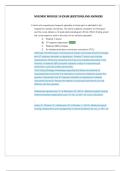
A client who experiences frequent episodes of chest pain is admitted to the
hospital for cardiac monitoring. The client suddenly complains of chest pain,
and the nurse obtains a 12-lead electrocardiogram (ECG). Which finding would
the nurse expect to note in the event of an ischemic episode?
A. Peaked T waves
B. ST-segment depression Correct
C. Widened QRS complex
D. An isolated premature ventricular contraction (PVC)
. Rationale: An ECG taken in the presence of pain may reveal ischemic changes
with ST-segment elevation or depression. Peaked T waves may indicate
hyperkalemia. PVCs are caused by the firing of an irritable pacemaker in the
ventricle. A widened QRS complex indicates a delay in intraventricular
conduction, such as bundle branch block.
. Test-Taking Strategy: Knowledge regarding the effects of ischemia on
myocardial tissue and how it is reflected on an ECG is needed to answer this
question. Remember that ST-segment elevation or depression indicates
myocardial ischemia. Review the effects of myocardial ischemia if you had
difficulty with this question.
.
. References: Ignatavicius, D., & Workman, M. (2013). Medical-surgical nursing:
Patient-centered collaborative care. (7th ed., p. 831). St. Louis: Saunders.
.
.
. Lewis, S., Dirksen, S., Heitkemper, M., & Bucher, L. (2014). Medical-surgical
nursing: Assessment and management of clinical problems (9th ed., p. 791). St.
1 A CLIENT WHO EXPERIENCES FREQUENT EPISODES OF CHEST PAIN IS ADMITTED TO THE HOSPITAL FOR CARDIAC MONITORING. THE CLIENT SUDDENLY COMPLAINS OF CHEST PAIN, AND THE NURSE OBTAINS A 12-LEAD ELECTROCARDIOGRAM (ECG). W
FINDING WOULD THE NURSE EXPECT TO NOTE IN THE EVENT OF AN ISCHEMIC EPISODE?((*)@*#(&$(*&@(*(@__________@
, Louis: Mosby.
. Level of Cognitive Ability: Analyzing
. Client Needs: Physiological Integrity
. Integrated Process: Nursing Process/Assessment
. Content Area: Adult Health/Cardiovascular
.
.
. Giddens Concepts: Clinical Judgment, Perfusion
. HESI Concepts: Clinical Decision Making/Clinical Judgment, Perfusion
. Awarded 1.0 points out of 1.0 possible points.
. 2.ID: 9476924021
. A client with gastroenteritis who has been vomiting and has diarrhea is admitted
to the hospital with a diagnosis of dehydration. For which clinical manifestations
that correlate with this fluid imbalance would the nurse assess the client?
Select all that apply.
A. Decreased pulse
B. Decreased urine output Correct
C. Increased blood pressure
D. Increased respiratory rate Correct
E. Decreased respiratory depth
. Rationale: A client with dehydration has an increased depth and rate of
respirations. The diminished fluid volume is perceived by the body as a
decreased oxygen level (hypoxia), and increased respiration is an attempt to
maintain oxygen delivery. Other assessment findings in insufficient fluid volume
are decreased urine volume, increased pulse, weight loss, poor skin turgor, dry
mucous membranes, concentrated urine with increased specific gravity,
increased hematocrit, and altered level of consciousness. Increased blood
pressure, decreased pulse, and increased urine output occur with fluid-volume
overload.
. Test-Taking Strategy: Use the process of elimination and focus on the subject,
dehydration (deficient fluid volume). Think about the pathophysiology of
deficient fluid volume. Remember that the body will increase the respiratory rate
in an attempt to maintain the oxygen level. If you had difficulty with this
question, review the signs of insufficient fluid volume.
. Reference: Lewis, S., Dirksen, S., Heitkemper, M., & Bucher, L. (2014).
Medical-surgical nursing: Assessment and management of clinical problems (9th
2 A CLIENT WHO EXPERIENCES FREQUENT EPISODES OF CHEST PAIN IS ADMITTED TO THE HOSPITAL FOR CARDIAC MONITORING. THE CLIENT SUDDENLY COMPLAINS OF CHEST PAIN, AND THE NURSE OBTAINS A 12-LEAD ELECTROCARDIOGRAM (ECG). W
FINDING WOULD THE NURSE EXPECT TO NOTE IN THE EVENT OF AN ISCHEMIC EPISODE?((*)@*#(&$(*&@(*(@__________@
, ed., pp. 291-292). St. Louis: Mosby.
. Level of Cognitive Ability: Analyzing
. Client Needs: Physiological Integrity
. Integrated Process: Nursing Process/Assessment
. Content Area: Fluid and Electrolytes
. Giddens Concepts: Clinical Judgment,Fluid and Electrolyte Balance
. HESI Concepts: Clinical Decision Making/Clinical Judgment, Fluid and
Electrolytes
. Awarded 2.0 points out of 2.0 possible points.
. 3.ID: 9476934084
. A nurse is reviewing the medical records of the clients to whom she is assigned
3 A CLIENT WHO EXPERIENCES FREQUENT EPISODES OF CHEST PAIN IS ADMITTED TO THE HOSPITAL FOR CARDIAC MONITORING. THE CLIENT SUDDENLY COMPLAINS OF CHEST PAIN, AND THE NURSE OBTAINS A 12-LEAD ELECTROCARDIOGRAM (ECG). W
FINDING WOULD THE NURSE EXPECT TO NOTE IN THE EVENT OF AN ISCHEMIC EPISODE?((*)@*#(&$(*&@(*(@__________@
, on the 7 am–7 pm shift. Which client will the nurse monitor most closely for
excessive fluid volume?
A. A 48-year-old client receiving diuretics to treat hypertension
B. A 35-year old client who is vomiting undigested food after eating
C. An 85-year-old client receiving intravenous (IV) therapy at a rate of
100 mL/hr Correct
D. A 65-year-old client with a nasogastric tube attached to low suction
following partial gastrectomy
. Rationale: The older adult client receiving IV therapy at 100 mL/hr is at the
greatest risk for excessive fluid volume because of the diminished
cardiovascular and renal function that occur with aging. Other causes of
excessive fluid volume include renal failure, heart failure, liver disorders,
excessive use of hypotonic IV fluids to replace isotonic losses, excessive
irrigation of body fluids, and excessive ingestion of table salt. A client who is
receiving diuretics, vomiting, or has a nasogastric tube attached to suction is at
risk for deficient fluid volume.
. Test-Taking Strategy: Read the question carefully, noting that it asks for the
client at risk for excessive fluid volume. Read each option and think about the
fluid imbalance that could occur in each situation; in the case of the incorrect
options, it is fluid-volume deficiency; the only option reflecting conditions that
could result in an excess is the correct option. If you had difficulty with this
question, review the causes of excessive fluid volume.
. Reference: Lewis, S., Dirksen, S., Heitkemper, M., & Bucher, L. (2014).
Medical-surgical nursing: Assessment and management of clinical problems (9th
ed., pp. 291, 293). St. Louis: Mosby.
. Level of Cognitive Ability: Analyzing
. Client Needs: Physiological Integrity
. Integrated Process: Nursing Process/Assessment
. Content Area: Fluid and Electrolytes
.
.
. Giddens Concepts: Care Coordination, Fluid and Electrolyte Balance
. HESI Concepts: Collaboration/Managing Care, Fluid and Electrolytes
. Awarded 1.0 points out of 1.0 possible points.
. 4.ID: 9476926416
. A nurse is caring for a client who is being treated for congestive heart failure
and has been assigned a nursing diagnosis of excessive fluid volume. Which
assessment finding causes the nurse to determine that the client’s condition has
4 A CLIENT WHO EXPERIENCES FREQUENT EPISODES OF CHEST PAIN IS ADMITTED TO THE HOSPITAL FOR CARDIAC MONITORING. THE CLIENT SUDDENLY COMPLAINS OF CHEST PAIN, AND THE NURSE OBTAINS A 12-LEAD ELECTROCARDIOGRAM (ECG). W
FINDING WOULD THE NURSE EXPECT TO NOTE IN THE EVENT OF AN ISCHEMIC EPISODE?((*)@*#(&$(*&@(*(@__________@
A client who experiences frequent episodes of chest pain is admitted to the
hospital for cardiac monitoring. The client suddenly complains of chest pain,
and the nurse obtains a 12-lead electrocardiogram (ECG). Which finding would
the nurse expect to note in the event of an ischemic episode?
A. Peaked T waves
B. ST-segment depression Correct
C. Widened QRS complex
D. An isolated premature ventricular contraction (PVC)
. Rationale: An ECG taken in the presence of pain may reveal ischemic changes
with ST-segment elevation or depression. Peaked T waves may indicate
hyperkalemia. PVCs are caused by the firing of an irritable pacemaker in the
ventricle. A widened QRS complex indicates a delay in intraventricular
conduction, such as bundle branch block.
. Test-Taking Strategy: Knowledge regarding the effects of ischemia on
myocardial tissue and how it is reflected on an ECG is needed to answer this
question. Remember that ST-segment elevation or depression indicates
myocardial ischemia. Review the effects of myocardial ischemia if you had
difficulty with this question.
.
. References: Ignatavicius, D., & Workman, M. (2013). Medical-surgical nursing:
Patient-centered collaborative care. (7th ed., p. 831). St. Louis: Saunders.
.
.
. Lewis, S., Dirksen, S., Heitkemper, M., & Bucher, L. (2014). Medical-surgical
nursing: Assessment and management of clinical problems (9th ed., p. 791). St.
1 A CLIENT WHO EXPERIENCES FREQUENT EPISODES OF CHEST PAIN IS ADMITTED TO THE HOSPITAL FOR CARDIAC MONITORING. THE CLIENT SUDDENLY COMPLAINS OF CHEST PAIN, AND THE NURSE OBTAINS A 12-LEAD ELECTROCARDIOGRAM (ECG). W
FINDING WOULD THE NURSE EXPECT TO NOTE IN THE EVENT OF AN ISCHEMIC EPISODE?((*)@*#(&$(*&@(*(@__________@
, Louis: Mosby.
. Level of Cognitive Ability: Analyzing
. Client Needs: Physiological Integrity
. Integrated Process: Nursing Process/Assessment
. Content Area: Adult Health/Cardiovascular
.
.
. Giddens Concepts: Clinical Judgment, Perfusion
. HESI Concepts: Clinical Decision Making/Clinical Judgment, Perfusion
. Awarded 1.0 points out of 1.0 possible points.
. 2.ID: 9476924021
. A client with gastroenteritis who has been vomiting and has diarrhea is admitted
to the hospital with a diagnosis of dehydration. For which clinical manifestations
that correlate with this fluid imbalance would the nurse assess the client?
Select all that apply.
A. Decreased pulse
B. Decreased urine output Correct
C. Increased blood pressure
D. Increased respiratory rate Correct
E. Decreased respiratory depth
. Rationale: A client with dehydration has an increased depth and rate of
respirations. The diminished fluid volume is perceived by the body as a
decreased oxygen level (hypoxia), and increased respiration is an attempt to
maintain oxygen delivery. Other assessment findings in insufficient fluid volume
are decreased urine volume, increased pulse, weight loss, poor skin turgor, dry
mucous membranes, concentrated urine with increased specific gravity,
increased hematocrit, and altered level of consciousness. Increased blood
pressure, decreased pulse, and increased urine output occur with fluid-volume
overload.
. Test-Taking Strategy: Use the process of elimination and focus on the subject,
dehydration (deficient fluid volume). Think about the pathophysiology of
deficient fluid volume. Remember that the body will increase the respiratory rate
in an attempt to maintain the oxygen level. If you had difficulty with this
question, review the signs of insufficient fluid volume.
. Reference: Lewis, S., Dirksen, S., Heitkemper, M., & Bucher, L. (2014).
Medical-surgical nursing: Assessment and management of clinical problems (9th
2 A CLIENT WHO EXPERIENCES FREQUENT EPISODES OF CHEST PAIN IS ADMITTED TO THE HOSPITAL FOR CARDIAC MONITORING. THE CLIENT SUDDENLY COMPLAINS OF CHEST PAIN, AND THE NURSE OBTAINS A 12-LEAD ELECTROCARDIOGRAM (ECG). W
FINDING WOULD THE NURSE EXPECT TO NOTE IN THE EVENT OF AN ISCHEMIC EPISODE?((*)@*#(&$(*&@(*(@__________@
, ed., pp. 291-292). St. Louis: Mosby.
. Level of Cognitive Ability: Analyzing
. Client Needs: Physiological Integrity
. Integrated Process: Nursing Process/Assessment
. Content Area: Fluid and Electrolytes
. Giddens Concepts: Clinical Judgment,Fluid and Electrolyte Balance
. HESI Concepts: Clinical Decision Making/Clinical Judgment, Fluid and
Electrolytes
. Awarded 2.0 points out of 2.0 possible points.
. 3.ID: 9476934084
. A nurse is reviewing the medical records of the clients to whom she is assigned
3 A CLIENT WHO EXPERIENCES FREQUENT EPISODES OF CHEST PAIN IS ADMITTED TO THE HOSPITAL FOR CARDIAC MONITORING. THE CLIENT SUDDENLY COMPLAINS OF CHEST PAIN, AND THE NURSE OBTAINS A 12-LEAD ELECTROCARDIOGRAM (ECG). W
FINDING WOULD THE NURSE EXPECT TO NOTE IN THE EVENT OF AN ISCHEMIC EPISODE?((*)@*#(&$(*&@(*(@__________@
, on the 7 am–7 pm shift. Which client will the nurse monitor most closely for
excessive fluid volume?
A. A 48-year-old client receiving diuretics to treat hypertension
B. A 35-year old client who is vomiting undigested food after eating
C. An 85-year-old client receiving intravenous (IV) therapy at a rate of
100 mL/hr Correct
D. A 65-year-old client with a nasogastric tube attached to low suction
following partial gastrectomy
. Rationale: The older adult client receiving IV therapy at 100 mL/hr is at the
greatest risk for excessive fluid volume because of the diminished
cardiovascular and renal function that occur with aging. Other causes of
excessive fluid volume include renal failure, heart failure, liver disorders,
excessive use of hypotonic IV fluids to replace isotonic losses, excessive
irrigation of body fluids, and excessive ingestion of table salt. A client who is
receiving diuretics, vomiting, or has a nasogastric tube attached to suction is at
risk for deficient fluid volume.
. Test-Taking Strategy: Read the question carefully, noting that it asks for the
client at risk for excessive fluid volume. Read each option and think about the
fluid imbalance that could occur in each situation; in the case of the incorrect
options, it is fluid-volume deficiency; the only option reflecting conditions that
could result in an excess is the correct option. If you had difficulty with this
question, review the causes of excessive fluid volume.
. Reference: Lewis, S., Dirksen, S., Heitkemper, M., & Bucher, L. (2014).
Medical-surgical nursing: Assessment and management of clinical problems (9th
ed., pp. 291, 293). St. Louis: Mosby.
. Level of Cognitive Ability: Analyzing
. Client Needs: Physiological Integrity
. Integrated Process: Nursing Process/Assessment
. Content Area: Fluid and Electrolytes
.
.
. Giddens Concepts: Care Coordination, Fluid and Electrolyte Balance
. HESI Concepts: Collaboration/Managing Care, Fluid and Electrolytes
. Awarded 1.0 points out of 1.0 possible points.
. 4.ID: 9476926416
. A nurse is caring for a client who is being treated for congestive heart failure
and has been assigned a nursing diagnosis of excessive fluid volume. Which
assessment finding causes the nurse to determine that the client’s condition has
4 A CLIENT WHO EXPERIENCES FREQUENT EPISODES OF CHEST PAIN IS ADMITTED TO THE HOSPITAL FOR CARDIAC MONITORING. THE CLIENT SUDDENLY COMPLAINS OF CHEST PAIN, AND THE NURSE OBTAINS A 12-LEAD ELECTROCARDIOGRAM (ECG). W
FINDING WOULD THE NURSE EXPECT TO NOTE IN THE EVENT OF AN ISCHEMIC EPISODE?((*)@*#(&$(*&@(*(@__________@