Personality Disorders 1
TOPIC 1-2: PERSONALITY DISORDERS
APA (2022). Personality Disorders. In DSM (pp. 645–684).
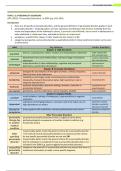
Introduc on
there are 10 specific personality disorders, and the general defini on of personality disorder applies to each
personality disorder = enduring pa ern of inner experience and behavior that deviates markedly from the
norms and expecta ons of the individual’s culture, is pervasive and inflexible, has an onset in adolescence or
early adulthood, is stable over me, and leads to distress or impairment
prevalence: overall 10.5%; cluster A 3.6%; cluster B 4.5%; cluster C 2.8%
categorical perspec ve: personality disorders a qualita vely dis nct clinical syndrome (clusters can be seen
as dimensions)
label key features similar disorders
Cluster A: Odd-Eccentric
distrust, suspiciousness, others’ motives are interpreted as malevolent weak relationship
paranoid with schizophrenia
detachment from social relationships, restricted range of emotional unclear relationship
schizoid
expression with schizophrenia
acute discomfort in close relationships, cognitive and perceptual mild version of
schizotypal
distortions, eccentricities of behavior schizophrenia
Cluster B: Dramatic-Emotional
disregard for and violation of the rights of others, criminal, impulsive,
antisocial conduct disorder
failure to learn from experience
instability in self-image, mood, and interpersonal relationships,
borderline impulsivity, transient dissociative states, high reactivity to real or mood disorders
imagined abandonment
excessive emotionality, attention seeking, dramatic, seductive or somatoform and
histrionic
provocative behavior mood disorders
narcissistic grandiosity, need for admiration, lack of empathy, entitled manic symptoms
Cluster C: Anxious-Fearful
social inhibition, feelings of inadequacy, hypersensitivity to negative
avoidant social phobia
evaluation
submissive and clinging behavior, excessive need to be taken care of, separation anxiety
dependent high dependence on others disorder, persistent
depressive disorder
obsessive- preoccupation with orderliness, extreme perfectionism and control obsessive-compulsive
compulsive disorder
Other Personality Disorders
personality persistent personality disturbance that is judged to be the direct
change due pathophysiological consequence of another medical condition (e.g.
to another frontal lobe lesion)
medical
condition
1) personality patter meets the general criteria for a personality disorder
other + the traits of several personality disorders are present, but the criteria
specified for any specific personality disorder are not met OR
personality 2) personality patter meets the general criteria for a personality disorder,
disorder but the individual is considered to have a personality disorder that is not
included in the DSM (e.g. passive-aggressive personality disorder)
unspecified symptoms characteristic of a personality disorder are present but there is
personality insufficient information to make a more specific diagnosis
disorder
, Personality Disorders 2
General Personality Disorder
GENERAL PERSONALITY DISORDER
A Enduring pa ern of inner experience and behavior that deviates markedly from the expecta ons of the
individual’s culture. This pa ern is manifested in 2 or more of the following areas:
1. Cogni on (interpreta on & percep on of self, others, events)
2. Affec vity (range, intensity, lability, appropriateness of emo on response)
3. Interpersonal Func oning
4. Impulse Control
B Pa ern is inflexible and pervasive across a broad range or personal and social situa ons
C Pa ern leads to clinically significant distress or impairment in social, occupa onal, or other important areas
of func oning
D Pa ern is stable and of long dura on, and onset in at least adolescence or early adulthood
E Pa ern is not be er explained as a manifesta on or consequence of another mental disorder
F Pa ern is not a ributable to the psychological effects of a substance or another medical condi on
development and course:
usually becomes recognizable during adolescence/early adult life
an social & borderline less evident / remit with age (<> vs. obsessive-compulsive, schizotypal)
for diagnosis under age 18, the features must have been present for at least 1 year and not
a ributable to a developmental stage (<> an social diagnosis can only be given from age 18 in any
case)
culture-related diagnos c issues:
core aspects of personality (e.g. emo on regula on, interpersonal func oning) are influenced by
culture >> means of protec on/assimila on/norms for acceptance/denuncia on of specific behaviors
& personality traits
>> judgment must take into account: ethnic, cultural, social background
>> not to be confused with: problems associated with accultura on a er migra on; expression of
habits, customs, religious or poli cal values
sex- and gender-related diagnos c issues:
more frequently diagnosed in men: an social
more frequently diagnosed in women: borderline, histrionic, dependent
higher help-seeking in women
differen al diagnosis:
personality disorder should be diagnosed only when the defining characteris cs:
appeared before early adulthood
are typical of the individual’s long-term condi oning
don’t occur exclusively during an episode of another mental disorder
when a personality disorder precedes a psycho c disorder, “premorbid” needs to be added
Cluster A: atypical, withdrawal, interpersonal difficul es
Cluster B: big emo ons
Cluster C: control of anxiety
Cluster A: Paranoid Personality Disorder
PARANOID PERSONALITY DISORDER (Stalin)
A A pervasive distrust and suspiciousness of others such that their mo ves are interpreted as malevolent,
beginning by early adulthood and present in a variety of contexts, as indicated by 4 (or more) of the following:
1. Suspects, without sufficient basis, that others are exploi ng, harming, or deceiving him or her.
2. Is preoccupied with unjus fied doubts about the loyalty or trustworthiness of friends or associates.
3. Is reluctant to confide in others because of unwarranted fear that the informa on will be used
maliciously against him or her.
4. Reads hidden demeaning or threatening meanings into benign remarks or events.
5. Persistently bears grudges (i.e., is unforgiving of insults, injuries, or slights).
6. Perceives a acks on his or her character or reputa on that are not apparent to others and is quick to
react angrily or to countera ack.
7. Has recurrent suspicions, without jus fica on, regarding fidelity of spouse or sexual partner.
, Personality Disorders 3
B Does not occur exclusively during the course of schizophrenia, a bipolar disorder or depressive disorder with
psycho c features, or another psycho c disorder and is not a ributable to the physiological effects of another
medical condi on.
associated features:
difficult to get along with & problems with close rela onships
excessive suspiciousness >> argumenta veness, complaining
lack in trust in others >> need for a high control in people around
rigid, cri cal of others, unable to collaborate; blame others for shortcomings
exhibi on of unrealis c grandiose fantasies (o en rela ng to power, rank)
likely to form cults/groups with others who share paranoid belief system
prevalence in forensic se ngs: 23%
development and course:
early signs: loneliness, poor peer rela onships, social anxiety, underachievement in school,
interpersonal hypersensi vity
prior history of: childhood maltreatment, externalizing symptoms, bullying of peers, adult
appearance of interpersonal aggression
risk and prognos c factors:
exposure to social stressors (socioeconomic inequality, marginaliza on, racism, childhood trauma)
Cluster A: Schizoid Personality Disorder
SCHIZOID PERSONALITY DISORDER (Dexter)
A A pervasive pa ern of detachment from social rela onships and a restricted range of expression of emo ons
in interpersonal se ngs, beginning by early adulthood and present in a variety of contexts, as indicated by
four (or more) of the following:
1. Neither desires nor enjoys close rela onships, including being part of a family.
2. Almost always chooses solitary ac vi es.
3. Has li le, if any, interest in having sexual experiences with another person.
4. Takes pleasure in few, if any, ac vi es.
5. Lacks close friends or confidants other than first-degree rela ves.
6. Appears indifferent to the praise or cri cism of others.
7. Shows emo onal coldness, detachment, or fla ened affec vity.
B Does not occur exclusively during the course of schizophrenia, a bipolar disorder or depressive disorder with
psycho c features, another psycho c disorder, or au sm spectrum disorder and is not a ributable to the
physiological effects of another medical condi on.
associated features:
difficult to express any emo on / react appropriately to important life events
life seems direc onless
few friendships, few roman c rela onships, not too likely to marry
not likely to seek help because they don’t experience much distress
development and course:
early signs: loneliness, poor peer rela onships, social anxiety, underachievement in school
differen al diagnosis:
schizophrenia has psycho c symptoms
au sm has stereotyped behaviors and interests
schizoid has no desire for social connec ons, au sm has
Cluster A: Schizotypal Personality Disorder
SCHIZOTYPAL PERSONALITY DISORDER (Willy Wonka)
A A pervasive pa ern of social and interpersonal deficits marked by acute discomfort with, and reduced
capacity for, close rela onships as well as by cogni ve or perceptual distor ons and eccentrici es of behavior,
beginning by early adulthood and present in a variety of contexts, as indicated by five (or more) of the
following:
1. Ideas of reference (excluding delusions of reference).
TOPIC 1-2: PERSONALITY DISORDERS
APA (2022). Personality Disorders. In DSM (pp. 645–684).
Introduc on
there are 10 specific personality disorders, and the general defini on of personality disorder applies to each
personality disorder = enduring pa ern of inner experience and behavior that deviates markedly from the
norms and expecta ons of the individual’s culture, is pervasive and inflexible, has an onset in adolescence or
early adulthood, is stable over me, and leads to distress or impairment
prevalence: overall 10.5%; cluster A 3.6%; cluster B 4.5%; cluster C 2.8%
categorical perspec ve: personality disorders a qualita vely dis nct clinical syndrome (clusters can be seen
as dimensions)
label key features similar disorders
Cluster A: Odd-Eccentric
distrust, suspiciousness, others’ motives are interpreted as malevolent weak relationship
paranoid with schizophrenia
detachment from social relationships, restricted range of emotional unclear relationship
schizoid
expression with schizophrenia
acute discomfort in close relationships, cognitive and perceptual mild version of
schizotypal
distortions, eccentricities of behavior schizophrenia
Cluster B: Dramatic-Emotional
disregard for and violation of the rights of others, criminal, impulsive,
antisocial conduct disorder
failure to learn from experience
instability in self-image, mood, and interpersonal relationships,
borderline impulsivity, transient dissociative states, high reactivity to real or mood disorders
imagined abandonment
excessive emotionality, attention seeking, dramatic, seductive or somatoform and
histrionic
provocative behavior mood disorders
narcissistic grandiosity, need for admiration, lack of empathy, entitled manic symptoms
Cluster C: Anxious-Fearful
social inhibition, feelings of inadequacy, hypersensitivity to negative
avoidant social phobia
evaluation
submissive and clinging behavior, excessive need to be taken care of, separation anxiety
dependent high dependence on others disorder, persistent
depressive disorder
obsessive- preoccupation with orderliness, extreme perfectionism and control obsessive-compulsive
compulsive disorder
Other Personality Disorders
personality persistent personality disturbance that is judged to be the direct
change due pathophysiological consequence of another medical condition (e.g.
to another frontal lobe lesion)
medical
condition
1) personality patter meets the general criteria for a personality disorder
other + the traits of several personality disorders are present, but the criteria
specified for any specific personality disorder are not met OR
personality 2) personality patter meets the general criteria for a personality disorder,
disorder but the individual is considered to have a personality disorder that is not
included in the DSM (e.g. passive-aggressive personality disorder)
unspecified symptoms characteristic of a personality disorder are present but there is
personality insufficient information to make a more specific diagnosis
disorder
, Personality Disorders 2
General Personality Disorder
GENERAL PERSONALITY DISORDER
A Enduring pa ern of inner experience and behavior that deviates markedly from the expecta ons of the
individual’s culture. This pa ern is manifested in 2 or more of the following areas:
1. Cogni on (interpreta on & percep on of self, others, events)
2. Affec vity (range, intensity, lability, appropriateness of emo on response)
3. Interpersonal Func oning
4. Impulse Control
B Pa ern is inflexible and pervasive across a broad range or personal and social situa ons
C Pa ern leads to clinically significant distress or impairment in social, occupa onal, or other important areas
of func oning
D Pa ern is stable and of long dura on, and onset in at least adolescence or early adulthood
E Pa ern is not be er explained as a manifesta on or consequence of another mental disorder
F Pa ern is not a ributable to the psychological effects of a substance or another medical condi on
development and course:
usually becomes recognizable during adolescence/early adult life
an social & borderline less evident / remit with age (<> vs. obsessive-compulsive, schizotypal)
for diagnosis under age 18, the features must have been present for at least 1 year and not
a ributable to a developmental stage (<> an social diagnosis can only be given from age 18 in any
case)
culture-related diagnos c issues:
core aspects of personality (e.g. emo on regula on, interpersonal func oning) are influenced by
culture >> means of protec on/assimila on/norms for acceptance/denuncia on of specific behaviors
& personality traits
>> judgment must take into account: ethnic, cultural, social background
>> not to be confused with: problems associated with accultura on a er migra on; expression of
habits, customs, religious or poli cal values
sex- and gender-related diagnos c issues:
more frequently diagnosed in men: an social
more frequently diagnosed in women: borderline, histrionic, dependent
higher help-seeking in women
differen al diagnosis:
personality disorder should be diagnosed only when the defining characteris cs:
appeared before early adulthood
are typical of the individual’s long-term condi oning
don’t occur exclusively during an episode of another mental disorder
when a personality disorder precedes a psycho c disorder, “premorbid” needs to be added
Cluster A: atypical, withdrawal, interpersonal difficul es
Cluster B: big emo ons
Cluster C: control of anxiety
Cluster A: Paranoid Personality Disorder
PARANOID PERSONALITY DISORDER (Stalin)
A A pervasive distrust and suspiciousness of others such that their mo ves are interpreted as malevolent,
beginning by early adulthood and present in a variety of contexts, as indicated by 4 (or more) of the following:
1. Suspects, without sufficient basis, that others are exploi ng, harming, or deceiving him or her.
2. Is preoccupied with unjus fied doubts about the loyalty or trustworthiness of friends or associates.
3. Is reluctant to confide in others because of unwarranted fear that the informa on will be used
maliciously against him or her.
4. Reads hidden demeaning or threatening meanings into benign remarks or events.
5. Persistently bears grudges (i.e., is unforgiving of insults, injuries, or slights).
6. Perceives a acks on his or her character or reputa on that are not apparent to others and is quick to
react angrily or to countera ack.
7. Has recurrent suspicions, without jus fica on, regarding fidelity of spouse or sexual partner.
, Personality Disorders 3
B Does not occur exclusively during the course of schizophrenia, a bipolar disorder or depressive disorder with
psycho c features, or another psycho c disorder and is not a ributable to the physiological effects of another
medical condi on.
associated features:
difficult to get along with & problems with close rela onships
excessive suspiciousness >> argumenta veness, complaining
lack in trust in others >> need for a high control in people around
rigid, cri cal of others, unable to collaborate; blame others for shortcomings
exhibi on of unrealis c grandiose fantasies (o en rela ng to power, rank)
likely to form cults/groups with others who share paranoid belief system
prevalence in forensic se ngs: 23%
development and course:
early signs: loneliness, poor peer rela onships, social anxiety, underachievement in school,
interpersonal hypersensi vity
prior history of: childhood maltreatment, externalizing symptoms, bullying of peers, adult
appearance of interpersonal aggression
risk and prognos c factors:
exposure to social stressors (socioeconomic inequality, marginaliza on, racism, childhood trauma)
Cluster A: Schizoid Personality Disorder
SCHIZOID PERSONALITY DISORDER (Dexter)
A A pervasive pa ern of detachment from social rela onships and a restricted range of expression of emo ons
in interpersonal se ngs, beginning by early adulthood and present in a variety of contexts, as indicated by
four (or more) of the following:
1. Neither desires nor enjoys close rela onships, including being part of a family.
2. Almost always chooses solitary ac vi es.
3. Has li le, if any, interest in having sexual experiences with another person.
4. Takes pleasure in few, if any, ac vi es.
5. Lacks close friends or confidants other than first-degree rela ves.
6. Appears indifferent to the praise or cri cism of others.
7. Shows emo onal coldness, detachment, or fla ened affec vity.
B Does not occur exclusively during the course of schizophrenia, a bipolar disorder or depressive disorder with
psycho c features, another psycho c disorder, or au sm spectrum disorder and is not a ributable to the
physiological effects of another medical condi on.
associated features:
difficult to express any emo on / react appropriately to important life events
life seems direc onless
few friendships, few roman c rela onships, not too likely to marry
not likely to seek help because they don’t experience much distress
development and course:
early signs: loneliness, poor peer rela onships, social anxiety, underachievement in school
differen al diagnosis:
schizophrenia has psycho c symptoms
au sm has stereotyped behaviors and interests
schizoid has no desire for social connec ons, au sm has
Cluster A: Schizotypal Personality Disorder
SCHIZOTYPAL PERSONALITY DISORDER (Willy Wonka)
A A pervasive pa ern of social and interpersonal deficits marked by acute discomfort with, and reduced
capacity for, close rela onships as well as by cogni ve or perceptual distor ons and eccentrici es of behavior,
beginning by early adulthood and present in a variety of contexts, as indicated by five (or more) of the
following:
1. Ideas of reference (excluding delusions of reference).