NR_305 Week 5 Discussion, Assessing for Family Violence
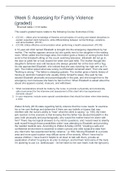
Week 5: Assessing for Family Violence (graded) 4848 unread replies. replies. This week's graded topics relate to the following Course Outcomes (COs). • (CO #1) - Utilize prior knowledge of theories and principles of nursing and related disciplines to explain expected client behaviors, while differentiating between normal findings, variations, and abnormalities. (PO #1) • (CO #4) Utilize effective communication when performing a health assessment. (PO #3) A 10-year-old child named Elizabeth is brought into the emergency department by her mother. The mother appears anxious but sits quietly next to her daughter in the waiting room. When called into the triage area, the mother gives a history of coming home from work to find Elizabeth sitting on the couch watching television. Elizabeth did not go to the door to greet her or look toward her when she said hello. The mother thought the daughter's behavior was odd because she always greeted her at the door with a hug. As she approached Elizabeth, she noticed that she was clutching her right arm as if in pain. The mother asked what was wrong, but Elizabeth remained silent. Then she said "Nothing is wrong." The father is sleeping upstairs. The mother gives a family history of having an alcoholic husband who usually drinks himself to sleep. She said he has abused Elizabeth physically and psychologically in the past, and she brought her to the emergency room because she fears he has hurt her. When Elizabeth is asked about the abuse she appears scared, insecure, and withdrawn. 1. What considerations should be made by the nurse, to provide a physically and emotionally safe environment for the interview and assessment of this client who has experienced domestic abuse? 2. In your response, include some special considerations that should be taken when interviewing a child. Weber & Kelly (2018) state regarding family violence that the nurse needs “to examine his or her own feelings and determine if there are any beliefs or biases that may interfere with the nurse’s ability to “hear” what the client is saying." (p. 168). My knee-jerk reaction to this scenario is that knowing that the father has abused Elizabeth in the past, both physically and psychologically, why would the mother leave her alone with him? There may be logical answers to my mind’s questions, and I would need to silently walk myself through those possibilities while I was attending to Elizabeth and providing the needed medical care. According to Weber & Kelley (2018) “creating a safe and confidential environment is essential to obtain concise and valid subjective data from any client who has experienced family violence.” (p 169). Moving Elizabeth to a private area and more quiet location may diffuse some of her anxiety. When I have had to assess children, I have found it helpful to sit down to talk with them, provide an explanation of what I’m going to do prior to doing it, and let them hold some of the tools I’m planning to use (i.e. stethoscope – let her listen to her own heart, hold the light pen). In an attempt to distract Elizabeth from her current situation, I would ask about any pets she has, what was her favorite cartoon, a favorite candy bar or maybe a favorite subject in school, but also respecting her need for silence if that is what is indicated. In their article, Lazoritz, Rossiter & Whiteaker (2010) say that since the child has already experienced abuse, they need “empathy, not sympathy” and that the child may feel that they did something to cause their abuse. The authors of this article reinforce that as health care professionals, we need to provide assurance to the child that they did nothing to deserve this treatment and what they have experienced is not normal. I had often thought that pediatric nursing was something I may work into. However, after reading through this material, this subject triggered a lot of emotions for me and I’m not sure pediatric nursing is for me. References, Weber, J. R., & Kelley, J. H. (2018). Health Assessment in Nursing (6th ed.). Philadelphia, PA: Wolters Kluwer. Lazoritz, S., Rossiter, K., & Whiteaker, D. (2010). What every nurse needs to know about the clinical aspects of child abuse. American Nurse Today, 5(July), 7th ser. Retrieved April 2, 2019, from
Geschreven voor
Documentinformatie
- Geüpload op
- 22 januari 2021
- Aantal pagina's
- 2
- Geschreven in
- 2020/2021
- Type
- Case uitwerking
- Docent(en)
- Professor
- Cijfer
- A+
Onderwerpen
-
nr305 week 5 discussion
-
assessing for family violence
-
week 5 assessing for family violence graded 4848 unread replies113113 replies this weeks graded topics relate to the following course o

Ook beschikbaar in voordeelbundel