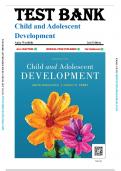
Child and Adolescent Development – 2nd
ST
Edition
UV
TEST BANK
IA
_A
Anita Woolfolk
PP
Nancy E. Perry
RO
Comprehensive Test Bank for Instructors and
VE
Students
D?
© Anita Woolfolk & Nancy E. Perry
??
All rights reserved. Reproduction or distribution without permission is prohibited
©STUDYSTREAM
, Chapter 1
INTRODUCTION: DIMENSIONS OF DEVELOPMENT
ST
CHAPTER OBJECTIVES RELEVANT TEST ITEMS
OBJECTIVE 1.1: Describe the field of child Multiple Choice: 1-3
UV
development and compare it to the science of Essay: 25-26
developmental psychology.
OBJECTIVE 1.2: Explain four broad time periods in the Multiple Choice: 4-7
IA
development of children, including the social Essay: 25
expectations about what children can do at each period.
_A
OBJECTIVE 1.3: Describe three broad areas of Multiple Choice: 8-10
development during childhood and adolescence. Essay: 25
OBJECTIVE 1.4: Discuss three key and constant Multiple Choice: 11-17
PP
questions in child development involving the shape, Essay: 24
timing, and sources of development, and explain how
these questions are answered today.
RO
OBJECTIVE 1.5: Discuss how family, ethnicity, social Multiple Choice: 18-22
class, social policies, and historical time periods provide Essay: 26
contexts for child development.
VE
OBJECTIVE 1.6: Decide how to apply the knowledge Multiple Choice: 23
you have gained about child development. Essay: 24
D?
??
1
, Multiple Choice Questions
1. How do developmental scientists examine questions about what changes
ST
during a child’s development and how the changes occur?
a. Developmental scientists focus on biological factors and the physical
changes that occur during a child’s development.
b. Developmental scientists target environmental factors and the social
UV
emotional changes that occur during a child’s development.
c. Developmental scientists consider biological and environmental factors in
continuous interaction.
d. Developmental scientists primarily consider environmental factors and
their interaction with societal structures.
IA
2. What is the relationship between child development and adult development?
a. The behaviors of an adult are unrelated to his/her behaviors as a child.
_A
b. Adult behaviors can be predicted from adolescent behaviors, but not from
the behaviors of a child.
c. It is impossible to disconnect adult development from child development.
d. A child’s personality is fixed and development ends after adolescence.
PP
3. Which of the following children is experiencing a developmental change?
a. Four-year-old Kara made a bow in her shoelace and tied her sneakers for
the first time.
b. Eight-year-old Cory broke his arm while playing flag football after school.
RO
c. Seven-year-old Sherra developed a bad case of measles after being
exposed at a slumber party.
d. Twelve-year-old Pedro got braces on his teeth to correct an overbite and
misalignment.
VE
4. The authors of our text differentiate four periods of development: beginnings,
early childhood, middle childhood, and adolescence. These time period
segments are commonly used to organize discussions of child development
because they tend to be characterized by:
a. the age of the children.
D?
b. the physical capabilities of children.
c. performance on age-appropriate school readiness tests.
d. particular patterns of limitations and growing capabilities.
??
5. Miguel’s vocabulary seems to explode in a very short time period. We can
conclude that Miguel is in which of the four major periods of development?
a. Toddlerhood
2
, b. Middle Childhood
c. Early Childhood.
d. Adolescence
ST
6. All of the following descriptors characterize adolescence EXCEPT:
a. Their growing cognitive abilities lead to the development of greater
UV
idealism.
b. They move toward an independent identity and accept greater
responsibility.
c. They are beginning to understand abstract concepts such as intention and
morality.
d. They spend more time with peers than with family.
IA
7. Joseph believes that the solutions to complex world problems, such as hunger,
war, and global warming can be solved quickly if the right people come
_A
together and make a commitment to finding solutions to global problems.
Which one of the four major periods of development can we predict Joseph is
in?
a. Adolescence
b. Between early and middle childhood
PP
c. Middle childhood
d. Adulthood
8. According to our text authors, what are the three broad domains of
RO
development?
a. Personality, social reasoning, and temperament
b. Physical, cognitive, and social emotional
c. Height, weight, and age
d. Thinking, cognition, and reasoning
VE
9. Mrs. Hernandez is concerned about the common childhood diseases her son
may encounter in early elementary school. Her concerns relate to what domain
of development?
D?
a. Cognitive
b. Emotional
c. Social
d. Physical
??
10. What developmental changes are relatively unaffected by environment?
a. Cognitive skill development
3
ST
Edition
UV
TEST BANK
IA
_A
Anita Woolfolk
PP
Nancy E. Perry
RO
Comprehensive Test Bank for Instructors and
VE
Students
D?
© Anita Woolfolk & Nancy E. Perry
??
All rights reserved. Reproduction or distribution without permission is prohibited
©STUDYSTREAM
, Chapter 1
INTRODUCTION: DIMENSIONS OF DEVELOPMENT
ST
CHAPTER OBJECTIVES RELEVANT TEST ITEMS
OBJECTIVE 1.1: Describe the field of child Multiple Choice: 1-3
UV
development and compare it to the science of Essay: 25-26
developmental psychology.
OBJECTIVE 1.2: Explain four broad time periods in the Multiple Choice: 4-7
IA
development of children, including the social Essay: 25
expectations about what children can do at each period.
_A
OBJECTIVE 1.3: Describe three broad areas of Multiple Choice: 8-10
development during childhood and adolescence. Essay: 25
OBJECTIVE 1.4: Discuss three key and constant Multiple Choice: 11-17
PP
questions in child development involving the shape, Essay: 24
timing, and sources of development, and explain how
these questions are answered today.
RO
OBJECTIVE 1.5: Discuss how family, ethnicity, social Multiple Choice: 18-22
class, social policies, and historical time periods provide Essay: 26
contexts for child development.
VE
OBJECTIVE 1.6: Decide how to apply the knowledge Multiple Choice: 23
you have gained about child development. Essay: 24
D?
??
1
, Multiple Choice Questions
1. How do developmental scientists examine questions about what changes
ST
during a child’s development and how the changes occur?
a. Developmental scientists focus on biological factors and the physical
changes that occur during a child’s development.
b. Developmental scientists target environmental factors and the social
UV
emotional changes that occur during a child’s development.
c. Developmental scientists consider biological and environmental factors in
continuous interaction.
d. Developmental scientists primarily consider environmental factors and
their interaction with societal structures.
IA
2. What is the relationship between child development and adult development?
a. The behaviors of an adult are unrelated to his/her behaviors as a child.
_A
b. Adult behaviors can be predicted from adolescent behaviors, but not from
the behaviors of a child.
c. It is impossible to disconnect adult development from child development.
d. A child’s personality is fixed and development ends after adolescence.
PP
3. Which of the following children is experiencing a developmental change?
a. Four-year-old Kara made a bow in her shoelace and tied her sneakers for
the first time.
b. Eight-year-old Cory broke his arm while playing flag football after school.
RO
c. Seven-year-old Sherra developed a bad case of measles after being
exposed at a slumber party.
d. Twelve-year-old Pedro got braces on his teeth to correct an overbite and
misalignment.
VE
4. The authors of our text differentiate four periods of development: beginnings,
early childhood, middle childhood, and adolescence. These time period
segments are commonly used to organize discussions of child development
because they tend to be characterized by:
a. the age of the children.
D?
b. the physical capabilities of children.
c. performance on age-appropriate school readiness tests.
d. particular patterns of limitations and growing capabilities.
??
5. Miguel’s vocabulary seems to explode in a very short time period. We can
conclude that Miguel is in which of the four major periods of development?
a. Toddlerhood
2
, b. Middle Childhood
c. Early Childhood.
d. Adolescence
ST
6. All of the following descriptors characterize adolescence EXCEPT:
a. Their growing cognitive abilities lead to the development of greater
UV
idealism.
b. They move toward an independent identity and accept greater
responsibility.
c. They are beginning to understand abstract concepts such as intention and
morality.
d. They spend more time with peers than with family.
IA
7. Joseph believes that the solutions to complex world problems, such as hunger,
war, and global warming can be solved quickly if the right people come
_A
together and make a commitment to finding solutions to global problems.
Which one of the four major periods of development can we predict Joseph is
in?
a. Adolescence
b. Between early and middle childhood
PP
c. Middle childhood
d. Adulthood
8. According to our text authors, what are the three broad domains of
RO
development?
a. Personality, social reasoning, and temperament
b. Physical, cognitive, and social emotional
c. Height, weight, and age
d. Thinking, cognition, and reasoning
VE
9. Mrs. Hernandez is concerned about the common childhood diseases her son
may encounter in early elementary school. Her concerns relate to what domain
of development?
D?
a. Cognitive
b. Emotional
c. Social
d. Physical
??
10. What developmental changes are relatively unaffected by environment?
a. Cognitive skill development
3