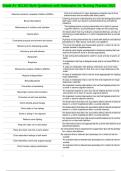
Grade A+ NCLEX-Style Questions with Rationales for Nursing Practice 2025
First-line treatment for major depressive disorder due to their
Selective serotonin reuptake inhibitors (SSRIs)
effectiveness and favorable side effect profile.
Claiming exclusive understanding of a client by disregarding other
Blurred boundaries staff input, which can lead to countertransference and ethical
violations.
The highest priority nursing intervention for a client in severe
Maintenance of nutrition and hydration
cognitive decline, as physiological needs are life-sustaining.
An observation that may indicate unresolved distress, anxiety, or
Fearful affect continuing suicidal ideation in a client hospitalized after a suicide
attempt.
Consistent physical environment and routine A priority nursing intervention for a client with delirium and altered
perceptions to help reduce confusion and agitation.
The most immediate and measurable goal for a client at risk for
Refraining from attempting suicide
suicide related to hopelessness.
A cultural value highly emphasized in American society that can
Autonomy and self-reliance
lead to ethnocentric care in diverse populations.
A fast-acting benzodiazepine used for acute anxiety or panic at-
Alprazolam
tacks.
Buspirone A medication that has a delayed onset and is not used PRN for
anxiety.
A class of medication with dietary restrictions and more risks,
Monoamine oxidase inhibitors (MAOIs) making them less ideal for first-line use in major depressive dis-
order.
A class of medication that is not the most appropriate for treating
Atypical antipsychotics
major depression.
A class of medication that is not the first-line treatment for major
Benzodiazepines
depressive disorder.
An important nursing intervention, but not the highest priority for
Prevention of wandering
a client in severe cognitive decline.
An important aspect of care, but not the highest priority nursing
Meaningful verbal communication
intervention for a client in severe cognitive decline.
An important nursing intervention, but not the highest priority for
Promotion of self-care activities
a client in severe cognitive decline.
An observation that does not accurately reflect internal emotional
Client attends group therapy
states in a client hospitalized after a suicide attempt.
An observation that does not accurately reflect internal emotional
Client walks in the hallway
states in a client hospitalized after a suicide attempt.
An observation that does not accurately reflect internal emotional
Client is sitting in the dayroom
states in a client hospitalized after a suicide attempt.
An intervention that may help avoid overstimulation but is not the
Reduce room lighting
priority for a client with delirium.
An intervention that is not appropriate for a client with delirium and
Keep the radio on for stimulation
altered perceptions.
Place the client near the nurse's station An intervention that is important for supervision but not the priority
for a client with delirium.
Client describes feelings of self-worth An outcome that is relevant but secondary for a client at risk for
suicide.
An outcome that is relevant but secondary for a client at risk for
Client identifies community support groups
suicide.
Client names coping mechanisms An outcome that is relevant but secondary for a client at risk for
suicide.
1/5
, Actions like walking or attending a group that do not accurately
External behaviors
reflect internal emotional states.
Associated with sympathetic overdrive, including elevated tem-
Stimulant intoxication
perature, heart rate, and pupil dilation.
Staying with the client provides immediate support and promotes
Priority intervention for severe anxiety
safety and grounding.
Echolalia, associative looseness, clang associations, and word
Positive symptoms of schizophrenia related to speech alterations
salad reflect disorganized thinking.
Include dilated pupils (mydriasis), runny nose (rhinorrhea), tachy-
Opioid withdrawal symptoms
cardia, and other flu-like symptoms.
Tertiary prevention for suicide survivors Attending a self-help group for survivors helps cope and process
grief.
Responsible for differences in drug metabolism among ethnic
CYP450 enzyme
groups.
Ataxia, giddiness, and drowsiness are early signs of toxicity at a
Lithium toxicity symptoms
level of 1.4 mEq/L.
Stage 2 (moderate) Alzheimer's is characterized by significant
Stage of dementia for anger over memory loss
memory loss and confusion.
Therapeutic response to hallucinations Staying with the client and focusing on conversation helps reduce
anxiety and promotes grounding.
An opioid antagonist that rapidly reverses opioid overdose effects
Naloxone
like respiratory depression.
A condition where alcohol and benzodiazepines like diazepam
Synergistic effect
increase sedation and respiratory depression risk.
A medication that can suppress growth in children, requiring base-
Methylphenidate
line height and weight assessments.
A dangerous complication of anticholinergic medications that re-
Urinary retention
quires prompt medical intervention.
A benzodiazepine commonly used to manage alcohol withdrawal
Lorazepam
symptoms and prevent seizures.
Methods that encourage client expression and self-exploration,
Therapeutic communication techniques
such as open-ended questions.
A condition that can occur 12 to 24 hours after the last drink,
Alcohol withdrawal psychosis
characterized by auditory and visual hallucinations.
Setting firm and clear limits while ensuring safety is key when a
Bipolar disorder intervention
client becomes hyperactive and threatening.
Respiratory depression A critical effect of opioid overdose that naloxone is used to reverse.
The most important baseline assessment for a child prescribed
Height and weight assessment
methylphenidate.
Providing a simple, non-monotonous task can help redirect energy
Agitation in depressed clients
and focus.
Questions that encourage clients to express their feelings and
Open-ended questions
thoughts, enhancing therapeutic communication.
Alcohol-related hallucinosis A medical emergency that typically begins 12 to 24 hours after the
last drink.
Substances like alcohol and benzodiazepines that can cause
CNS depressants
increased sedation and respiratory depression when combined.
Critical emergency intervention The use of naloxone in cases of opioid overdose.
Complications of anticholinergic medications Urinary retention is a serious side effect that requires contacting
the provider.
Management of alcohol withdrawal Lorazepam is fast-acting and appropriate for acute settings.
Client safety intervention
2/5
First-line treatment for major depressive disorder due to their
Selective serotonin reuptake inhibitors (SSRIs)
effectiveness and favorable side effect profile.
Claiming exclusive understanding of a client by disregarding other
Blurred boundaries staff input, which can lead to countertransference and ethical
violations.
The highest priority nursing intervention for a client in severe
Maintenance of nutrition and hydration
cognitive decline, as physiological needs are life-sustaining.
An observation that may indicate unresolved distress, anxiety, or
Fearful affect continuing suicidal ideation in a client hospitalized after a suicide
attempt.
Consistent physical environment and routine A priority nursing intervention for a client with delirium and altered
perceptions to help reduce confusion and agitation.
The most immediate and measurable goal for a client at risk for
Refraining from attempting suicide
suicide related to hopelessness.
A cultural value highly emphasized in American society that can
Autonomy and self-reliance
lead to ethnocentric care in diverse populations.
A fast-acting benzodiazepine used for acute anxiety or panic at-
Alprazolam
tacks.
Buspirone A medication that has a delayed onset and is not used PRN for
anxiety.
A class of medication with dietary restrictions and more risks,
Monoamine oxidase inhibitors (MAOIs) making them less ideal for first-line use in major depressive dis-
order.
A class of medication that is not the most appropriate for treating
Atypical antipsychotics
major depression.
A class of medication that is not the first-line treatment for major
Benzodiazepines
depressive disorder.
An important nursing intervention, but not the highest priority for
Prevention of wandering
a client in severe cognitive decline.
An important aspect of care, but not the highest priority nursing
Meaningful verbal communication
intervention for a client in severe cognitive decline.
An important nursing intervention, but not the highest priority for
Promotion of self-care activities
a client in severe cognitive decline.
An observation that does not accurately reflect internal emotional
Client attends group therapy
states in a client hospitalized after a suicide attempt.
An observation that does not accurately reflect internal emotional
Client walks in the hallway
states in a client hospitalized after a suicide attempt.
An observation that does not accurately reflect internal emotional
Client is sitting in the dayroom
states in a client hospitalized after a suicide attempt.
An intervention that may help avoid overstimulation but is not the
Reduce room lighting
priority for a client with delirium.
An intervention that is not appropriate for a client with delirium and
Keep the radio on for stimulation
altered perceptions.
Place the client near the nurse's station An intervention that is important for supervision but not the priority
for a client with delirium.
Client describes feelings of self-worth An outcome that is relevant but secondary for a client at risk for
suicide.
An outcome that is relevant but secondary for a client at risk for
Client identifies community support groups
suicide.
Client names coping mechanisms An outcome that is relevant but secondary for a client at risk for
suicide.
1/5
, Actions like walking or attending a group that do not accurately
External behaviors
reflect internal emotional states.
Associated with sympathetic overdrive, including elevated tem-
Stimulant intoxication
perature, heart rate, and pupil dilation.
Staying with the client provides immediate support and promotes
Priority intervention for severe anxiety
safety and grounding.
Echolalia, associative looseness, clang associations, and word
Positive symptoms of schizophrenia related to speech alterations
salad reflect disorganized thinking.
Include dilated pupils (mydriasis), runny nose (rhinorrhea), tachy-
Opioid withdrawal symptoms
cardia, and other flu-like symptoms.
Tertiary prevention for suicide survivors Attending a self-help group for survivors helps cope and process
grief.
Responsible for differences in drug metabolism among ethnic
CYP450 enzyme
groups.
Ataxia, giddiness, and drowsiness are early signs of toxicity at a
Lithium toxicity symptoms
level of 1.4 mEq/L.
Stage 2 (moderate) Alzheimer's is characterized by significant
Stage of dementia for anger over memory loss
memory loss and confusion.
Therapeutic response to hallucinations Staying with the client and focusing on conversation helps reduce
anxiety and promotes grounding.
An opioid antagonist that rapidly reverses opioid overdose effects
Naloxone
like respiratory depression.
A condition where alcohol and benzodiazepines like diazepam
Synergistic effect
increase sedation and respiratory depression risk.
A medication that can suppress growth in children, requiring base-
Methylphenidate
line height and weight assessments.
A dangerous complication of anticholinergic medications that re-
Urinary retention
quires prompt medical intervention.
A benzodiazepine commonly used to manage alcohol withdrawal
Lorazepam
symptoms and prevent seizures.
Methods that encourage client expression and self-exploration,
Therapeutic communication techniques
such as open-ended questions.
A condition that can occur 12 to 24 hours after the last drink,
Alcohol withdrawal psychosis
characterized by auditory and visual hallucinations.
Setting firm and clear limits while ensuring safety is key when a
Bipolar disorder intervention
client becomes hyperactive and threatening.
Respiratory depression A critical effect of opioid overdose that naloxone is used to reverse.
The most important baseline assessment for a child prescribed
Height and weight assessment
methylphenidate.
Providing a simple, non-monotonous task can help redirect energy
Agitation in depressed clients
and focus.
Questions that encourage clients to express their feelings and
Open-ended questions
thoughts, enhancing therapeutic communication.
Alcohol-related hallucinosis A medical emergency that typically begins 12 to 24 hours after the
last drink.
Substances like alcohol and benzodiazepines that can cause
CNS depressants
increased sedation and respiratory depression when combined.
Critical emergency intervention The use of naloxone in cases of opioid overdose.
Complications of anticholinergic medications Urinary retention is a serious side effect that requires contacting
the provider.
Management of alcohol withdrawal Lorazepam is fast-acting and appropriate for acute settings.
Client safety intervention
2/5