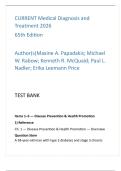
CURRENT Medical Diagnosis and
Treatment 2026
65th Edition
Author(s)Maxine A. Papadakis; Michael
W. Rabow; Kenneth R. McQuaid; Paul L.
Nadler; Erika Leemann Price
TEST BANK
Part 1 — Disease Prevention & Health Promotion (5 items)
Reference: Part 1 — Disease Prevention & Health Promotion.
Google Books
1) Question Stem
A 52-year-old man with well-controlled type 2 diabetes asks
which primary-prevention strategy will most reduce his long-
term risk of atherosclerotic cardiovascular disease (ASCVD). He
has LDL 140 mg/dL, systolic BP 128 mmHg, and a 10-year
,ASCVD risk estimated ~10%. Which intervention is most likely to
reduce his ASCVD risk?
A. Start low-intensity statin therapy.
B. Begin intensive smoking cessation counseling and refer to a
quit program.
C. Start daily low-dose aspirin for primary prevention.
D. Schedule immediate coronary CT calcium scoring.
Correct Answer: B
Rationales
• Correct (B): Smoking cessation provides large, immediate
and long-term reductions in ASCVD risk and is a first-line,
high-impact preventive measure for patients who smoke;
CMDT emphasizes behavioral risk reduction as primary
prevention.
• A: Statin therapy reduces LDL and ASCVD risk, but in a
patient whose highest-impact modifiable risk is active
smoking, cessation yields larger immediate benefit; statin
choice depends on overall risk and shared decision-
making.
• C: Low-dose aspirin for primary prevention is individualized
and often not routinely recommended for many adults
because of bleeding risk; not the best first step here.
• D: Coronary CT calcium is a risk-stratification tool but does
not itself reduce risk and is lower priority than eliminating
a major modifiable risk factor.
,Teaching Point: Smoking cessation yields the largest immediate
ASCVD risk reduction among modifiable behaviors.
Citation (Simplified APA): Papadakis et al. (2025). CURRENT
Medical Diagnosis & Treatment 2026 (65th Ed.). Part 1. Google
Books
Reference: Part 1 — Disease Prevention & Health Promotion.
Google Books
2) Question Stem
A 23-year-old woman requests guidance about HPV vaccination.
She had no prior HPV vaccine and is sexually active. According
to preventive strategies described, what is the best
recommendation?
A. No vaccine is indicated after sexual debut.
B. Administer the HPV vaccine series now; effectiveness
remains despite prior sexual activity.
C. Defer vaccination until age 30 when screening begins.
D. Give a single booster dose of vaccine only if HPV DNA test is
positive.
Correct Answer: B
Rationales
• Correct (B): CMDT supports vaccinating eligible young
adults who are unvaccinated because vaccination still
, prevents infection with HPV types not yet encountered and
reduces future risk of HPV-related disease.
• A: Past sexual activity does not obviate benefit from
vaccination; many individuals haven’t been exposed to all
vaccine strains.
• C: Cervical cancer screening timing is separate from
vaccination; deferring until age 30 misses prevention
opportunities.
• D: HPV DNA testing is not a prerequisite for vaccination;
vaccination is given regardless of current test status.
Teaching Point: Offer HPV vaccination to eligible unvaccinated
young adults even after sexual debut.
Citation (Simplified APA): Papadakis et al. (2025). CURRENT
Medical Diagnosis & Treatment 2026 (65th Ed.). Part 1. Google
Books
Reference: Part 1 — Disease Prevention & Health Promotion.
Google Books
3) Question Stem
A 67-year-old woman with no prior colorectal screening asks
whether she still benefits from colorectal cancer screening.
Which action aligns with prevention guidance?
A. No screening indicated after age 65 in any circumstance.
B. Offer screening because individuals up to ~75 may still
Treatment 2026
65th Edition
Author(s)Maxine A. Papadakis; Michael
W. Rabow; Kenneth R. McQuaid; Paul L.
Nadler; Erika Leemann Price
TEST BANK
Part 1 — Disease Prevention & Health Promotion (5 items)
Reference: Part 1 — Disease Prevention & Health Promotion.
Google Books
1) Question Stem
A 52-year-old man with well-controlled type 2 diabetes asks
which primary-prevention strategy will most reduce his long-
term risk of atherosclerotic cardiovascular disease (ASCVD). He
has LDL 140 mg/dL, systolic BP 128 mmHg, and a 10-year
,ASCVD risk estimated ~10%. Which intervention is most likely to
reduce his ASCVD risk?
A. Start low-intensity statin therapy.
B. Begin intensive smoking cessation counseling and refer to a
quit program.
C. Start daily low-dose aspirin for primary prevention.
D. Schedule immediate coronary CT calcium scoring.
Correct Answer: B
Rationales
• Correct (B): Smoking cessation provides large, immediate
and long-term reductions in ASCVD risk and is a first-line,
high-impact preventive measure for patients who smoke;
CMDT emphasizes behavioral risk reduction as primary
prevention.
• A: Statin therapy reduces LDL and ASCVD risk, but in a
patient whose highest-impact modifiable risk is active
smoking, cessation yields larger immediate benefit; statin
choice depends on overall risk and shared decision-
making.
• C: Low-dose aspirin for primary prevention is individualized
and often not routinely recommended for many adults
because of bleeding risk; not the best first step here.
• D: Coronary CT calcium is a risk-stratification tool but does
not itself reduce risk and is lower priority than eliminating
a major modifiable risk factor.
,Teaching Point: Smoking cessation yields the largest immediate
ASCVD risk reduction among modifiable behaviors.
Citation (Simplified APA): Papadakis et al. (2025). CURRENT
Medical Diagnosis & Treatment 2026 (65th Ed.). Part 1. Google
Books
Reference: Part 1 — Disease Prevention & Health Promotion.
Google Books
2) Question Stem
A 23-year-old woman requests guidance about HPV vaccination.
She had no prior HPV vaccine and is sexually active. According
to preventive strategies described, what is the best
recommendation?
A. No vaccine is indicated after sexual debut.
B. Administer the HPV vaccine series now; effectiveness
remains despite prior sexual activity.
C. Defer vaccination until age 30 when screening begins.
D. Give a single booster dose of vaccine only if HPV DNA test is
positive.
Correct Answer: B
Rationales
• Correct (B): CMDT supports vaccinating eligible young
adults who are unvaccinated because vaccination still
, prevents infection with HPV types not yet encountered and
reduces future risk of HPV-related disease.
• A: Past sexual activity does not obviate benefit from
vaccination; many individuals haven’t been exposed to all
vaccine strains.
• C: Cervical cancer screening timing is separate from
vaccination; deferring until age 30 misses prevention
opportunities.
• D: HPV DNA testing is not a prerequisite for vaccination;
vaccination is given regardless of current test status.
Teaching Point: Offer HPV vaccination to eligible unvaccinated
young adults even after sexual debut.
Citation (Simplified APA): Papadakis et al. (2025). CURRENT
Medical Diagnosis & Treatment 2026 (65th Ed.). Part 1. Google
Books
Reference: Part 1 — Disease Prevention & Health Promotion.
Google Books
3) Question Stem
A 67-year-old woman with no prior colorectal screening asks
whether she still benefits from colorectal cancer screening.
Which action aligns with prevention guidance?
A. No screening indicated after age 65 in any circumstance.
B. Offer screening because individuals up to ~75 may still