11/3/25, 8:28 PM ESS 101 EXAM 1
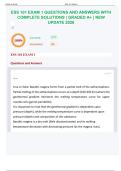
ESS 101 EXAM 1 QUESTIONS AND ANSWERS WITH
COMPLETE SOLUTIONS | GRADED A+ | NEW
UPDATE 2026
ESS 101 EXAM 1
Questions and Answers
1 of 277
Term
true or false: Basaltic magma forms from a partial melt of the asthenosphere.
Partial melting of the asthenosphere occurs at a depth (100-350 km) where the
geothermal gradient intersects the melting temperature curve for upper
mantle rock (garnet peridotite).
It is important to note that the geothermal gradient is dependent upon
pressure (depth), while the melting temperature curve is dependent upon
pressure (depth) and composition of the substance.
Basaltic magma is a dry melt (little dissolved water) and its melting
temperature decreases with decreasing pressure (as the magma rises).
,11/3/25, 8:28 PM ESS 101 EXAM 1
t
,11/3/25, 8:28 PM ESS 101 EXAM 1
t
, 11/3/25, 8:28 PM ESS 101 EXAM 1
ESS 101 EXAM 1 QUESTIONS AND ANSWERS WITH
COMPLETE SOLUTIONS | GRADED A+ | NEW
UPDATE 2026
ESS 101 EXAM 1
Questions and Answers
1 of 277
Term
true or false: Basaltic magma forms from a partial melt of the asthenosphere.
Partial melting of the asthenosphere occurs at a depth (100-350 km) where the
geothermal gradient intersects the melting temperature curve for upper
mantle rock (garnet peridotite).
It is important to note that the geothermal gradient is dependent upon
pressure (depth), while the melting temperature curve is dependent upon
pressure (depth) and composition of the substance.
Basaltic magma is a dry melt (little dissolved water) and its melting
temperature decreases with decreasing pressure (as the magma rises).
,11/3/25, 8:28 PM ESS 101 EXAM 1
t
,11/3/25, 8:28 PM ESS 101 EXAM 1
t
, 11/3/25, 8:28 PM ESS 101 EXAM 1