100% satisfaction guarantee Immediately available after payment Both online and in PDF No strings attached 4.6 TrustPilot
logo-home
Exam (elaborations)

CAMPBELL-BIOLOGY CHAPTER 18 EXAM Q’S AND A’S

Rating
-
Sold
-
Pages
4
Grade
A+
Uploaded on
02-11-2025
Written in
2025/2026

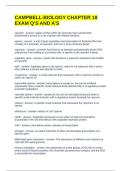
CAMPBELL-BIOLOGY CHAPTER 18 EXAM Q’S AND A’S operator - answer- region of DNA within the promoter that controls RNA polymerase's access to a set of genes with related functions operon - answer- a unit of gene regulation and transcription in bacterial DNA that consists of a promoter, an operator, and one or more structural genes repressor - answer- a protein that binds to an operator and physically blocks RNA polymerase from binding to a promoter site. is specific to the operator it binds. regulatory gene - answer- a gene that produces a repressor substance that inhibits an operator trpR - answer- regulatory gene or trp operon; codes for trp repressor that is active when effector is bound and attaches to DNA corepressor - answer- a small molecule that cooperates with a repressor protein to switch an operon off repressible operon - answer- transcription is usually on, but can be inhibited (repressed) when a specific small molecule binds allosterically to a regulatory protein (example tryptophan) inducible operon - answer- usually off, but can be stimulated (induced) when a specific small molecule interacts with a regulatory protein (example lac operon) inducer - answer- A specific small molecule that inactivates the repressor in an operon. allolactose - answer- inducer in LAC operon cAMP - answer- Catabolite repression occurs when its high concentrations accumulate in the cell and interact with catabolite repressor protein. CAP - answer- stimulatory protein, activator of transcription activator - answer- A protein that binds to DNA and stimulates transcription of a specific gene. differential gene expression - answer- The expression of different sets of genes by cells with the same genome. histone acetylation - answer- the attachment of acetyl groups (-COCH3) to certain amino acids of histone proteins, the chromatin becomes less compact, and the DNA is accessible for transcription histone code hypothesis - answer- specific combinations of modifications, rather than the overall level of histone acetylation, help determine the chromatin configuration, influencing transcription. DNA methylation - answer- addition of methyl group to DNA (usually to Cytosine), associated with decreased transcription (permanent deactivation) genomic imprinting - answer- A phenomenon in which expression of an allele in offspring depends on whether the allele is inherited from the male or female parent. epigenetic inheritance - answer- Inheritance of traits transmitted by mechanisms not directly involving the nucleotide sequence. control elements - answer- Segments of noncoding DNA that help regulate transcription of a gene by binding proteins called transcription factors. specific transcription factors - answer- Increase the level of transcription in certain cell types or in response to signals proximal control elements - answer- Control elements located close to the promoter Still do the same job of binding proteins to DNA so that transcription can take place Increase rate of transcription Distal control elements - answer- Also called enhancers. They are segments of eukaryotic DNA that contain multiple control elements, usually located far from the gene whose transcription is regulated. enhancers - answer- A DNA sequence that recognizes certain transcription factors that can stimulate transcription of nearby genes alternative RNA splicing - answer- different mRNA molecules are produced from the same primary transcript, depending on which RNA segments are treated as exons and which as introns proteasome - answer- A giant protein complex that recognizes and destroys proteins tagged for elimination by the small protein ubiquitin. protein-coding DNA - answer- ~1.5% of human genome noncoding RNA - answer- ncRNA - forms an extensive and sophisticated genome regulatory network microRNAs - answer- small single stranded RNA molecules that bind to mRNA and can degrade mRNA or block its translation - miRNAs RNA interference - answer- Blocking gene expression by means of an miRNA silencing complex small interfering RNAs - answer- length of 21-23 nucleotides double-stranded inhibit gene expression by degrading homologous mRNA

Show more Read less
Institution
CAMPBELL-BIOLOGY CHAPTER 18
Course
CAMPBELL-BIOLOGY CHAPTER 18


Whoops! We can’t load your doc right now. Try again or contact support.

Written for

Institution
CAMPBELL-BIOLOGY CHAPTER 18
Course
CAMPBELL-BIOLOGY CHAPTER 18

Document information

Uploaded on
November 2, 2025
Number of pages
4
Written in
2025/2026
Type
Exam (elaborations)
Contains
Questions & answers

Subjects

Content preview

CAMPBELL-BIOLOGY CHAPTER 18
EXAM Q’S AND A’S
operator - answer- region of DNA within the promoter that controls RNA
polymerase's access to a set of genes with related functions

operon - answer- a unit of gene regulation and transcription in bacterial DNA that
consists of a promoter, an operator, and one or more structural genes

repressor - answer- a protein that binds to an operator and physically blocks RNA
polymerase from binding to a promoter site. is specific to the operator it binds.

regulatory gene - answer- a gene that produces a repressor substance that inhibits
an operator

trpR - answer- regulatory gene or trp operon; codes for trp repressor that is active
when effector is bound and attaches to DNA

corepressor - answer- a small molecule that cooperates with a repressor protein to
switch an operon off

repressible operon - answer- transcription is usually on, but can be inhibited
(repressed) when a specific small molecule binds allosterically to a regulatory protein
(example tryptophan)

inducible operon - answer- usually off, but can be stimulated (induced) when a
specific small molecule interacts with a regulatory protein (example lac operon)

inducer - answer- A specific small molecule that inactivates the repressor in an
operon.

allolactose - answer- inducer in LAC operon

cAMP - answer- Catabolite repression occurs when its high concentrations
accumulate in the cell and interact with catabolite repressor protein.

CAP - answer- stimulatory protein, activator of transcription

activator - answer- A protein that binds to DNA and stimulates transcription of a
specific gene.

differential gene expression - answer- The expression of different sets of genes by
cells with the same genome.

histone acetylation - answer- the attachment of acetyl groups (-COCH3) to certain
amino acids of histone proteins, the chromatin becomes less compact, and the DNA
is accessible for transcription

Get to know the seller

Seller avatar
Reputation scores are based on the amount of documents a seller has sold for a fee and the reviews they have received for those documents. There are three levels: Bronze, Silver and Gold. The better the reputation, the more your can rely on the quality of the sellers work.
Freshy Oxford University
View profile
Follow You need to be logged in order to follow users or courses
Sold
53
Member since
1 year
Number of followers
4
Documents
6784
Last sold
3 weeks ago

3.6

10 reviews

5
3
4
4
3
1
2
0
1
2

Recently viewed by you

Why students choose Stuvia

Created by fellow students, verified by reviews

Quality you can trust: written by students who passed their tests and reviewed by others who've used these notes.

Didn't get what you expected? Choose another document

No worries! You can instantly pick a different document that better fits what you're looking for.

Pay as you like, start learning right away

No subscription, no commitments. Pay the way you're used to via credit card and download your PDF document instantly.

Student with book image

“Bought, downloaded, and aced it. It really can be that simple.”

Alisha Student

Frequently asked questions