100% satisfaction guarantee Immediately available after payment Both online and in PDF No strings attached 4.6 TrustPilot
logo-home
Exam (elaborations)

CAMPBELL BIOLOGY CHAPTER 8 EXAM QUESTIONS AND ANSWERS

Rating
-
Sold
-
Pages
3
Grade
A+
Uploaded on
02-11-2025
Written in
2025/2026

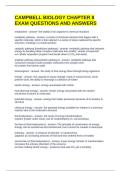
CAMPBELL BIOLOGY CHAPTER 8 EXAM QUESTIONS AND ANSWERS metabolism - answer- the totality of an organism's chemical reactions metabolic pathway - answer- a series of chemical reactions that begins with a specific molecule, which is then altered in a series of steps catalyzed by specific enzymes, resulting in a certain product catabolic pathway (breakdown pathway) - answer- metabolic pathway that releases energy by breaking down complex molecules into smaller, simpler compounds ex/ cellular respiration (organic fuels break down to CO₂ and water) anabolic pathway (biosynthetic pathways) - answer- metabolic pathway that consumes energy to build complex molecules from simpler ones ex/ protein from amino acids bioenergetics - answer- the study of how energy flows through living organisms energy - answer- the capacity to cause change; exists in various forms, some perform work; the ability to rearrange a collection of matter kinetic energy - answer- energy associated with motion heat (thermal energy) - answer- kinetic energy associated with the random movement of atoms or molecules potential energy - answer- energy that matter possesses because of its location or structure chemical energy - answer- the potential energy available for release in a chemical reaction due to the molecule's structure thermodynamics - answer- the study of energy transformations (system [matter under study, can be isolated/open] vs. surroundings) first law (of thermodynamics) - answer- The principle of conservation of energy: Energy can be transferred and transformed, but it cannot be created or destroyed. enthropy - answer- a measure of disorder, or randomness; (appears as increasing amounts of heat and less ordered forms of matter) second law (of thermodynamics) - answer- Every energy transfer or transformation increases the entropy (disorder) of the universe. ex/ bear making kinetic energy - produces heat and CO₂ (as it exhales) spontaneous process - answer- a process that can occur without an input of energy; it is "energetically favorable", it increases entropy of the universe; a process that is moving toward equilibrium ex/ water flowing downhill (Gibbs) free energy - answer- the portion of a system's energy that can perform work when temperature and pressure are uniform throughout the system, as in a living cell; measure of a system's instability (tendency to change to stability) (change in) free energy (∆G) - answer- ∆G = ∆H - T∆S ∆G = [final energy] - [initial energy] equilibrium - answer- maximum stability; ∆G = 0; a cell that is metabolically at this is dead exergonic reaction - answer- a spontaneous chem reaction with a net release of free energy (also some released as heat); ∆G < 0; the greater the decrease, the greater the amount of work that can be done; reactants have higher free energy, products have less free energy endergonic reaction - answer- a nonspontaneous chem reaction that absorbs free energy from its surroundings; ∆G > 0, the quantity of energy needed to drive the reaction ("get the reaction to go"); reactants have less free energy, products have more free energy chemical, transport, mechanical - answer- the three main kinds of work that a cell does/uses ATP for energy coupling (Rx coupling) - answer- the use of an exergonic process to drive an endergonic one; makes the overall process spontaneous; made possible with ATP hydrolysis · A+B → C+D ∆G = +5 (endergonic) · X+Y → Z+W ∆G = -7 (exergonic) · A+B+X+Y → C+D+Z+W ∆G = -2 (exergonic) ATP (adenosine triphosphate) - answer- ribose with nitrogenous base adenine and a chain of three phosphate groups; bonds broken through hydrolysis; cycles 7.3 kcal/mol - answer- energy given off in this exergonic reaction (therefore it would be -): ATP + H₂O → ADP + P + energy; energy need to drive this endergonic reaction: ADP + P + energy → ATP enzyme - answer- a macromolecule (protein) that acts as a catalyst (most ending in -ase); 1. lowers activation energy 2. not used up 3. specific for reaction catalyst - answer- a chemical agent that speeds up a reaction without being consumed by the reaction

Show more Read less
Institution
CAMPBELL BIOLOGY CHAPTER 8
Course
CAMPBELL BIOLOGY CHAPTER 8


Whoops! We can’t load your doc right now. Try again or contact support.

Written for

Institution
CAMPBELL BIOLOGY CHAPTER 8
Course
CAMPBELL BIOLOGY CHAPTER 8

Document information

Uploaded on
November 2, 2025
Number of pages
3
Written in
2025/2026
Type
Exam (elaborations)
Contains
Questions & answers

Subjects

Content preview

CAMPBELL BIOLOGY CHAPTER 8
EXAM QUESTIONS AND ANSWERS
metabolism - answer- the totality of an organism's chemical reactions

metabolic pathway - answer- a series of chemical reactions that begins with a
specific molecule, which is then altered in a series of steps catalyzed by specific
enzymes, resulting in a certain product

catabolic pathway (breakdown pathway) - answer- metabolic pathway that releases
energy by breaking down complex molecules into smaller, simpler compounds
ex/ cellular respiration (organic fuels break down to CO₂ and water)

anabolic pathway (biosynthetic pathways) - answer- metabolic pathway that
consumes energy to build complex molecules from simpler ones
ex/ protein from amino acids

bioenergetics - answer- the study of how energy flows through living organisms

energy - answer- the capacity to cause change; exists in various forms, some
perform work; the ability to rearrange a collection of matter

kinetic energy - answer- energy associated with motion

heat (thermal energy) - answer- kinetic energy associated with the random
movement of atoms or molecules

potential energy - answer- energy that matter possesses because of its location or
structure

chemical energy - answer- the potential energy available for release in a chemical
reaction due to the molecule's structure

thermodynamics - answer- the study of energy transformations
(system [matter under study, can be isolated/open] vs. surroundings)

first law (of thermodynamics) - answer- The principle of conservation of energy:
Energy can be transferred and transformed, but it cannot be created or destroyed.

enthropy - answer- a measure of disorder, or randomness;
(appears as increasing amounts of heat and less ordered forms of matter)

second law (of thermodynamics) - answer- Every energy transfer or transformation
increases the entropy (disorder) of the universe.
ex/ bear making kinetic energy - produces heat and CO₂ (as it exhales)

Get to know the seller

Seller avatar
Reputation scores are based on the amount of documents a seller has sold for a fee and the reviews they have received for those documents. There are three levels: Bronze, Silver and Gold. The better the reputation, the more your can rely on the quality of the sellers work.
Freshy Oxford University
View profile
Follow You need to be logged in order to follow users or courses
Sold
53
Member since
1 year
Number of followers
4
Documents
6784
Last sold
3 weeks ago

3.6

10 reviews

5
3
4
4
3
1
2
0
1
2

Recently viewed by you

Why students choose Stuvia

Created by fellow students, verified by reviews

Quality you can trust: written by students who passed their tests and reviewed by others who've used these notes.

Didn't get what you expected? Choose another document

No worries! You can instantly pick a different document that better fits what you're looking for.

Pay as you like, start learning right away

No subscription, no commitments. Pay the way you're used to via credit card and download your PDF document instantly.

Student with book image

“Bought, downloaded, and aced it. It really can be that simple.”

Alisha Student

Frequently asked questions