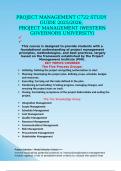
PROJECT MANAGEMENT C722 STUDY
GUIDE 2025/2026,
PROJECT MANAGEMENT (WESTERN
GOVERNORS UNIVERSITY)
This course is designed to provide students with a
foundational understanding of project management
principles, methodologies, and best practices, largely
based on the framework established by the Project
Management Institute (PMI).
KEY TOPICS COVERED
The Five Process Groups:
Initiating: Defining the project and getting authorization to start.
Planning: Developing the project plan, defining scope, schedule, budget,
and resources.
Executing: Carrying out the tasks defined in the plan.
Monitoring & Controlling: Tracking progress, managing changes, and
ensuring the project stays on track.
Closing: Formalizing acceptance of the project deliverables and ending the
project.
The Ten Knowledge Areas:
Integration Management
Scope Management
Schedule Management
Cost Management
Quality Management
Resource Management
Communications Management
Risk Management
Procurement Management
Stakeholder Management
Project Selection / Model Selection Criteria >>>
involve evaluating potential projects or instructional/project management
models against a set of predetermined criteria to choose the option that
,offers the best alignment with organizational goals, maximizes benefits, and
minimizes risks.
Realistic
• Accurately reflects the way the organization does business
• Appropriate for the level of resources, capabilities, and external environment of the
organization
Example: Using profitability model when the organization is focused on market share growth would
not be appropriate.
Capable
• Uses factors that are relevant to the organization
• You would not expect one model to cover all dimensions of a project; you would want to
use models that cover their dimension comprehensively.
Example: For organizations with a long-term value perspective, the net present value model provides a
rigorous evaluation of a project’s future cash flows.
Flexible
• The model should provide accurate measures across a reasonable range of conditions.
Example: The model would allow for changing conditions where the cost of a new government
regulation must be factored into the analysis.
Easy to use
• Provide results in a reasonable amount of time
• Results should be easily understood by the decision makers.
Example: Use models that provide measures that the decision maker can easily apply, such as dollars,
months, or percentage change.
Low cost
• The costs of gathering data and running the model should be low relative to the scale of
the project.
Example: A model that requires hiring a consultant to run and interpret may not be cost effective for
smaller projects.
Comparable
• The model should be usable across a range of projects such that the outcomes of the model
can be used to compare projects.
Example: Using a profitability model for one project and a qualitative scoring model for another would
not allow the decision maker to analyze the projects relative to each other.
,
GUIDE 2025/2026,
PROJECT MANAGEMENT (WESTERN
GOVERNORS UNIVERSITY)
This course is designed to provide students with a
foundational understanding of project management
principles, methodologies, and best practices, largely
based on the framework established by the Project
Management Institute (PMI).
KEY TOPICS COVERED
The Five Process Groups:
Initiating: Defining the project and getting authorization to start.
Planning: Developing the project plan, defining scope, schedule, budget,
and resources.
Executing: Carrying out the tasks defined in the plan.
Monitoring & Controlling: Tracking progress, managing changes, and
ensuring the project stays on track.
Closing: Formalizing acceptance of the project deliverables and ending the
project.
The Ten Knowledge Areas:
Integration Management
Scope Management
Schedule Management
Cost Management
Quality Management
Resource Management
Communications Management
Risk Management
Procurement Management
Stakeholder Management
Project Selection / Model Selection Criteria >>>
involve evaluating potential projects or instructional/project management
models against a set of predetermined criteria to choose the option that
,offers the best alignment with organizational goals, maximizes benefits, and
minimizes risks.
Realistic
• Accurately reflects the way the organization does business
• Appropriate for the level of resources, capabilities, and external environment of the
organization
Example: Using profitability model when the organization is focused on market share growth would
not be appropriate.
Capable
• Uses factors that are relevant to the organization
• You would not expect one model to cover all dimensions of a project; you would want to
use models that cover their dimension comprehensively.
Example: For organizations with a long-term value perspective, the net present value model provides a
rigorous evaluation of a project’s future cash flows.
Flexible
• The model should provide accurate measures across a reasonable range of conditions.
Example: The model would allow for changing conditions where the cost of a new government
regulation must be factored into the analysis.
Easy to use
• Provide results in a reasonable amount of time
• Results should be easily understood by the decision makers.
Example: Use models that provide measures that the decision maker can easily apply, such as dollars,
months, or percentage change.
Low cost
• The costs of gathering data and running the model should be low relative to the scale of
the project.
Example: A model that requires hiring a consultant to run and interpret may not be cost effective for
smaller projects.
Comparable
• The model should be usable across a range of projects such that the outcomes of the model
can be used to compare projects.
Example: Using a profitability model for one project and a qualitative scoring model for another would
not allow the decision maker to analyze the projects relative to each other.
,