WGU C972 Task 4 |Passed on First Attempt |Latest
Update with Complete Solution
Curtis Allen
C972 task 4
A. Demonstrate, using an example, that the result of performing two isometries—
called isometry P and isometry Q—is not always commutative (i.e., P○Q does not
always equal Q○P). Show and explain all steps.
Notes:
1: Initial Triangle; A = (2, 2), B = (5, 2), C = (5, 4).
2: Isometry P; rotate clockwise 90 degrees around the point (-4, 2).
3: Isometry Q; reflect across the x-axis.
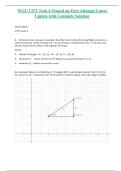
An example figure is established. Triangle ABC, consisting of point A (2, 2), B (5,
2), and C (5, 4). Isometries for P○Q and Q○P will be taken from this figure (ABC).
, Evaluation P○Q: The initial step is evaluating the isometry Q; (with the triangle
ABC), isometry Q is reflected across the X-axis. This created A’B’C’ at points A’ (2,
-2), B’ (5, -2), C’ (5, -4).
Update with Complete Solution
Curtis Allen
C972 task 4
A. Demonstrate, using an example, that the result of performing two isometries—
called isometry P and isometry Q—is not always commutative (i.e., P○Q does not
always equal Q○P). Show and explain all steps.
Notes:
1: Initial Triangle; A = (2, 2), B = (5, 2), C = (5, 4).
2: Isometry P; rotate clockwise 90 degrees around the point (-4, 2).
3: Isometry Q; reflect across the x-axis.
An example figure is established. Triangle ABC, consisting of point A (2, 2), B (5,
2), and C (5, 4). Isometries for P○Q and Q○P will be taken from this figure (ABC).
, Evaluation P○Q: The initial step is evaluating the isometry Q; (with the triangle
ABC), isometry Q is reflected across the X-axis. This created A’B’C’ at points A’ (2,
-2), B’ (5, -2), C’ (5, -4).