

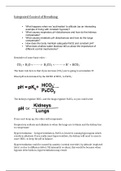
Integrated Control of Breathing
What happens when we 'acclimatise' to altitude (as an interesting
example of living with constant hypoxia)?
What causes respiratory pH disturbances and how do the kidneys
compensate?
What causes metabolic pH disturbances and how do the lungs
compensate?
How does the body maintain adequate PaO2 and constant pH?
What does shallow-water blackout tell us about the importance of
different control mechanisms?
Reminder of some basic rules –
CO2 + H2O <-------> H2CO3 <--------> H+ + HCO3-
The basic rule here is that if you increase [CO2] you’re going to accumulate H+
Blood pH is determined by the RATIO of HCO3- to PaCO2:
The kidneys regulate HCO3- and the lungs regulate PaCO2, so you could write
If one can’t keep up, the other will compensate
Respiratory acidosis and alkalosis is when the lungs are to blame and the kidney has
to compensate
Hyperventilation – In hyperventilation, PaCO2 is lowered, causing hypocapnia which
results in alkalosis. If you really must hyperventilate, the kidney will need to excrete
more HCO3- to keep the pH in balance.
Hyperventilation could be caused by anxiety (cortical override), by altitude (explored
later) or due to diffusion defect, VQ mismatch or shunt, this would be because when
hypoxic drive kicks in, hyperventilation may result.
, Anxiety, a situation could be as below -
Here we can see the pH is within the normal range (just), however her CO 2 is low
(due to blowing it off), however we can see her HCO 3- is also low, meaning there is
renal compensation.
Hypoventilation – In hypoventilation, PaCO2 is raised, causing hypercapnia which
results in acidosis. If you really must hypoventilate, the kidney will need to retain
more HCO3- to keep pH in balance.
Hypoventilation may be caused by a number of factors including: obesity due to too
much work required to breathe adequately, stroke due to damage to central
respiratory pathways, drugs such as opioids suppress respiratory drive and
neuromuscular problems make it harder to breathe adequately also.
Metabolic acidosis and alkalosis is when the body is to blame and the lungs have to
compensate.
So if we look at our earlier equation, we can see this
CO2 + H2O <-------> H2CO3 <--------> H+ + HCO3-
In metabolic acidosis, the body adds H+, so the lungs blow off more CO2, to shift the
equilibrium to the left.
Metabolic acidosis may be caused by:
Lactic acidosis – Caused by exercise (including shivering) or sepsis (organ
hypofusion due to low BP caused by sepsis vasodilation)
Renal failure – Kidneys can’t do their part properly
Diabetic ketoacidosis – When the liver starts to burn fatty acids for fuel
Diarrhoea – Failure to reabsorb HCO3- released from pancreas
In metabolic alkalosis, the body loses H+, so the lungs try to retain CO2, so equilibrium
shifts to right. Causes of metabolic alkalosis include:
Vomiting – Throwing up your acid, this needs to be excessive however
What happens when we 'acclimatise' to altitude (as an interesting
example of living with constant hypoxia)?
What causes respiratory pH disturbances and how do the kidneys
compensate?
What causes metabolic pH disturbances and how do the lungs
compensate?
How does the body maintain adequate PaO2 and constant pH?
What does shallow-water blackout tell us about the importance of
different control mechanisms?
Reminder of some basic rules –
CO2 + H2O <-------> H2CO3 <--------> H+ + HCO3-
The basic rule here is that if you increase [CO2] you’re going to accumulate H+
Blood pH is determined by the RATIO of HCO3- to PaCO2:
The kidneys regulate HCO3- and the lungs regulate PaCO2, so you could write
If one can’t keep up, the other will compensate
Respiratory acidosis and alkalosis is when the lungs are to blame and the kidney has
to compensate
Hyperventilation – In hyperventilation, PaCO2 is lowered, causing hypocapnia which
results in alkalosis. If you really must hyperventilate, the kidney will need to excrete
more HCO3- to keep the pH in balance.
Hyperventilation could be caused by anxiety (cortical override), by altitude (explored
later) or due to diffusion defect, VQ mismatch or shunt, this would be because when
hypoxic drive kicks in, hyperventilation may result.
, Anxiety, a situation could be as below -
Here we can see the pH is within the normal range (just), however her CO 2 is low
(due to blowing it off), however we can see her HCO 3- is also low, meaning there is
renal compensation.
Hypoventilation – In hypoventilation, PaCO2 is raised, causing hypercapnia which
results in acidosis. If you really must hypoventilate, the kidney will need to retain
more HCO3- to keep pH in balance.
Hypoventilation may be caused by a number of factors including: obesity due to too
much work required to breathe adequately, stroke due to damage to central
respiratory pathways, drugs such as opioids suppress respiratory drive and
neuromuscular problems make it harder to breathe adequately also.
Metabolic acidosis and alkalosis is when the body is to blame and the lungs have to
compensate.
So if we look at our earlier equation, we can see this
CO2 + H2O <-------> H2CO3 <--------> H+ + HCO3-
In metabolic acidosis, the body adds H+, so the lungs blow off more CO2, to shift the
equilibrium to the left.
Metabolic acidosis may be caused by:
Lactic acidosis – Caused by exercise (including shivering) or sepsis (organ
hypofusion due to low BP caused by sepsis vasodilation)
Renal failure – Kidneys can’t do their part properly
Diabetic ketoacidosis – When the liver starts to burn fatty acids for fuel
Diarrhoea – Failure to reabsorb HCO3- released from pancreas
In metabolic alkalosis, the body loses H+, so the lungs try to retain CO2, so equilibrium
shifts to right. Causes of metabolic alkalosis include:
Vomiting – Throwing up your acid, this needs to be excessive however


