ASPE CPD STUDY QUESTIONS &
ANSWERS|| 2025 LATEST UPDATE
Front - ANSWERBack
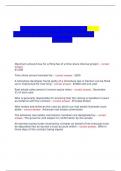
What is the specific weight of water? - ANSWER62.4 lbs per cubic foot
What happens in a storm and sanitary system after it passes the water test? -
ANSWERA smoke pressure test is recommended with a smoke pressure of 1 in wc to
prove the system gas tight.
Is an air test acceptable for a storm and sanitary system? - ANSWERYes, if a water test
is not possible, at a pressure of 5 psi, are tests are impractical and costly
What are the testing procedures for the storm and sanitary system? - ANSWERA water
test upon completion of the rough piping and prior to concealment of 10 ft wc minimum
(except the topmost 10 feet of pipe), not to exceed 100 ft wc. If system is higher than
100 feet, test plugs must be installed to facilitate testing, rarely are more than 7 stories
tested at one time. A peppermint oil test may also be done with 2 oz of peppermint oil
and 10 qt boiling water, and searching for peppermint smell at leaks, however it is
difficult to pinpoint the leak by this method
The maximum length from the vent connection to any future drain outlet is required by
code, why, how long is the distance (listed in the book), and what’s the exception? -
ANSWERTo prevent a dead end where slime, sludge and fungi can grow, 2 feet, unless
the piping must be extended to an accessible location for a cleanout
A sanitary tee may be used in the vertical but what may not be used in the vertical and
why? - ANSWERA double sanitary tee because the possibility of flow crossover and
excessive pressures when one branch is discharging and the other isn’t are possible
What are the slopes of pipe inside the building that correspond to 2 fps velocity? -
ANSWER1/4 in per foot for 3 in and smaller 1/8 in per foot for larger pipe all elbows,
taps, tees etc are tapped at a pitch of 1/4” per foot
Where should cleanouts be provided? - ANSWER1) Inside or outside the building at the
point of exit (use a wye branch) 2) at every change in direction greater than 45 degrees
3) every 50 feet for piping 4” and less, and 100 ft for larger piping 4) underground
piping larger than 10 in should be provided with manholes at every change in direction
and every 150 feet 5) at the base of all stacks 6) as required by code
What size cleanouts are provided in piping? - ANSWERPiping up to 4 inches, the
cleanout is the same size as the pipe. Piping greater than 4 inches, 4 inch cleanouts are
adequate.
,What should be installed in the house drain if there is a danger of backflow of sewage
into the building? Whats the difference? - ANSWERA backwater valve or a combination
BWV with manually operated gate valve. The BWV does not interfere with the airflow
throughout the system, and the gate valve is recommended where there is a history of
backflow as a positive means of protection.
Branch connections to the house drain should be made where and why? - ANSWERAt
the upper portion of the pipe (above the 1/2 - 2/3 full mark) because: 1) there is a lower
chance of stoppages in the branch 2) there is less flow interference at the point of
connection 3) When there is no flow in the branch, the full area of the pipe is available
to relieve pneumatic pressure fluctuations in the house drain
How many fixture units are equivalent to 1 gpm continuous or semicontinuous flow and
what are examples of these types of flow? - ANSWER2 FUs, sump pumps, ejectors, air
conditioning equipment, water cooled, equipment, etc
What minimum slopes are required for building drains and why? - ANSWER3 in pipe
and smaller: 1/4 in/ft 4-6 in pipe: 1/8 in/ft 8 in pipe and larger: 1/16 in/ft to maintain 2 fps
scouring action if low flow fixtures are present, 1/4 in/ft for all is a good idea
House drains are designed to flow how full? - ANSWER1/2 full to 3/4 full max under
uniform flow conditions
What is a house (building) drain? - ANSWERThe lowest piping of a gravity drainage
system that receives the discharge from soil, waste, and other drainage pipes inside the
building that extends a short distance from the building and conveys the drainage to the
building sewer
What is the measurement from horizontal that separates horizontal and vertical
drainage stacks? - ANSWER45 degrees
Does an interior drainage stack that offsets 45 degrees or less from the vertical require
a change in size? - ANSWERNo. Any more than a 45 degree offset requires sizing the
offset as a house drain.
What is a branch interval? - ANSWERA building story or a distance between two branch
connections greater than 8 feet apart.
Describe the procedure for sizing interior drainage stacks. - ANSWER1) First size the
horizontal branches connecting to the stack 2) Determine the minimum size that will
accept each branch at one branch interval 3) Total all fixture units connected to the
stack, and determine the size. The minimum size must be at least equal to the largest
diameter required at the base. You may reduce in size at upper branch intervals, but
never by more than 1/2 the largest size.
,What is the total recommended maximum permissible flow in a stack? - ANSWER7/24
of the total cross sectional area of the stack.
Where should and shouldn’t you connect branch connections to stack offsets? -
ANSWERNot to the horizontal offset to the stack if at all possible, unless its at least 10
pipe diameters downstream, and ideally 2 feet above the offset or 2 feet below to avoid
pressure fluctuations.
What can minimize hydraulic jump? - ANSWERIncreasing the slope of the horizontal
drain. Connecting to a horizontal drain that is larger than the stack.
Any offset of the stack greater than what can cause hydraulic jump? - ANSWER45
degrees
When does terminal velocity occur in a drainage stack? - ANSWERIt is achieved at
approximately 10 - 15 fps and this velocity is achieved within 10 - 15 feet of fall from the
point of entry.
A drainage stack should never be designed for a capacity greater than what and why? -
ANSWEROne-thrid full, because the pressure fluctuations in the system could greatly
exceed the maximum 1 in water column criterion and lose their seal by siphonage
blowout
What is one positive and one negative of a tee-wye fitting? - ANSWERThe long radius
tee-wye fitting gives the water a greater downward component than a sanitary tee, but
also has a greater probability of siphoning the traps
How are horizontal branch connections to the stack made? - ANSWERWith a sanitary
tee (a short radius tee-wye, vertical position only) or with a long radius tee-wye (vertical
or horizontal position). (The tee-wye is also called a combination wye and one-eighth
bend)
What is the difference between soil stacks and waste stacks? - ANSWERSoil stacks
collect wastes that contain fecal matter, and waste stacks collect wastes that do not
contain fecal matter (lavatories, sinks, etc)
What is a vent stack? - ANSWERA vent stack prevents the development of excessive
pressures in the lower regions of the drainage stack by relieving the air that is rapidly
carried down the drainage stack. It does not include vertical fixture drains and branch
vents that do not pass through more than two stories before being connected to the soil
or waste stack or vent stack.
What is a general term for any vertical line of soil or waste piping that collects water and
wastes from fixture drains and horizontal branch drains from two or more floors of a
building? - ANSWERA Stack.
, Properties of uniform flow apply to branches of what length and longer? - ANSWER5
feet
Special wastes, tank overflows, tank emptying lines, releif valve discharges, etc. should
discharge where and why? - ANSWERThrough an air break to an appropriate
receptacle (floor drain or other) to prevent overpressurization of the drainage system.
High temperature wastes should be cooled to what temperature before discharging into
the drainage system? - ANSWER140F
When interior drainage piping developed length reaches 100 feet, what should happen
and why? - ANSWERA vent to atmosphere should be provided. It should run
independently through the roof, this is to prevent the rapid fouling of the pipe due to the
growth of slime and fungi in the absence of air circulation.
The sizing for indirect wastes is the same as direct-waste connections with what
exception? - ANSWERDue to the low velocities usually present in indirect wastes,
stoppages are more prevalent, and cleanouts should be provided at every possible
location.
For an indirect waste, the discharge outlet should be what? - ANSWERA minimum of
1.5 times the indirect pipe size above the flood level of the receptacle.
How can the fixture unit flow rate be calculated? - ANSWERBy dividing the total
discharge flow in gallons per minute of a single fixture divided by 7.5 gal/ft^3
What factors do FUs account for? - ANSWERApplication in conjunction with the
probability of simultaneous use of fixtures.
For interior drainage systems, the rate of flow in a fixture drain should be what? -
ANSWERThe same as the rate of flow discharged at the fixture outlet.
For interior drainage systems, the minimum fixture drain size is what? - ANSWERThe
minimum size of the fixture trap (often given in a table)
What is the recommended value of n, the coefficient of roughness, for storm drains of all
sizes? - ANSWER0.0145
The designer must know what as related to the sewer, water, and gas inverts and
locations? - ANSWERThe actual elevation of all of the floors of the building.
What is the minimum velocity of flow to achieve scouring action in piping? For keeping
grease in suspension in greasy wastes? For suspension in Storm Sewers? - ANSWER2
fps, 4 fps, 3 fps. Dont forget to limit the length of runs for 1-1/2 and 2” pipe to
maintain scouring action.
ANSWERS|| 2025 LATEST UPDATE
Front - ANSWERBack
What is the specific weight of water? - ANSWER62.4 lbs per cubic foot
What happens in a storm and sanitary system after it passes the water test? -
ANSWERA smoke pressure test is recommended with a smoke pressure of 1 in wc to
prove the system gas tight.
Is an air test acceptable for a storm and sanitary system? - ANSWERYes, if a water test
is not possible, at a pressure of 5 psi, are tests are impractical and costly
What are the testing procedures for the storm and sanitary system? - ANSWERA water
test upon completion of the rough piping and prior to concealment of 10 ft wc minimum
(except the topmost 10 feet of pipe), not to exceed 100 ft wc. If system is higher than
100 feet, test plugs must be installed to facilitate testing, rarely are more than 7 stories
tested at one time. A peppermint oil test may also be done with 2 oz of peppermint oil
and 10 qt boiling water, and searching for peppermint smell at leaks, however it is
difficult to pinpoint the leak by this method
The maximum length from the vent connection to any future drain outlet is required by
code, why, how long is the distance (listed in the book), and what’s the exception? -
ANSWERTo prevent a dead end where slime, sludge and fungi can grow, 2 feet, unless
the piping must be extended to an accessible location for a cleanout
A sanitary tee may be used in the vertical but what may not be used in the vertical and
why? - ANSWERA double sanitary tee because the possibility of flow crossover and
excessive pressures when one branch is discharging and the other isn’t are possible
What are the slopes of pipe inside the building that correspond to 2 fps velocity? -
ANSWER1/4 in per foot for 3 in and smaller 1/8 in per foot for larger pipe all elbows,
taps, tees etc are tapped at a pitch of 1/4” per foot
Where should cleanouts be provided? - ANSWER1) Inside or outside the building at the
point of exit (use a wye branch) 2) at every change in direction greater than 45 degrees
3) every 50 feet for piping 4” and less, and 100 ft for larger piping 4) underground
piping larger than 10 in should be provided with manholes at every change in direction
and every 150 feet 5) at the base of all stacks 6) as required by code
What size cleanouts are provided in piping? - ANSWERPiping up to 4 inches, the
cleanout is the same size as the pipe. Piping greater than 4 inches, 4 inch cleanouts are
adequate.
,What should be installed in the house drain if there is a danger of backflow of sewage
into the building? Whats the difference? - ANSWERA backwater valve or a combination
BWV with manually operated gate valve. The BWV does not interfere with the airflow
throughout the system, and the gate valve is recommended where there is a history of
backflow as a positive means of protection.
Branch connections to the house drain should be made where and why? - ANSWERAt
the upper portion of the pipe (above the 1/2 - 2/3 full mark) because: 1) there is a lower
chance of stoppages in the branch 2) there is less flow interference at the point of
connection 3) When there is no flow in the branch, the full area of the pipe is available
to relieve pneumatic pressure fluctuations in the house drain
How many fixture units are equivalent to 1 gpm continuous or semicontinuous flow and
what are examples of these types of flow? - ANSWER2 FUs, sump pumps, ejectors, air
conditioning equipment, water cooled, equipment, etc
What minimum slopes are required for building drains and why? - ANSWER3 in pipe
and smaller: 1/4 in/ft 4-6 in pipe: 1/8 in/ft 8 in pipe and larger: 1/16 in/ft to maintain 2 fps
scouring action if low flow fixtures are present, 1/4 in/ft for all is a good idea
House drains are designed to flow how full? - ANSWER1/2 full to 3/4 full max under
uniform flow conditions
What is a house (building) drain? - ANSWERThe lowest piping of a gravity drainage
system that receives the discharge from soil, waste, and other drainage pipes inside the
building that extends a short distance from the building and conveys the drainage to the
building sewer
What is the measurement from horizontal that separates horizontal and vertical
drainage stacks? - ANSWER45 degrees
Does an interior drainage stack that offsets 45 degrees or less from the vertical require
a change in size? - ANSWERNo. Any more than a 45 degree offset requires sizing the
offset as a house drain.
What is a branch interval? - ANSWERA building story or a distance between two branch
connections greater than 8 feet apart.
Describe the procedure for sizing interior drainage stacks. - ANSWER1) First size the
horizontal branches connecting to the stack 2) Determine the minimum size that will
accept each branch at one branch interval 3) Total all fixture units connected to the
stack, and determine the size. The minimum size must be at least equal to the largest
diameter required at the base. You may reduce in size at upper branch intervals, but
never by more than 1/2 the largest size.
,What is the total recommended maximum permissible flow in a stack? - ANSWER7/24
of the total cross sectional area of the stack.
Where should and shouldn’t you connect branch connections to stack offsets? -
ANSWERNot to the horizontal offset to the stack if at all possible, unless its at least 10
pipe diameters downstream, and ideally 2 feet above the offset or 2 feet below to avoid
pressure fluctuations.
What can minimize hydraulic jump? - ANSWERIncreasing the slope of the horizontal
drain. Connecting to a horizontal drain that is larger than the stack.
Any offset of the stack greater than what can cause hydraulic jump? - ANSWER45
degrees
When does terminal velocity occur in a drainage stack? - ANSWERIt is achieved at
approximately 10 - 15 fps and this velocity is achieved within 10 - 15 feet of fall from the
point of entry.
A drainage stack should never be designed for a capacity greater than what and why? -
ANSWEROne-thrid full, because the pressure fluctuations in the system could greatly
exceed the maximum 1 in water column criterion and lose their seal by siphonage
blowout
What is one positive and one negative of a tee-wye fitting? - ANSWERThe long radius
tee-wye fitting gives the water a greater downward component than a sanitary tee, but
also has a greater probability of siphoning the traps
How are horizontal branch connections to the stack made? - ANSWERWith a sanitary
tee (a short radius tee-wye, vertical position only) or with a long radius tee-wye (vertical
or horizontal position). (The tee-wye is also called a combination wye and one-eighth
bend)
What is the difference between soil stacks and waste stacks? - ANSWERSoil stacks
collect wastes that contain fecal matter, and waste stacks collect wastes that do not
contain fecal matter (lavatories, sinks, etc)
What is a vent stack? - ANSWERA vent stack prevents the development of excessive
pressures in the lower regions of the drainage stack by relieving the air that is rapidly
carried down the drainage stack. It does not include vertical fixture drains and branch
vents that do not pass through more than two stories before being connected to the soil
or waste stack or vent stack.
What is a general term for any vertical line of soil or waste piping that collects water and
wastes from fixture drains and horizontal branch drains from two or more floors of a
building? - ANSWERA Stack.
, Properties of uniform flow apply to branches of what length and longer? - ANSWER5
feet
Special wastes, tank overflows, tank emptying lines, releif valve discharges, etc. should
discharge where and why? - ANSWERThrough an air break to an appropriate
receptacle (floor drain or other) to prevent overpressurization of the drainage system.
High temperature wastes should be cooled to what temperature before discharging into
the drainage system? - ANSWER140F
When interior drainage piping developed length reaches 100 feet, what should happen
and why? - ANSWERA vent to atmosphere should be provided. It should run
independently through the roof, this is to prevent the rapid fouling of the pipe due to the
growth of slime and fungi in the absence of air circulation.
The sizing for indirect wastes is the same as direct-waste connections with what
exception? - ANSWERDue to the low velocities usually present in indirect wastes,
stoppages are more prevalent, and cleanouts should be provided at every possible
location.
For an indirect waste, the discharge outlet should be what? - ANSWERA minimum of
1.5 times the indirect pipe size above the flood level of the receptacle.
How can the fixture unit flow rate be calculated? - ANSWERBy dividing the total
discharge flow in gallons per minute of a single fixture divided by 7.5 gal/ft^3
What factors do FUs account for? - ANSWERApplication in conjunction with the
probability of simultaneous use of fixtures.
For interior drainage systems, the rate of flow in a fixture drain should be what? -
ANSWERThe same as the rate of flow discharged at the fixture outlet.
For interior drainage systems, the minimum fixture drain size is what? - ANSWERThe
minimum size of the fixture trap (often given in a table)
What is the recommended value of n, the coefficient of roughness, for storm drains of all
sizes? - ANSWER0.0145
The designer must know what as related to the sewer, water, and gas inverts and
locations? - ANSWERThe actual elevation of all of the floors of the building.
What is the minimum velocity of flow to achieve scouring action in piping? For keeping
grease in suspension in greasy wastes? For suspension in Storm Sewers? - ANSWER2
fps, 4 fps, 3 fps. Dont forget to limit the length of runs for 1-1/2 and 2” pipe to
maintain scouring action.