

Structure and Function of the Renal Tubule
The main functional unit of the kidney, the nephron, description of the nephron
How the glomerular filtrate is formed and modified (reabsorption and secretion)
Explanation of active and passive transfer along with secondary active transport
Diagram illustrating secondary active transport – symport and antiport
How these transfer processes work together in tubule to transport substances, in
particular Na+
Techniques to investigate transport and function in the kidney tubule via clearance
studies, micropuncture and isolated perfusion, electrophysiological measurements
including patch clamping
Segments of the renal tubule
Diagram illustrating the two different types of nephron
Proximal convoluted tubule – anatomy and function
Loop of Henle – Anatomy and function with particular reference to creation of the
osmotic medullary gradient for counter-current multiplication
Distal Convoluted Tubule and Collecting tubule – anatomy and function
Collecting duct – anatomy and function
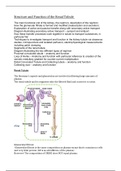
Renal Tubule
The Bowman’s capsule and glomerulus are involved in filtering large amounts of
plasma.
The renal tubule and its segments take the filtered fluid and convert it to urine.
Glomerular filtrate:
-Glomerular filtrate is the same composition as plasma except that it contains no cells
and very little protein (GF is an ultrafiltrate of the plasma)
However! The composition of URINE does NOT equal plasma.
, So obviously something is happening to this glomerular fluid as it passes through the
tubule. The clue is in that the GF is formed at a rate of 120ml/min whereas urine flow
is only about 1ml/min.
There is selective modification of the filtrate as it passes through the tubule.
Modification of GF
Filtration at the glomerulus is relatively non-selective. Modification of the filtrate
then occurs along the tubule, via reabsorption and secretion of water and various
solutes and this changes the composition of the filtrate.
Reabsorption is movement from the tubular lumen into the peritubular capillary
plasma/interstitial fluid
Secretion is movement from the peritubular capillary plasma into the tubular lumen
The main functional unit of the kidney, the nephron, description of the nephron
How the glomerular filtrate is formed and modified (reabsorption and secretion)
Explanation of active and passive transfer along with secondary active transport
Diagram illustrating secondary active transport – symport and antiport
How these transfer processes work together in tubule to transport substances, in
particular Na+
Techniques to investigate transport and function in the kidney tubule via clearance
studies, micropuncture and isolated perfusion, electrophysiological measurements
including patch clamping
Segments of the renal tubule
Diagram illustrating the two different types of nephron
Proximal convoluted tubule – anatomy and function
Loop of Henle – Anatomy and function with particular reference to creation of the
osmotic medullary gradient for counter-current multiplication
Distal Convoluted Tubule and Collecting tubule – anatomy and function
Collecting duct – anatomy and function
Renal Tubule
The Bowman’s capsule and glomerulus are involved in filtering large amounts of
plasma.
The renal tubule and its segments take the filtered fluid and convert it to urine.
Glomerular filtrate:
-Glomerular filtrate is the same composition as plasma except that it contains no cells
and very little protein (GF is an ultrafiltrate of the plasma)
However! The composition of URINE does NOT equal plasma.
, So obviously something is happening to this glomerular fluid as it passes through the
tubule. The clue is in that the GF is formed at a rate of 120ml/min whereas urine flow
is only about 1ml/min.
There is selective modification of the filtrate as it passes through the tubule.
Modification of GF
Filtration at the glomerulus is relatively non-selective. Modification of the filtrate
then occurs along the tubule, via reabsorption and secretion of water and various
solutes and this changes the composition of the filtrate.
Reabsorption is movement from the tubular lumen into the peritubular capillary
plasma/interstitial fluid
Secretion is movement from the peritubular capillary plasma into the tubular lumen


