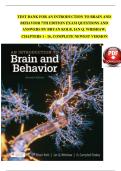
Test Bank for An Introduction to Brain and Behavior
d5 d5 d5 d5 d5 d5 d5 d5 d5
7th Edition by Bryan Kolb, Ian Q. Whishaw,
d5 d5 d5 d5 d5 d5 d5
Chapters 1 - 16, Complete Newest Version
d5 d5 d5 d5 d5 d5 d5
,Tabled5ofd5Contents
Chapterd51d 5 Whatd5Ared5thed5Originsd5ofd5Braind5andd5Behavior
?d5Chapterd52d 5 Whatd5Isd5thed5Nervousd5System’sd5Functionald5An
atomy?d5Chapterd53d 5 Whatd5Ared5thed5Nervousd5System’sd5Func
tionald5Units?
Chapterd54d 5 Howd5Dod5Neuronsd5Used5Electricald5Signalsd5tod5Transmitd5Informatio
n?d5Chapterd55d 5 Howd5Dod5Neuronsd5Communicated5andd5Adapt?
Chapterd56d5Howd5Dod5Drugsd5andd5Hormonesd5Influenced5thed5Braind5andd5Behavior
?d5Chapterd57d 5 Howd5Dod5Wed5Studyd5thed5Brain’sd5Structuresd5andd5Functions?
Chapterd58d 5 Howd5Doesd5thed5Nervousd5Systemd5Developd5andd5A
dapt?d5Chapterd59d 5 Howd5Dod5Wed5Sense,d5Perceive,d5andd5Seed
5thed5World?
Chapterd510d5Howd5Dod5Wed5Hear,d5Speak,d5andd5Maked5Music?
Chapterd511d5Howd5Doesd5thed5Nervousd5Systemd5Respondd5tod5Stimulationd5andd5Produced5Movemen
t?d5Chapterd512d5Whatd5Causesd5Emotionald5andd5Motivatedd5Behavior?
Chapterd513d5Whyd5Dod5Wed5Sleepd5andd5Dream?d5
Chapterd514d5Howd5Dod5Wed5Learnd5andd5Remember
?d5Chapterd515d5Howd5Doesd5thed5Braind5Think?
Chapterd516d5Whatd5Happensd5Whend5thed5Braind5Misbehaves?
,Chapterd51d5–d5Whatd5ared5thed5originsd5ofd5Braind5andd5Behaviour?
1. Braind5abnormalitiesd5cand5bed5relatedd5to:
A) 500d5disorders.
B) 1000d5disorders.
C) 1500d5disorders.
D) mored5thand52,000d5disorders.
2. Alld5thed5nerved5processesd5radiatingd5outd5beyondd5thed5braind5andd5spinald5cordd5asd5wel
ld5asd5alld5thed5neuronsd5outsided5thed5braind5andd5spinald5cordd5constituted5the:
A) nervousd5system.
B) centrald5nervousd5system.
C) peripherald5nervousd5system.
D) externald5nervousd5system.
3. Whichd5isd5NOTd5partd5ofd5thed5peripherald5nervousd5system?
A) sensoryd5receptorsd5ind5thed5skin
B) connectionsd5tod5motord5neurons
C) sensoryd5andd5motord5connectionsd5tod5internald5organsd5(e.g.,d5thed5stomach)
D) thed5spinald5cord
4. Thed5setd5ofd5braind5structuresd5responsibled5ford5mostd5ofd5ourd5unconsciousd5behaviorsd5isd5cal
led:
A) thed5cerebrald5hemisphere.
B) thed5brainstem.
C) thed5cerebrum.
D) thed5cerebellum.
5. Thed5postulationd5thatd5wed5maked5subliminald5movementsd5ofd5ourd5larynxd5andd5muscl
esd5whend5wed5imagined5wasd5expoundedd5by:
A) D.d5O.d5Hebb.
B) Edmondd5Jacobson.
C) Irenäusd5 Eibl-Eibesfeldt.
Paged51
, D) Fredd5Linge.
6. “Behaviord5consistsd5ofd5patternsd5ind5time”d5isd5ad5definitiond5ofd5behaviord5expoundedd5by:
A) D.d5O.d5Hebb.
B) Edmondd5Jacobson.
C) Irenäusd5 Eibl-Eibesfeldt.
D) Fredd5Linge.
7. Patternsd5ind5timed5cand5bed5maded5upd5of:
A) movements.
B) thinking.
C) bothd5movementsd5andd5thinking.
D) neitherd5movementsd5nord5thinking.
8. Animalsd5withd5smallerd5brainsd5andd5simplerd5nervousd5systemsd5haved5mostly
behaviors,
d5whereasd5animalsd5withd5largerd5brainsd5andd5mored5complexd5nervousd5systemsd5haved5
mostly
behaviors.
A) learned;d5inherited
B) inherited;d5learned
C) innate;d5inherited
D) learned;d5innate
9. Crossbilld5birdsd5haved5ad5beakd5thatd5isd5designedd5tod5eatd5pined5cones.d5Ifd5wed5trimd5t
hed5beak,d5thed5behaviord5disappears.d5Thisd5exampled5illustrates:
A) fixedd5behavior.
B) flexibled5behavior.
C) learnedd5behavior.
D) adaptived5behavior.
10. Thed5suckingd5responsed5observedd5ind5newbornd5humand5infantsd5isd5and5exampled5ofd5a(n):
A) learnedd5response.
Paged52
d5 d5 d5 d5 d5 d5 d5 d5 d5
7th Edition by Bryan Kolb, Ian Q. Whishaw,
d5 d5 d5 d5 d5 d5 d5
Chapters 1 - 16, Complete Newest Version
d5 d5 d5 d5 d5 d5 d5
,Tabled5ofd5Contents
Chapterd51d 5 Whatd5Ared5thed5Originsd5ofd5Braind5andd5Behavior
?d5Chapterd52d 5 Whatd5Isd5thed5Nervousd5System’sd5Functionald5An
atomy?d5Chapterd53d 5 Whatd5Ared5thed5Nervousd5System’sd5Func
tionald5Units?
Chapterd54d 5 Howd5Dod5Neuronsd5Used5Electricald5Signalsd5tod5Transmitd5Informatio
n?d5Chapterd55d 5 Howd5Dod5Neuronsd5Communicated5andd5Adapt?
Chapterd56d5Howd5Dod5Drugsd5andd5Hormonesd5Influenced5thed5Braind5andd5Behavior
?d5Chapterd57d 5 Howd5Dod5Wed5Studyd5thed5Brain’sd5Structuresd5andd5Functions?
Chapterd58d 5 Howd5Doesd5thed5Nervousd5Systemd5Developd5andd5A
dapt?d5Chapterd59d 5 Howd5Dod5Wed5Sense,d5Perceive,d5andd5Seed
5thed5World?
Chapterd510d5Howd5Dod5Wed5Hear,d5Speak,d5andd5Maked5Music?
Chapterd511d5Howd5Doesd5thed5Nervousd5Systemd5Respondd5tod5Stimulationd5andd5Produced5Movemen
t?d5Chapterd512d5Whatd5Causesd5Emotionald5andd5Motivatedd5Behavior?
Chapterd513d5Whyd5Dod5Wed5Sleepd5andd5Dream?d5
Chapterd514d5Howd5Dod5Wed5Learnd5andd5Remember
?d5Chapterd515d5Howd5Doesd5thed5Braind5Think?
Chapterd516d5Whatd5Happensd5Whend5thed5Braind5Misbehaves?
,Chapterd51d5–d5Whatd5ared5thed5originsd5ofd5Braind5andd5Behaviour?
1. Braind5abnormalitiesd5cand5bed5relatedd5to:
A) 500d5disorders.
B) 1000d5disorders.
C) 1500d5disorders.
D) mored5thand52,000d5disorders.
2. Alld5thed5nerved5processesd5radiatingd5outd5beyondd5thed5braind5andd5spinald5cordd5asd5wel
ld5asd5alld5thed5neuronsd5outsided5thed5braind5andd5spinald5cordd5constituted5the:
A) nervousd5system.
B) centrald5nervousd5system.
C) peripherald5nervousd5system.
D) externald5nervousd5system.
3. Whichd5isd5NOTd5partd5ofd5thed5peripherald5nervousd5system?
A) sensoryd5receptorsd5ind5thed5skin
B) connectionsd5tod5motord5neurons
C) sensoryd5andd5motord5connectionsd5tod5internald5organsd5(e.g.,d5thed5stomach)
D) thed5spinald5cord
4. Thed5setd5ofd5braind5structuresd5responsibled5ford5mostd5ofd5ourd5unconsciousd5behaviorsd5isd5cal
led:
A) thed5cerebrald5hemisphere.
B) thed5brainstem.
C) thed5cerebrum.
D) thed5cerebellum.
5. Thed5postulationd5thatd5wed5maked5subliminald5movementsd5ofd5ourd5larynxd5andd5muscl
esd5whend5wed5imagined5wasd5expoundedd5by:
A) D.d5O.d5Hebb.
B) Edmondd5Jacobson.
C) Irenäusd5 Eibl-Eibesfeldt.
Paged51
, D) Fredd5Linge.
6. “Behaviord5consistsd5ofd5patternsd5ind5time”d5isd5ad5definitiond5ofd5behaviord5expoundedd5by:
A) D.d5O.d5Hebb.
B) Edmondd5Jacobson.
C) Irenäusd5 Eibl-Eibesfeldt.
D) Fredd5Linge.
7. Patternsd5ind5timed5cand5bed5maded5upd5of:
A) movements.
B) thinking.
C) bothd5movementsd5andd5thinking.
D) neitherd5movementsd5nord5thinking.
8. Animalsd5withd5smallerd5brainsd5andd5simplerd5nervousd5systemsd5haved5mostly
behaviors,
d5whereasd5animalsd5withd5largerd5brainsd5andd5mored5complexd5nervousd5systemsd5haved5
mostly
behaviors.
A) learned;d5inherited
B) inherited;d5learned
C) innate;d5inherited
D) learned;d5innate
9. Crossbilld5birdsd5haved5ad5beakd5thatd5isd5designedd5tod5eatd5pined5cones.d5Ifd5wed5trimd5t
hed5beak,d5thed5behaviord5disappears.d5Thisd5exampled5illustrates:
A) fixedd5behavior.
B) flexibled5behavior.
C) learnedd5behavior.
D) adaptived5behavior.
10. Thed5suckingd5responsed5observedd5ind5newbornd5humand5infantsd5isd5and5exampled5ofd5a(n):
A) learnedd5response.
Paged52