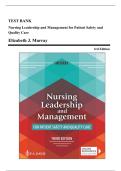
TEST BANK
Nursing Leadership and Management for Patient Safety and
Quality Care
Elizabeth J. Murray
3rd Edition
,Table of Contents
Chapter 01 Core Competencies for Safe and Quality Nursing Care 1
Chapter 02 Health-Care Environment and Health Policy 10
Chapter 03 Theories and Principles of Nursing Leadership and Management 19
Chapter 04 Ethical Aspects of Nursing Practice 28
Chapter 05 Legal Aspects of Nursing Practice 37
Chapter 06 Critical Thinking, Decision Making, Clinical Reasoning, and Clinical Judgment 46
Chapter 07 High-Reliability Health-Care Organizations 54
Chapter 08 Effective Communication 63
Chapter 09 Improving and Managing Safe and Quality Care 74
Chapter 10 Information Technology for Safe and Quality Patient Care 87
Chapter 11 Creating and Managing a Sustainable Workforce 95
Chapter 12 Creating and Sustaining a Healthy Work Environment 104
Chapter 13 Organizing Patient Care and Staffing for Patient Safety 111
Chapter 14 Delegating Effectively 119
Chapter 15 Leading Change and Managing Conflict 127
Chapter 16 Managing Finances 134
Chapter 17 Transitioning From Student to Professional Nurse and Beyond 142
,______________________________________________________________________________________________
Test Bank - Nursing Leadership and Management for Patient Safety and Quality Care, 3rd Edition (Murray, 2026)
Chapter 1: Core Competencies for Safe and Quality Nursing Care
MULTIPLE CHOICE
1. The nurse admits a patient to the nursing unit for treatment of pneumonia. Before completing
the nursing care plan, the nurse discusses the planned nursing interventions and requests the
patient’s input into the plan. This patient–nurse interaction represents the use of which Quality
and Safety Education for Nurses (QSEN) competency?
1. Apply quality improvement.
2. Use informatics.
3. Provide patient-centered care.
4. Employ evidence-based practice.
ANS: 3
Chapter number and title: 1, Core Competencies for Safe and Quality Nursing Care
Chapter learning outcome: Identify and describe fundamental elements for each core competency
for nursing.
Heading: Patient-Centered Care
Integrated Process: Nursing Process
Client Need: Safe and Effective Care Environment: Management of Care
Cognitive Level: Application [Applying]
Concept: Patient-Centered Care
Difficulty: Moderate
Feedback
1. Although patient involvement in care is integral to all QSEN competencies, involving
the patient in the development of the plan of care is part of the competency that centers
on patient care, not quality improvement. Quality improvement is designed to identify
errors and hazards in care.
2. Informatics is designed to ensure that information technology supports the work of
health-care professionals.
3. Active involvement of patients and their families in the plan of care is considered a
precursor to safe, effective, and quality care.
4. Evidence-based practice ensures that the nurse uses research to drive all nursing care.
2. According to the Institute of Medicine (IOM), which health profession has been directly
linked to patient safety?
1. Nurses
2. Physicians
3. Social workers
4. Physical therapists
ANS: 1
______________________________________________________________________________________________
1|Page
,______________________________________________________________________________________________
Test Bank - Nursing Leadership and Management for Patient Safety and Quality Care, 3rd Edition (Murray, 2026)
Chapter number and title: 1, Core Competencies for Safe and Quality Nursing Care
Chapter learning outcome: Describe the impact of the Institute of Medicine (IOM) reports on the
quality of health care in the United States.
Heading: Quality and Safety Education for Nurses Core Competencies
Integrated Process: Caring
Client Need: Safe and Effective Care Environment: Management of Care
Cognitive Level: Comprehension [Understanding]
Concept: Safety
Difficulty: Easy
Feedback
1. Although all health-care professionals have an obligation to provide safe and quality
care, nurses have been directly linked to ensuring patient safety and quality care
outcomes.
2. Although all health-care professionals have an obligation to provide safe and quality
care, nurses have been directly linked to ensuring patient safety and quality care
outcomes.
3. Although all health-care professionals have an obligation to provide safe and quality
care, nurses have been directly linked to ensuring patient safety and quality care
outcomes.
4. Although all health-care professionals have an obligation to provide safe and quality
care, nurses have been directly linked to ensuring patient safety and quality care
outcomes.
3. The nurse is caring for a patient who is currently hospitalized for the third time with diabetic
ketoacidosis. The nurse notes that the patient does not eat any food from the hospital tray and
will only eat food from fast-food restaurants that is brought in by family members. The nurse is
aware that this patient’s diet may be directly related to what major barrier to patient-centered
care?
1. Cultural competence
2. Health literacy
3. Self-management
4. Optimal healing environment
ANS: 2
Chapter number and title: 1, Core Competencies for Safe and Quality Nursing Care
Chapter learning outcome: Identify and describe fundamental elements for each core competency
for nursing.
Heading: Health Literacy
Integrated Process: Teaching/Learning
Client Need: Safe and Effective Care Environment: Management of Care
Cognitive Level: Application [Applying]
Concept: Health Promotion
______________________________________________________________________________________________
2|Page
,______________________________________________________________________________________________
Test Bank - Nursing Leadership and Management for Patient Safety and Quality Care, 3rd Edition (Murray, 2026)
Difficulty: Moderate
Feedback
1. Although cultural competence can influence a patient’s desire to participate in care, it is
more likely that this patient does not understand the basic tenets of diabetes
management.
2. The inability of patients and their families to read, understand, and/or act on health-care
information can lead to problems with accessing care, managing illness, and processing
information.
3. The patient in this scenario is unable to participate in self-management because they do
not understand the basic tenets of diabetes management.
4. There is no indication that the optimal healing environment is not present in this
scenario. The patient is lacking health literacy to understand their disease.
4. A nurse’s willingness to learn through the process of open, self-aware, and egoless
interactions with diverse patients and individuals describes the IOM patient-centered care skill of
1. cultural competence.
2. diversity.
3. cultural humility.
4. disparity.
ANS: 3
Chapter number and title: 1, Core Competencies for Safe and Quality Nursing Care
Chapter learning outcome: Define the IOM competencies.
Heading: Patient-Centered Care
Integrated Process: Culture and spirituality
Client Need: Psychosocial Integrity
Cognitive Level: Application [Applying]
Concept: Population Health
Difficulty: Moderate
Feedback
1. Cultural competence is an ability to work within a cultural context but does not include
a willingness to learn from patients.
2. Diversity is a term used to describe differences in groups, both patients and coworkers.
3. Cultural humility seeks to understand cultural, social, ethnic, and economic differences
through a lifelong process of self-reflection and self-critique.
4. Disparity is a term used for racial or ethnic differences in health-care quality.
5. What quality would the nurse manager strive to achieve in ensuring a culture of safety on the
maternal-child unit?
______________________________________________________________________________________________
3|Page
,______________________________________________________________________________________________
Test Bank - Nursing Leadership and Management for Patient Safety and Quality Care, 3rd Edition (Murray, 2026)
1. Fairness
2. Preoccupation with success
3. Transparency
4. Discouragement of interprofessional collaboration
ANS: 3
Chapter number and title: 1, Core Competencies for Safe and Quality Nursing Care
Chapter learning outcome: Discuss the importance of effective nursing leadership and
management in providing safe, effective, and quality person-/family-centered care.
Heading: Safety Culture
Integrated Process: Caring
Client Need: Safe and Effective Care Environment: Management of Care
Cognitive Level: Application [Applying]
Concept: Leadership and Management
Difficulty: Moderate
Feedback
1. Fairness is not an element of the culture of safety.
2. Preoccupation with success may delay a culture of safety because nurses may feel that
reporting errors will delay success.
3. Transparency is critical in a safety culture. Staff must feel comfortable reporting errors,
near misses, and potential for errors.
4. Interprofessional collaboration assists in a culture of safety because it involves working
with others to develop solutions to common errors or to prevent errors from occurring.
Discouraging this would not be a part of a culture of safety.
6. The 2003 IOM report Health Professions Education: A Bridge to Quality led to what
initiative?
1. Three domains of quality
2. Ten rules for the redesign of health-care delivery
3. Five quality and safety competencies
4. Six aims for health-care improvement
ANS: 3
Chapter number and title: 1, Core Competencies for Safe and Quality Nursing Care
Chapter learning outcome: Describe the impact of the Institute of Medicine (IOM) reports on the
quality of health care in the United States.
Heading: Institute of Medicine Reports
Integrated Process: Caring
Client Need: Safe and Effective Care Environment: Management of Care
Cognitive Level: Application [Applying]
Concept: Health-Care Systems
______________________________________________________________________________________________
4|Page
,______________________________________________________________________________________________
Test Bank - Nursing Leadership and Management for Patient Safety and Quality Care, 3rd Edition (Murray, 2026)
Difficulty: Moderate
Feedback
1. The three domains of quality were a result of the first IOM report, To Err Is Human:
Building a Safer Health System.
2. The ten rules for the redesign of health-care delivery were the result of the 2001 IOM
report Crossing the Quality Chasm: A New Health System for the 21st Century.
3. The 2003 IOM report that set forth five competencies for safety and quality resulted in
the five competencies of QSEN.
4. The six aims were a part of the 2001 IOM report Crossing the Quality Chasm: A New
Health System for the 21st Century.
7. The nurse is aware that which one of the six aims of the 2001 IOM report Crossing the Quality
Chasm: A New Health System for the 21st Century is also one of the health-care education
competencies found in the 2003 IOM report Health Professions Education: A Bridge to Quality?
1. Provide patient-centered care.
2. Work in interdisciplinary teams.
3. Use informatics.
4. Employ evidence-based practice.
ANS: 1
Chapter number and title: 1, Core Competencies for Safe and Quality Nursing Care
Chapter learning outcome: Describe the impact of the Institute of Medicine (IOM) reports on the
quality of health care in the United States.
Heading: Institute of Medicine Reports
Integrated Process: Caring
Client Need: Safe and Effective Care Environment: Management of Care
Cognitive Level: Application [Applying]
Concept: Health-Care Systems
Difficulty: Moderate
Feedback
1. “Provide patient-centered care” is a part of both the six aims of the 2001 IOM report
and the five competencies of health-care education in the 2003 IOM report.
2. “Work in interdisciplinary teams” is found only in the competencies of the 2003 IOM
report.
3. “Use informatics” is found only in the competencies of the 2003 IOM report.
4. “Employ evidence-based practice” is found only in the competencies of the 2003 IOM
report.
______________________________________________________________________________________________
5|Page
, ______________________________________________________________________________________________
Test Bank - Nursing Leadership and Management for Patient Safety and Quality Care, 3rd Edition (Murray, 2026)
8. What was the intention of the six aims found in the 2001 IOM report Crossing the Quality
Chasm: A New Health System for the 21st Century?
1. Reduction of the time patients wait to receive quality health care
2. Provision of health care based on the most recent scientific knowledge
3. Avoidance of waste of health-care dollars
4. Narrowing of the quality gap in health care
ANS: 4
Chapter number and title: 1, Core Competencies for Safe and Quality Nursing Care
Chapter learning outcome: Describe the impact of the Institute of Medicine (IOM) reports on the
quality of health care in the United States.
Heading: Institute of Medicine Reports
Integrated Process: Caring
Client Need: Safe and Effective Care Environment: Management of Care
Cognitive Level: Application [Applying]
Concept: Health-Care Systems
Difficulty: Moderate
Feedback
1. Reduction of wait time is one of the six aims of the IOM 2001 report, but it does not
describe the full intention of the report.
2. Health care based on scientific knowledge is one of the six aims of the IOM 2001
report, but it does not describe the full intention of the report.
3. Avoidance of waste is one of the six aims of the IOM 2001 report, but it does not
describe the full intention of the report.
4. Narrowing the quality gap in health care was the intention of the IOM 2001 report,
which sought to restructure the health-care system.
9. What competency did the QSEN project add to the competencies set forth by the IOM 2003
report Health Professions Education: A Bridge to Quality?
1. Informatics
2. Safety
3. Teamwork and Collaboration
4. Evidence-Based Practice
ANS: 2
Chapter number and title: 1, Core Competencies for Safe and Quality Nursing Care
Chapter learning outcome: Compare and contrast the IOM competencies and the Quality and
Safety Education for Nurses (QSEN) core competencies.
Heading: Quality and Safety Education for Nurses Core Competencies
Integrated Process: Caring
Client Need: Safe and Effective Care Environment: Management of Care
______________________________________________________________________________________________
6|Page
Nursing Leadership and Management for Patient Safety and
Quality Care
Elizabeth J. Murray
3rd Edition
,Table of Contents
Chapter 01 Core Competencies for Safe and Quality Nursing Care 1
Chapter 02 Health-Care Environment and Health Policy 10
Chapter 03 Theories and Principles of Nursing Leadership and Management 19
Chapter 04 Ethical Aspects of Nursing Practice 28
Chapter 05 Legal Aspects of Nursing Practice 37
Chapter 06 Critical Thinking, Decision Making, Clinical Reasoning, and Clinical Judgment 46
Chapter 07 High-Reliability Health-Care Organizations 54
Chapter 08 Effective Communication 63
Chapter 09 Improving and Managing Safe and Quality Care 74
Chapter 10 Information Technology for Safe and Quality Patient Care 87
Chapter 11 Creating and Managing a Sustainable Workforce 95
Chapter 12 Creating and Sustaining a Healthy Work Environment 104
Chapter 13 Organizing Patient Care and Staffing for Patient Safety 111
Chapter 14 Delegating Effectively 119
Chapter 15 Leading Change and Managing Conflict 127
Chapter 16 Managing Finances 134
Chapter 17 Transitioning From Student to Professional Nurse and Beyond 142
,______________________________________________________________________________________________
Test Bank - Nursing Leadership and Management for Patient Safety and Quality Care, 3rd Edition (Murray, 2026)
Chapter 1: Core Competencies for Safe and Quality Nursing Care
MULTIPLE CHOICE
1. The nurse admits a patient to the nursing unit for treatment of pneumonia. Before completing
the nursing care plan, the nurse discusses the planned nursing interventions and requests the
patient’s input into the plan. This patient–nurse interaction represents the use of which Quality
and Safety Education for Nurses (QSEN) competency?
1. Apply quality improvement.
2. Use informatics.
3. Provide patient-centered care.
4. Employ evidence-based practice.
ANS: 3
Chapter number and title: 1, Core Competencies for Safe and Quality Nursing Care
Chapter learning outcome: Identify and describe fundamental elements for each core competency
for nursing.
Heading: Patient-Centered Care
Integrated Process: Nursing Process
Client Need: Safe and Effective Care Environment: Management of Care
Cognitive Level: Application [Applying]
Concept: Patient-Centered Care
Difficulty: Moderate
Feedback
1. Although patient involvement in care is integral to all QSEN competencies, involving
the patient in the development of the plan of care is part of the competency that centers
on patient care, not quality improvement. Quality improvement is designed to identify
errors and hazards in care.
2. Informatics is designed to ensure that information technology supports the work of
health-care professionals.
3. Active involvement of patients and their families in the plan of care is considered a
precursor to safe, effective, and quality care.
4. Evidence-based practice ensures that the nurse uses research to drive all nursing care.
2. According to the Institute of Medicine (IOM), which health profession has been directly
linked to patient safety?
1. Nurses
2. Physicians
3. Social workers
4. Physical therapists
ANS: 1
______________________________________________________________________________________________
1|Page
,______________________________________________________________________________________________
Test Bank - Nursing Leadership and Management for Patient Safety and Quality Care, 3rd Edition (Murray, 2026)
Chapter number and title: 1, Core Competencies for Safe and Quality Nursing Care
Chapter learning outcome: Describe the impact of the Institute of Medicine (IOM) reports on the
quality of health care in the United States.
Heading: Quality and Safety Education for Nurses Core Competencies
Integrated Process: Caring
Client Need: Safe and Effective Care Environment: Management of Care
Cognitive Level: Comprehension [Understanding]
Concept: Safety
Difficulty: Easy
Feedback
1. Although all health-care professionals have an obligation to provide safe and quality
care, nurses have been directly linked to ensuring patient safety and quality care
outcomes.
2. Although all health-care professionals have an obligation to provide safe and quality
care, nurses have been directly linked to ensuring patient safety and quality care
outcomes.
3. Although all health-care professionals have an obligation to provide safe and quality
care, nurses have been directly linked to ensuring patient safety and quality care
outcomes.
4. Although all health-care professionals have an obligation to provide safe and quality
care, nurses have been directly linked to ensuring patient safety and quality care
outcomes.
3. The nurse is caring for a patient who is currently hospitalized for the third time with diabetic
ketoacidosis. The nurse notes that the patient does not eat any food from the hospital tray and
will only eat food from fast-food restaurants that is brought in by family members. The nurse is
aware that this patient’s diet may be directly related to what major barrier to patient-centered
care?
1. Cultural competence
2. Health literacy
3. Self-management
4. Optimal healing environment
ANS: 2
Chapter number and title: 1, Core Competencies for Safe and Quality Nursing Care
Chapter learning outcome: Identify and describe fundamental elements for each core competency
for nursing.
Heading: Health Literacy
Integrated Process: Teaching/Learning
Client Need: Safe and Effective Care Environment: Management of Care
Cognitive Level: Application [Applying]
Concept: Health Promotion
______________________________________________________________________________________________
2|Page
,______________________________________________________________________________________________
Test Bank - Nursing Leadership and Management for Patient Safety and Quality Care, 3rd Edition (Murray, 2026)
Difficulty: Moderate
Feedback
1. Although cultural competence can influence a patient’s desire to participate in care, it is
more likely that this patient does not understand the basic tenets of diabetes
management.
2. The inability of patients and their families to read, understand, and/or act on health-care
information can lead to problems with accessing care, managing illness, and processing
information.
3. The patient in this scenario is unable to participate in self-management because they do
not understand the basic tenets of diabetes management.
4. There is no indication that the optimal healing environment is not present in this
scenario. The patient is lacking health literacy to understand their disease.
4. A nurse’s willingness to learn through the process of open, self-aware, and egoless
interactions with diverse patients and individuals describes the IOM patient-centered care skill of
1. cultural competence.
2. diversity.
3. cultural humility.
4. disparity.
ANS: 3
Chapter number and title: 1, Core Competencies for Safe and Quality Nursing Care
Chapter learning outcome: Define the IOM competencies.
Heading: Patient-Centered Care
Integrated Process: Culture and spirituality
Client Need: Psychosocial Integrity
Cognitive Level: Application [Applying]
Concept: Population Health
Difficulty: Moderate
Feedback
1. Cultural competence is an ability to work within a cultural context but does not include
a willingness to learn from patients.
2. Diversity is a term used to describe differences in groups, both patients and coworkers.
3. Cultural humility seeks to understand cultural, social, ethnic, and economic differences
through a lifelong process of self-reflection and self-critique.
4. Disparity is a term used for racial or ethnic differences in health-care quality.
5. What quality would the nurse manager strive to achieve in ensuring a culture of safety on the
maternal-child unit?
______________________________________________________________________________________________
3|Page
,______________________________________________________________________________________________
Test Bank - Nursing Leadership and Management for Patient Safety and Quality Care, 3rd Edition (Murray, 2026)
1. Fairness
2. Preoccupation with success
3. Transparency
4. Discouragement of interprofessional collaboration
ANS: 3
Chapter number and title: 1, Core Competencies for Safe and Quality Nursing Care
Chapter learning outcome: Discuss the importance of effective nursing leadership and
management in providing safe, effective, and quality person-/family-centered care.
Heading: Safety Culture
Integrated Process: Caring
Client Need: Safe and Effective Care Environment: Management of Care
Cognitive Level: Application [Applying]
Concept: Leadership and Management
Difficulty: Moderate
Feedback
1. Fairness is not an element of the culture of safety.
2. Preoccupation with success may delay a culture of safety because nurses may feel that
reporting errors will delay success.
3. Transparency is critical in a safety culture. Staff must feel comfortable reporting errors,
near misses, and potential for errors.
4. Interprofessional collaboration assists in a culture of safety because it involves working
with others to develop solutions to common errors or to prevent errors from occurring.
Discouraging this would not be a part of a culture of safety.
6. The 2003 IOM report Health Professions Education: A Bridge to Quality led to what
initiative?
1. Three domains of quality
2. Ten rules for the redesign of health-care delivery
3. Five quality and safety competencies
4. Six aims for health-care improvement
ANS: 3
Chapter number and title: 1, Core Competencies for Safe and Quality Nursing Care
Chapter learning outcome: Describe the impact of the Institute of Medicine (IOM) reports on the
quality of health care in the United States.
Heading: Institute of Medicine Reports
Integrated Process: Caring
Client Need: Safe and Effective Care Environment: Management of Care
Cognitive Level: Application [Applying]
Concept: Health-Care Systems
______________________________________________________________________________________________
4|Page
,______________________________________________________________________________________________
Test Bank - Nursing Leadership and Management for Patient Safety and Quality Care, 3rd Edition (Murray, 2026)
Difficulty: Moderate
Feedback
1. The three domains of quality were a result of the first IOM report, To Err Is Human:
Building a Safer Health System.
2. The ten rules for the redesign of health-care delivery were the result of the 2001 IOM
report Crossing the Quality Chasm: A New Health System for the 21st Century.
3. The 2003 IOM report that set forth five competencies for safety and quality resulted in
the five competencies of QSEN.
4. The six aims were a part of the 2001 IOM report Crossing the Quality Chasm: A New
Health System for the 21st Century.
7. The nurse is aware that which one of the six aims of the 2001 IOM report Crossing the Quality
Chasm: A New Health System for the 21st Century is also one of the health-care education
competencies found in the 2003 IOM report Health Professions Education: A Bridge to Quality?
1. Provide patient-centered care.
2. Work in interdisciplinary teams.
3. Use informatics.
4. Employ evidence-based practice.
ANS: 1
Chapter number and title: 1, Core Competencies for Safe and Quality Nursing Care
Chapter learning outcome: Describe the impact of the Institute of Medicine (IOM) reports on the
quality of health care in the United States.
Heading: Institute of Medicine Reports
Integrated Process: Caring
Client Need: Safe and Effective Care Environment: Management of Care
Cognitive Level: Application [Applying]
Concept: Health-Care Systems
Difficulty: Moderate
Feedback
1. “Provide patient-centered care” is a part of both the six aims of the 2001 IOM report
and the five competencies of health-care education in the 2003 IOM report.
2. “Work in interdisciplinary teams” is found only in the competencies of the 2003 IOM
report.
3. “Use informatics” is found only in the competencies of the 2003 IOM report.
4. “Employ evidence-based practice” is found only in the competencies of the 2003 IOM
report.
______________________________________________________________________________________________
5|Page
, ______________________________________________________________________________________________
Test Bank - Nursing Leadership and Management for Patient Safety and Quality Care, 3rd Edition (Murray, 2026)
8. What was the intention of the six aims found in the 2001 IOM report Crossing the Quality
Chasm: A New Health System for the 21st Century?
1. Reduction of the time patients wait to receive quality health care
2. Provision of health care based on the most recent scientific knowledge
3. Avoidance of waste of health-care dollars
4. Narrowing of the quality gap in health care
ANS: 4
Chapter number and title: 1, Core Competencies for Safe and Quality Nursing Care
Chapter learning outcome: Describe the impact of the Institute of Medicine (IOM) reports on the
quality of health care in the United States.
Heading: Institute of Medicine Reports
Integrated Process: Caring
Client Need: Safe and Effective Care Environment: Management of Care
Cognitive Level: Application [Applying]
Concept: Health-Care Systems
Difficulty: Moderate
Feedback
1. Reduction of wait time is one of the six aims of the IOM 2001 report, but it does not
describe the full intention of the report.
2. Health care based on scientific knowledge is one of the six aims of the IOM 2001
report, but it does not describe the full intention of the report.
3. Avoidance of waste is one of the six aims of the IOM 2001 report, but it does not
describe the full intention of the report.
4. Narrowing the quality gap in health care was the intention of the IOM 2001 report,
which sought to restructure the health-care system.
9. What competency did the QSEN project add to the competencies set forth by the IOM 2003
report Health Professions Education: A Bridge to Quality?
1. Informatics
2. Safety
3. Teamwork and Collaboration
4. Evidence-Based Practice
ANS: 2
Chapter number and title: 1, Core Competencies for Safe and Quality Nursing Care
Chapter learning outcome: Compare and contrast the IOM competencies and the Quality and
Safety Education for Nurses (QSEN) core competencies.
Heading: Quality and Safety Education for Nurses Core Competencies
Integrated Process: Caring
Client Need: Safe and Effective Care Environment: Management of Care
______________________________________________________________________________________________
6|Page