Bio 253 Exam 1 – Questions With Fully Solved
Answers
Save
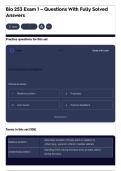
Practice questions for this set
Learn 1 /7 Study with Learn
chromosomes condense
Choose an answer
1 Relative position 2 Prophase
3 Ionic bond 4 Positive feedback
Don't know?
Terms in this set (108)
describes location of body parts in relation to
Relative position
others (e.g., superior, inferior, medial, lateral).
standing erect, facing forward, arms at sides, palms
Anatomical position
facing forward.
, include cranial, vertebral, thoracic, abdominal, and
Body cavities
pelvic cavities.
reverses a change (e.g., body temperature
Negative feedback
regulation).
increases a change (e.g., childbirth contractions,
Positive feedback
blood clotting).
Homeostasis maintaining a stable internal environment.
Planes/sections sagittal, frontal (coronal), and transverse.
Anatomy vs Physiology anatomy = structure, physiology = function.
right/left hypochondriac, epigastric, right/left
9 Regions of Abdomen
lumbar, umbilical, right/left iliac, hypogastric.
Structure of Atom protons (+), neutrons (0), electrons (−).
Ion atom with a charge (lost/gained electrons).
Cations and Anions Cations (+) and Anions (−).
Ionic bond between cation and anion (forms salts).
Covalent bond shares electrons; nonpolar = equal, polar = unequal.
weak attraction between H and O/N; holds DNA
Hydrogen bond
strands.
Chemical reactions reactants form products.
Synthesis build up.
Decomposition break down.
Acids & Bases pH <7 acid, >7 base; blood pH 7.35-7.45.
organic contains C/H (carbs, lipids, proteins, nucleic
Organic vs Inorganic
acids).
Carbs = glucose; Lipids = fatty acids; Proteins =
Macromolecules
amino acids; Nucleic acids = nucleotides.
DNA double stranded, stores code; RNA single
DNA vs RNA
stranded, makes proteins.
Ribosomes protein synthesis.
Rough ER makes proteins.
Answers
Save
Practice questions for this set
Learn 1 /7 Study with Learn
chromosomes condense
Choose an answer
1 Relative position 2 Prophase
3 Ionic bond 4 Positive feedback
Don't know?
Terms in this set (108)
describes location of body parts in relation to
Relative position
others (e.g., superior, inferior, medial, lateral).
standing erect, facing forward, arms at sides, palms
Anatomical position
facing forward.
, include cranial, vertebral, thoracic, abdominal, and
Body cavities
pelvic cavities.
reverses a change (e.g., body temperature
Negative feedback
regulation).
increases a change (e.g., childbirth contractions,
Positive feedback
blood clotting).
Homeostasis maintaining a stable internal environment.
Planes/sections sagittal, frontal (coronal), and transverse.
Anatomy vs Physiology anatomy = structure, physiology = function.
right/left hypochondriac, epigastric, right/left
9 Regions of Abdomen
lumbar, umbilical, right/left iliac, hypogastric.
Structure of Atom protons (+), neutrons (0), electrons (−).
Ion atom with a charge (lost/gained electrons).
Cations and Anions Cations (+) and Anions (−).
Ionic bond between cation and anion (forms salts).
Covalent bond shares electrons; nonpolar = equal, polar = unequal.
weak attraction between H and O/N; holds DNA
Hydrogen bond
strands.
Chemical reactions reactants form products.
Synthesis build up.
Decomposition break down.
Acids & Bases pH <7 acid, >7 base; blood pH 7.35-7.45.
organic contains C/H (carbs, lipids, proteins, nucleic
Organic vs Inorganic
acids).
Carbs = glucose; Lipids = fatty acids; Proteins =
Macromolecules
amino acids; Nucleic acids = nucleotides.
DNA double stranded, stores code; RNA single
DNA vs RNA
stranded, makes proteins.
Ribosomes protein synthesis.
Rough ER makes proteins.