HC13 Metabolic diversity IV -
Carbon-cycle, Methanogenesis,
Fermentations (BOOK)
Chapter 14.16, 14.17, 14.19, 14.20, 14.22 and 14.23
CH14 Metabolic Diversity of Microorganisms
14.16 Acetogenesis
Acetogens and methanogens use CO2 as electron acceptor for energy conservation.
Acetogens carry out the reaction:
4 H2 + H+ + 2 HCO3- —> CH3COO- + 4 H2O
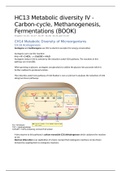
Acetogens reduce CO2 to acetate by the reductive acetyl-COA pathway. The reactions in this
pathway are reversible.
When growing on glucose, acetogens use glycolysis to oxidise the glucose into pyruvate which is
further oxidised to produced acetate.
The reductive acetyl-CoA pathway of CO2 fixation is not a cycle but it catalyses the reduction of CO2
along two linear pathways:
A key enzyme to this pathway is carbon monoxide (CO) dehydrogenase which catalyses the reaction
to CO.
Electron bifurcation is an application of a basic concept that endergonic reactions can be driven
forward by coupling them to exergonic reactions.
, 14.17 Methanogenesis
Methanogens also catalyse the process of methanogenesis which is the biological production of
methane. The reduction of CO2 by H2 to form methane is a major pathway of methanogenesis and if
a form of anaerobic respiration.
Methanogenesis from CO2 requires eight electrons, and these electrons are added two at a time this
leads to intermediary oxidation states of the carbon atom from +4 (CO2) to -4 (CH4).
There are several coenzymes involved:
- C1 carriers (carry the C1 unit)
o Methanofuran
o Methanopterin
o Coenzyme M
o Coenzyme F430
- Redox coenzymes (donate electrons)
o Coenzyme F420
o 7-mercaptoheptanoylthreonine
phosphate (B or CoB)
Methanogenesis from CO2 + H2
1. CO2 is activated and reduced
2. Formyl group is transferred and dehydrated
and reduced to methylene and methyl
3. Methyl group is transferred to CoM
4. Methyl-CoM is reduced to methane which is
reduced to CH4
Methanogenesis can also start from another C1 than
CO2, examples are methanol and acetate:
Carbon-cycle, Methanogenesis,
Fermentations (BOOK)
Chapter 14.16, 14.17, 14.19, 14.20, 14.22 and 14.23
CH14 Metabolic Diversity of Microorganisms
14.16 Acetogenesis
Acetogens and methanogens use CO2 as electron acceptor for energy conservation.
Acetogens carry out the reaction:
4 H2 + H+ + 2 HCO3- —> CH3COO- + 4 H2O
Acetogens reduce CO2 to acetate by the reductive acetyl-COA pathway. The reactions in this
pathway are reversible.
When growing on glucose, acetogens use glycolysis to oxidise the glucose into pyruvate which is
further oxidised to produced acetate.
The reductive acetyl-CoA pathway of CO2 fixation is not a cycle but it catalyses the reduction of CO2
along two linear pathways:
A key enzyme to this pathway is carbon monoxide (CO) dehydrogenase which catalyses the reaction
to CO.
Electron bifurcation is an application of a basic concept that endergonic reactions can be driven
forward by coupling them to exergonic reactions.
, 14.17 Methanogenesis
Methanogens also catalyse the process of methanogenesis which is the biological production of
methane. The reduction of CO2 by H2 to form methane is a major pathway of methanogenesis and if
a form of anaerobic respiration.
Methanogenesis from CO2 requires eight electrons, and these electrons are added two at a time this
leads to intermediary oxidation states of the carbon atom from +4 (CO2) to -4 (CH4).
There are several coenzymes involved:
- C1 carriers (carry the C1 unit)
o Methanofuran
o Methanopterin
o Coenzyme M
o Coenzyme F430
- Redox coenzymes (donate electrons)
o Coenzyme F420
o 7-mercaptoheptanoylthreonine
phosphate (B or CoB)
Methanogenesis from CO2 + H2
1. CO2 is activated and reduced
2. Formyl group is transferred and dehydrated
and reduced to methylene and methyl
3. Methyl group is transferred to CoM
4. Methyl-CoM is reduced to methane which is
reduced to CH4
Methanogenesis can also start from another C1 than
CO2, examples are methanol and acetate: