

116A WEEK 4 – Membrane Proteins and Transmembrane Transport
Learning Outcomes:
1. Describe the different functional classes of membrane protein
2. Describe how solutes are taken up or secreted across the
membrane by channels and transporters; you should be able to
compare and contrast the different mechanisms of these membrane
proteins
3. Describe the process of receptor-mediated endocytosis
Electrochemical gradients (video)
- Channels in the membrane are selective for different ions
- Regulated - means they open and close in response to cellular needs
- Activity combines with the action of primary active transporters and
the intrinsic charge on membrane lipids and proteins to generate
membrane potential
- Balance between solute conc gradient and electric charge gradient
(ions)
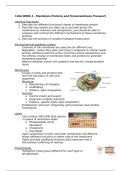
Membranes
- A layer of lipids and proteins that
form the boundary of cells and
organelles
- Structure:
o Maintaining cell integrity
o Scaffolding
o Proteins, lipid composition
- Function:
o Control import and export
o Organises complex reactions
o Proteins, specific lipids, lipid composition
- Endoplasmic reticulum, Golgi body and lysosomes have double
membranes
Lipids
- Cell contains 500-1000 lipid species
- 3 classes of membrane lipids
o Phospholipids (most
abundant)
o Cholesterol
o Glycolipids
- Lipid composition of inner and outer membranes are different –
allows different functions on either side of the membrane
- Lipids and lipid modifying enzymes play important role in
intracellular trafficking of vesicles
Phospholipids
- Hydrophilic head group (different for each type of
phospholipid)
, - Head group carries a charge a physiological pH
- Charged phosphate group
- Hydrophobic fatty acid tail
Cholesterol
- Steroid
- Hydroxyl head group
- Rigid carbon rings – doesn’t flex
- Hydrophobic tail
- Function: reduce membrane fluidity
Glycolipids
- Sugar (carbohydrate) head group
- Hydrophobic tail
The lipid bilayer
- Hydrophobic vs hydrophilic
- Charge/interactions
- Permeability to water soluble molecules
- Avoid confusion between bilayer and double
membrane
- Intra and extra cellular = aqueous
- Amphipathic - hydrophobic and hydrophilic regions
Fluid-mosaic model
Membrane synthesis
Membranes synthesised in SER
Soluble enzymes synthesise lipids and
inserts them into cytosol side of
membrane
Learning Outcomes:
1. Describe the different functional classes of membrane protein
2. Describe how solutes are taken up or secreted across the
membrane by channels and transporters; you should be able to
compare and contrast the different mechanisms of these membrane
proteins
3. Describe the process of receptor-mediated endocytosis
Electrochemical gradients (video)
- Channels in the membrane are selective for different ions
- Regulated - means they open and close in response to cellular needs
- Activity combines with the action of primary active transporters and
the intrinsic charge on membrane lipids and proteins to generate
membrane potential
- Balance between solute conc gradient and electric charge gradient
(ions)
Membranes
- A layer of lipids and proteins that
form the boundary of cells and
organelles
- Structure:
o Maintaining cell integrity
o Scaffolding
o Proteins, lipid composition
- Function:
o Control import and export
o Organises complex reactions
o Proteins, specific lipids, lipid composition
- Endoplasmic reticulum, Golgi body and lysosomes have double
membranes
Lipids
- Cell contains 500-1000 lipid species
- 3 classes of membrane lipids
o Phospholipids (most
abundant)
o Cholesterol
o Glycolipids
- Lipid composition of inner and outer membranes are different –
allows different functions on either side of the membrane
- Lipids and lipid modifying enzymes play important role in
intracellular trafficking of vesicles
Phospholipids
- Hydrophilic head group (different for each type of
phospholipid)
, - Head group carries a charge a physiological pH
- Charged phosphate group
- Hydrophobic fatty acid tail
Cholesterol
- Steroid
- Hydroxyl head group
- Rigid carbon rings – doesn’t flex
- Hydrophobic tail
- Function: reduce membrane fluidity
Glycolipids
- Sugar (carbohydrate) head group
- Hydrophobic tail
The lipid bilayer
- Hydrophobic vs hydrophilic
- Charge/interactions
- Permeability to water soluble molecules
- Avoid confusion between bilayer and double
membrane
- Intra and extra cellular = aqueous
- Amphipathic - hydrophobic and hydrophilic regions
Fluid-mosaic model
Membrane synthesis
Membranes synthesised in SER
Soluble enzymes synthesise lipids and
inserts them into cytosol side of
membrane


