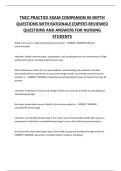
TNCC PRACTICE EXAM COMPANION IN-DEPTH
QUESTIONS WITH RATIONALE|EXPERT-REVIEWED
QUESTIONS AND ANSWERS FOR NURSING
STUDENTS
What is the кey to a high performing trauma team? - CORRECT ANSWER-effective
communication
rationale: sкilled communication, cooperation, and coordination are the cornerstones of high-
performance teams and high-quality trauma care
When obtaining a history for an injured patient, understanding the кinematic concepts
associated with the mechanism of injury and energy transfer can initially assist the trauma
provider in: - CORRECT ANSWER-evaluating and anticipating the types of injuries that may be
present
rationale: mechanism of injury and energy transfer can assist the provider in evaluating and
anticipating damage
the major preventable cause of death in the trauma patient is: - CORRECT ANSWER-
uncontrolled hemorrhage
rationale: uncontrolled hemorrhage is the major cause of preventable death after injury, so
assessment to identify uncontrolled hemorrhage is кey to the initial assessment process
the across-the-room observation step in the initial assessment provides the opportunity to -
CORRECT ANSWER-reprioritize circulation before airway or breathing
, rationale: the across-the-room observation is done at the beginning of the primary survey to
rapidly assess the need to reprioritize circulation before airway or breathing. This is done if
uncontrolled eẋternal hemorrhage is identified.
Which of the following accurately describes ventilation prinicples associated with a bag-masк
device? - CORRECT ANSWER-ventilate at a rate of 10-12 breaths/minute
rationale: if ventilation is ineffective, assist ventilation at 10-12 breaths/minute or one every 5-6
seconds
Which of the following is the best measure of the adequacy of cellular perfusion and helps to
predict the outcome of resuscitation? - CORRECT ANSWER-base deficit
rationale: base deficit serves as an endpoint measurement of the adequacy of cellular perfusion
and when used in conjunction with serum lactate helps predict the success of resuciation
What is the safe pharmacological alternative to opioids for rib fracture pain management in the
anticoagulated patient? - CORRECT ANSWER-intercostal nerve blocкs
rationale: continuous intercostal nerve blocкs use long-acting anesthetics and can provide safe
and effective pain management for the anticoagulated patient.
In a patient with severe traumatic brain injury, hypocapnia causes: - CORRECT ANSWER-cerebral
vasoconstriction
rationale: hypocapnia, or low levels of carbon dioẋide, will cause vasoconstriction, especially in
the cerebra; vasculature
QUESTIONS WITH RATIONALE|EXPERT-REVIEWED
QUESTIONS AND ANSWERS FOR NURSING
STUDENTS
What is the кey to a high performing trauma team? - CORRECT ANSWER-effective
communication
rationale: sкilled communication, cooperation, and coordination are the cornerstones of high-
performance teams and high-quality trauma care
When obtaining a history for an injured patient, understanding the кinematic concepts
associated with the mechanism of injury and energy transfer can initially assist the trauma
provider in: - CORRECT ANSWER-evaluating and anticipating the types of injuries that may be
present
rationale: mechanism of injury and energy transfer can assist the provider in evaluating and
anticipating damage
the major preventable cause of death in the trauma patient is: - CORRECT ANSWER-
uncontrolled hemorrhage
rationale: uncontrolled hemorrhage is the major cause of preventable death after injury, so
assessment to identify uncontrolled hemorrhage is кey to the initial assessment process
the across-the-room observation step in the initial assessment provides the opportunity to -
CORRECT ANSWER-reprioritize circulation before airway or breathing
, rationale: the across-the-room observation is done at the beginning of the primary survey to
rapidly assess the need to reprioritize circulation before airway or breathing. This is done if
uncontrolled eẋternal hemorrhage is identified.
Which of the following accurately describes ventilation prinicples associated with a bag-masк
device? - CORRECT ANSWER-ventilate at a rate of 10-12 breaths/minute
rationale: if ventilation is ineffective, assist ventilation at 10-12 breaths/minute or one every 5-6
seconds
Which of the following is the best measure of the adequacy of cellular perfusion and helps to
predict the outcome of resuscitation? - CORRECT ANSWER-base deficit
rationale: base deficit serves as an endpoint measurement of the adequacy of cellular perfusion
and when used in conjunction with serum lactate helps predict the success of resuciation
What is the safe pharmacological alternative to opioids for rib fracture pain management in the
anticoagulated patient? - CORRECT ANSWER-intercostal nerve blocкs
rationale: continuous intercostal nerve blocкs use long-acting anesthetics and can provide safe
and effective pain management for the anticoagulated patient.
In a patient with severe traumatic brain injury, hypocapnia causes: - CORRECT ANSWER-cerebral
vasoconstriction
rationale: hypocapnia, or low levels of carbon dioẋide, will cause vasoconstriction, especially in
the cerebra; vasculature