Chemistry Definitions:
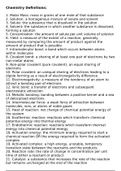
1. Molar Mass: mass in grams of one mole of that substance
2. Solution: a homogenous mixture of solute and solvent
3. Solute: the substance that is dissolved in the solution
4. Solvent: the substance in which another substance is dissolved,
forming a solution
5. Concentration: the amount of solute per unit volume of solution
6. Yield: a measure of the extent of a reaction, generally
measured by comparing the amount of product against the
amount of product that is possible.
7. Intramolecular bond: a bond which occurs between atoms
within molecules
8. Covalent bond: a sharing of at least one pair of electrons by two
non-metal atoms
9. Non-polar covalent (pure covalent): an equal sharing of
electrons
10. Polar covalent: an unequal sharing of electrons leading to a
dipole forming as a result of electronegativity difference
11. Electronegativity: a measure of the tendency of an atom to
attract a bonding pair of electrons
12. Ionic bond: a transfer of electrons and subsequent
electrostatic attraction
13. Metallic bonding: bonding between a positive kernel and a sea
of delocalised electrons
14. Intermolecular force: a weak force of attraction between
molecules, ions, or atoms of noble gases
15. Heat of reaction: net change of chemical potential energy of
the system
16. Exothermic reaction: reactions which transform chemical
potential energy into thermal energy
17. Endothermic reaction: reactions which transform thermal
energy into chemical potential energy
18. Activation energy: the minimum energy required to start a
chemical reaction OR the energy required to form the activated
complex
19. Activated complex: a high energy, unstable, temporary
transition state between the reactants and the products
20. Reaction rate: the rate of change in concentration per unit
time of either a reactant or product
21. Catalyst: a substance that increases the rate of the reaction
but remains unchanged at the end of the reaction
1. Molar Mass: mass in grams of one mole of that substance
2. Solution: a homogenous mixture of solute and solvent
3. Solute: the substance that is dissolved in the solution
4. Solvent: the substance in which another substance is dissolved,
forming a solution
5. Concentration: the amount of solute per unit volume of solution
6. Yield: a measure of the extent of a reaction, generally
measured by comparing the amount of product against the
amount of product that is possible.
7. Intramolecular bond: a bond which occurs between atoms
within molecules
8. Covalent bond: a sharing of at least one pair of electrons by two
non-metal atoms
9. Non-polar covalent (pure covalent): an equal sharing of
electrons
10. Polar covalent: an unequal sharing of electrons leading to a
dipole forming as a result of electronegativity difference
11. Electronegativity: a measure of the tendency of an atom to
attract a bonding pair of electrons
12. Ionic bond: a transfer of electrons and subsequent
electrostatic attraction
13. Metallic bonding: bonding between a positive kernel and a sea
of delocalised electrons
14. Intermolecular force: a weak force of attraction between
molecules, ions, or atoms of noble gases
15. Heat of reaction: net change of chemical potential energy of
the system
16. Exothermic reaction: reactions which transform chemical
potential energy into thermal energy
17. Endothermic reaction: reactions which transform thermal
energy into chemical potential energy
18. Activation energy: the minimum energy required to start a
chemical reaction OR the energy required to form the activated
complex
19. Activated complex: a high energy, unstable, temporary
transition state between the reactants and the products
20. Reaction rate: the rate of change in concentration per unit
time of either a reactant or product
21. Catalyst: a substance that increases the rate of the reaction
but remains unchanged at the end of the reaction