
Mid-latitude cyclones
General characteristics:
➔ Cells of low pressure
➔ Develops in mid-latitudes + travels from west to east
➔ Bring cold, cloudy, windy, wet weather
❖ General characteristics caused by the pressure and wind patterns of
MLC + air masses involved
Effects of pressure and wind pattern on mid-latitude cyclones:
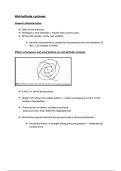
➔ A MLC ia cell of low pressure
➔ [Figure 2.4] shows the isobar pattern + winds converging in a MLC in the
southern hemisphere
➔ Pressure low at centre, increases outwards
(pressure lower than 1000 hPa regarded low)
➔ Wind blows around and into low pressure cell in clockwise direction
❖ Winds don't blow in straight along pressure gradient → deflected by
coriolis force
,[Figure 2.5] shows the pressure pattern and winds for a cyclone in the northern
hemisphere. Winds still converge into low pressure cell, but anticlockwise because of
coriolis force
Converging - coming together
Families - group of mid-latitude cyclones (expect more than a week of cold weather)
Deflect - turn away or to cause something to turn away
Coriolis force - force causing deflection of moving objects due to rotation of earth on
its axis; greatest at poles, least at equator
Mid-latitude cyclone - low pressure cell that develops in mid-latitudes and travels west
to east
The effect of air masses on mid-latitude cyclones
➔ Develop in ‘mid latitudes’ (between 30° and 60° north and south of equator).
Where the cold polar air mass meets warm subtropical airmass → zone called
polar front
When these air masses meet:
→ warm subtropical air rises + cold polar air wedges underneath
→ as it rises, warm air cools + condensation of water vapour occurs
→ produces clouds and rain (main weather characteristics of mid-latitude cyclone)
➔ MLC cover large area as they are between 1500 and 3000 km in diameter
➔ They can move 1200 km in a day
, ➔ Weather brought by MLC lasts about 5 days, if several MLC follow one
another → cold, wet weather continue for weeks
World distribution of mid-latitude cyclones:
➔ Develop in ‘mid latitudes’ between 30° and 60° north and south of equator →
zone called polar front
➔ MLC move west to east in northern and southern hemispheres
➔ Occur mainly over oceans + coastal areas; don't spread across large areas of
land (eg: Canada and Asia)
➔ Affect regions between 30° and 60° north and south of equator
Depressions - another name for mid-latitude cyclones
Mid-latitude cyclones in South Africa:
➔ Develop 30°S - 60°S, at polar front
❖ Southern tip of SA is 37°S, so cold fronts only reach SA in winter when all
pressure belts and wind systems move slightly north → why southwestern
cape receives winter rainfall; rain brought by cold fronts passing across
region from west to east
Pressure belts - bands of high or low pressure that surround earth at certain latitudes
(ex: equatorial low-pressure belt at equator)
, Conditions necessary for the formation of mid-latitude cyclones:
At latitude of 50°S, only a short distance separates the warm tropical air mass from the
cold polar mass → transition zone called polar front
Front - zone where two air masses of different temperatures meet
Polar front is where the warm, moist air of mid-latitude cell meets cold air of polar cell
→ Warmer air gets pushed up the polar front; colder air wedges underneath
→ Pressure difference exists between warm tropical air and cold polar air = pressure
gradient
→ Westerly winds and polar easterlies blow along these pressure gradients towards
polar front
General characteristics:
➔ Cells of low pressure
➔ Develops in mid-latitudes + travels from west to east
➔ Bring cold, cloudy, windy, wet weather
❖ General characteristics caused by the pressure and wind patterns of
MLC + air masses involved
Effects of pressure and wind pattern on mid-latitude cyclones:
➔ A MLC ia cell of low pressure
➔ [Figure 2.4] shows the isobar pattern + winds converging in a MLC in the
southern hemisphere
➔ Pressure low at centre, increases outwards
(pressure lower than 1000 hPa regarded low)
➔ Wind blows around and into low pressure cell in clockwise direction
❖ Winds don't blow in straight along pressure gradient → deflected by
coriolis force
,[Figure 2.5] shows the pressure pattern and winds for a cyclone in the northern
hemisphere. Winds still converge into low pressure cell, but anticlockwise because of
coriolis force
Converging - coming together
Families - group of mid-latitude cyclones (expect more than a week of cold weather)
Deflect - turn away or to cause something to turn away
Coriolis force - force causing deflection of moving objects due to rotation of earth on
its axis; greatest at poles, least at equator
Mid-latitude cyclone - low pressure cell that develops in mid-latitudes and travels west
to east
The effect of air masses on mid-latitude cyclones
➔ Develop in ‘mid latitudes’ (between 30° and 60° north and south of equator).
Where the cold polar air mass meets warm subtropical airmass → zone called
polar front
When these air masses meet:
→ warm subtropical air rises + cold polar air wedges underneath
→ as it rises, warm air cools + condensation of water vapour occurs
→ produces clouds and rain (main weather characteristics of mid-latitude cyclone)
➔ MLC cover large area as they are between 1500 and 3000 km in diameter
➔ They can move 1200 km in a day
, ➔ Weather brought by MLC lasts about 5 days, if several MLC follow one
another → cold, wet weather continue for weeks
World distribution of mid-latitude cyclones:
➔ Develop in ‘mid latitudes’ between 30° and 60° north and south of equator →
zone called polar front
➔ MLC move west to east in northern and southern hemispheres
➔ Occur mainly over oceans + coastal areas; don't spread across large areas of
land (eg: Canada and Asia)
➔ Affect regions between 30° and 60° north and south of equator
Depressions - another name for mid-latitude cyclones
Mid-latitude cyclones in South Africa:
➔ Develop 30°S - 60°S, at polar front
❖ Southern tip of SA is 37°S, so cold fronts only reach SA in winter when all
pressure belts and wind systems move slightly north → why southwestern
cape receives winter rainfall; rain brought by cold fronts passing across
region from west to east
Pressure belts - bands of high or low pressure that surround earth at certain latitudes
(ex: equatorial low-pressure belt at equator)
, Conditions necessary for the formation of mid-latitude cyclones:
At latitude of 50°S, only a short distance separates the warm tropical air mass from the
cold polar mass → transition zone called polar front
Front - zone where two air masses of different temperatures meet
Polar front is where the warm, moist air of mid-latitude cell meets cold air of polar cell
→ Warmer air gets pushed up the polar front; colder air wedges underneath
→ Pressure difference exists between warm tropical air and cold polar air = pressure
gradient
→ Westerly winds and polar easterlies blow along these pressure gradients towards
polar front


