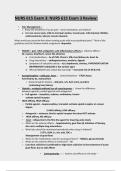
NURS 615 Exam 3: NURS 615 Exam 3 Review:
• Pain Management –
• o Know the treatment of acute pain – what medications are firstline?
o For non-cancer pain, mild-to-mod pain (aches, muscle pain, mild injuries): NSAIDs,
anticonvulsants, tylenol, muscle relaxants
What would you prescribe first when treating acute mild musculoskeletal pain? Think of the
guidelines and the Shadow Health assignment: ibuprofen
• NSAIDS – pain relief, antipyretic, anti-inflammatory effects o Adverse effects –
GI: nausea, heartburn, minor HA, dizziness
o Contraindications – hx of PUD, Chron’s, GIB, liver/kidney dx, heart dx
o Drug interactions – antihypertensives, warfarin, digoxin
o Symptoms of salicylate toxicity – n/v, diaphoresis, tinnitus, HYPERVENTILATION
(RESPIRATORY ALKALOSIS is the earliest sign)
o Why do NSAIDS have a black box warning? – increased risk of MI & CVA
• Acetaminophen – mild pain, fever o Contraindications – ETOH abuse,
liver/kidney dx, malnutrition
o Acetaminophen toxicity – abd pain, n/v, dark urine, jaundice
(indicating liver failure)
• Opioids – analgesia without loss of consciousness o Know the difference
between agonists, partial agonists and antagonists
o Full agonist – morphine, codeine, methadone, heroin:
activate opioid receptor
• HIGH affinity, HIGH efficacy
o Partial agonist – buprenorphine, tramadol: activate opioid receptor at a lesser
degree
HIGH affinity, LOW efficacy
o Antagonist – naloxone: bind to opioid receptor but does NOT activate
• HIGH affinity, NO efficacy
• Gout – Allopurinol is the first-line agent for lowering urate levels
o What are the adverse effects – hepatotoxicity, gout flare @ initiation of therapy,
skin rash, multiple drug interactions
o What labs should be monitored periodically when drug is initiated?
LFTs, BUN, Cr, uric acid, CBC o
Management of gout flares
o What are the medications used for acute gout flares? – NSAIDs, glucocorticoids
o What are the adverse effects of colchicine? – GI
o Low-dose colchicine is preferable to high-dose colchicine in the treatment of acute
gout flares due to side effects
• Corticosteroids – o Actions and effects on the body –
, o Decrease peripheral uptake of glucose; glucogenesis in
liver o Decrease protein synthesis in muscles, lymph
tissue, skin & bone
o Lipolysis in adipose tissue in extremities; lipogenesis in
face
& trunk o Decrease circulating eosinophils, lymphocytes, monocytes,
increase PMNs
o Decrease leukocytes at inflammation sites
o Decrease in lymphoid tissues; inhibit IL-1 & IL-2
production o Blocks generator for fever o Promotes
gastric acid secretion; enhances urinary excretion o
Decrease proliferation of fibroblasts in connective tissue;
delayed healing
o Maintains normal contractility of skeletal & heart muscle
o Increases osteoclastic activity; decreases osteoblastic
activity
o Maintains normal BP, increase response of arterioles to
norepinephrine
o Modulates emotional & perpetual function; essential for
normal arousal
o Principles of therapy –
Risk to benefit ratio
Short term for self-limiting, acute conditions
Long term used for life-threatening conditions or
severe disabling symptoms
Use local over systemic
o Know why it is important to taper the dose rather than
abruptly stopping when a patient has been taking
corticosteroids for an extended period of time
• HPA-axis suppression
• Can cause malaise, myalgia, nausea, HA, low grade fever, relapse
of symptoms, & hypotension
• Can cause acute adrenocortical insufficiency
o Adverse drug reactions – osteoporosis, poor wound healing, PUD/GI upset,
hyperglycemia, increased risk of infection, cataracts, mood changes/depression,
insomnia, thinning of skin
• Diabetes Medications – o Biguanides – Metformin: This is the
first-line medication in the treatment of type 2 DM
• It improves insulin sensitivity and physiological factors related to
metabolic syndrome
• Actions – Decrease glucose production in liver, decreases GI
glucose absorption, improves insulin sensitivity by increasing
peripheral glucose uptake & utilization, inhibits platelet
aggregation and reduces blood viscosity
• Adverse effects – mainly GI: take with food, titrate slowly
• Black Box Warning for lactic acidosis – Rare, but more likely in the
setting of renal dysfunction, dehydration & elderly
• Pain Management –
• o Know the treatment of acute pain – what medications are firstline?
o For non-cancer pain, mild-to-mod pain (aches, muscle pain, mild injuries): NSAIDs,
anticonvulsants, tylenol, muscle relaxants
What would you prescribe first when treating acute mild musculoskeletal pain? Think of the
guidelines and the Shadow Health assignment: ibuprofen
• NSAIDS – pain relief, antipyretic, anti-inflammatory effects o Adverse effects –
GI: nausea, heartburn, minor HA, dizziness
o Contraindications – hx of PUD, Chron’s, GIB, liver/kidney dx, heart dx
o Drug interactions – antihypertensives, warfarin, digoxin
o Symptoms of salicylate toxicity – n/v, diaphoresis, tinnitus, HYPERVENTILATION
(RESPIRATORY ALKALOSIS is the earliest sign)
o Why do NSAIDS have a black box warning? – increased risk of MI & CVA
• Acetaminophen – mild pain, fever o Contraindications – ETOH abuse,
liver/kidney dx, malnutrition
o Acetaminophen toxicity – abd pain, n/v, dark urine, jaundice
(indicating liver failure)
• Opioids – analgesia without loss of consciousness o Know the difference
between agonists, partial agonists and antagonists
o Full agonist – morphine, codeine, methadone, heroin:
activate opioid receptor
• HIGH affinity, HIGH efficacy
o Partial agonist – buprenorphine, tramadol: activate opioid receptor at a lesser
degree
HIGH affinity, LOW efficacy
o Antagonist – naloxone: bind to opioid receptor but does NOT activate
• HIGH affinity, NO efficacy
• Gout – Allopurinol is the first-line agent for lowering urate levels
o What are the adverse effects – hepatotoxicity, gout flare @ initiation of therapy,
skin rash, multiple drug interactions
o What labs should be monitored periodically when drug is initiated?
LFTs, BUN, Cr, uric acid, CBC o
Management of gout flares
o What are the medications used for acute gout flares? – NSAIDs, glucocorticoids
o What are the adverse effects of colchicine? – GI
o Low-dose colchicine is preferable to high-dose colchicine in the treatment of acute
gout flares due to side effects
• Corticosteroids – o Actions and effects on the body –
, o Decrease peripheral uptake of glucose; glucogenesis in
liver o Decrease protein synthesis in muscles, lymph
tissue, skin & bone
o Lipolysis in adipose tissue in extremities; lipogenesis in
face
& trunk o Decrease circulating eosinophils, lymphocytes, monocytes,
increase PMNs
o Decrease leukocytes at inflammation sites
o Decrease in lymphoid tissues; inhibit IL-1 & IL-2
production o Blocks generator for fever o Promotes
gastric acid secretion; enhances urinary excretion o
Decrease proliferation of fibroblasts in connective tissue;
delayed healing
o Maintains normal contractility of skeletal & heart muscle
o Increases osteoclastic activity; decreases osteoblastic
activity
o Maintains normal BP, increase response of arterioles to
norepinephrine
o Modulates emotional & perpetual function; essential for
normal arousal
o Principles of therapy –
Risk to benefit ratio
Short term for self-limiting, acute conditions
Long term used for life-threatening conditions or
severe disabling symptoms
Use local over systemic
o Know why it is important to taper the dose rather than
abruptly stopping when a patient has been taking
corticosteroids for an extended period of time
• HPA-axis suppression
• Can cause malaise, myalgia, nausea, HA, low grade fever, relapse
of symptoms, & hypotension
• Can cause acute adrenocortical insufficiency
o Adverse drug reactions – osteoporosis, poor wound healing, PUD/GI upset,
hyperglycemia, increased risk of infection, cataracts, mood changes/depression,
insomnia, thinning of skin
• Diabetes Medications – o Biguanides – Metformin: This is the
first-line medication in the treatment of type 2 DM
• It improves insulin sensitivity and physiological factors related to
metabolic syndrome
• Actions – Decrease glucose production in liver, decreases GI
glucose absorption, improves insulin sensitivity by increasing
peripheral glucose uptake & utilization, inhibits platelet
aggregation and reduces blood viscosity
• Adverse effects – mainly GI: take with food, titrate slowly
• Black Box Warning for lactic acidosis – Rare, but more likely in the
setting of renal dysfunction, dehydration & elderly