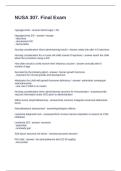
NUSA 307. Final Exam
Hypoglycemia - answer blood sugar < 60
Hypoglycemia S/S - answer- hunger
- dizziness
- decreased LOC
- tachycardia
Nursing consideration when administering insulin - answer rotate site after 4-6 injections
Nursing consideration for a 4 year-old child scared of injections - answer teach the child
about the procedure using a doll
How often should a child receive their influenza vaccine - answer annually after 6
months of age
Secreted by the pituitary gland - answer- human growth hormone
- important for normal growth and development
Medication for child with growth hormone deficiency - answer- administer somatropin
subcutaneously
- use care if child is on insulin
Nursing consideration when administering vaccines for immunization - answerprovide
vaccine information sheet (VIS) prior to administration
Wilms tumor (nephroblastoma) - answermost common malignant renal and abdominal
tumor
Neuroblastoma assessment - answerhypo/hyper reflexia
Leukemia diagnostic test - answerperform a bone marrow aspiration to assess for CNS
infiltration
Leukemia S/S - answer- anorexia
- petechiae
- unsteady gait
Soft tissue sarcoma risk factor - answercaucasian descent
PKU diet - answer- low phenylalanine diet (20-30 mg/kg)
- low protein
, - low dairy
Necrotizing Enterocolitis (NEC) - answer- an inflammatory disease of the GI mucosa
caused by ischemia
- ischemia results in the death of mucosal cells which leads to necrotic patches that
interfere with digestion
Necrotizing Enterocolitis (NEC) risk factor - answerprematurity
Respiratory Distress Syndrome (RDS) assessment - answer- tachypnea
- nasal flaring
- grunting
- retractions
- crackles
Pathologic hyperbilirubinemia - answerhemolytic disease of the newborn (HDN)
Pathologic hyperbilirubinemia considerations - answer- results from an underlying
disease
- appears before 24 hours of life
- unconjugated bilirubin exceeds 5 mg/dL
- usually caused by blood group incompatibility or isoimmunization
Newborn sepsis risk factor - answerinvasive procedures
Pediatric CPR - answer- deliver compression at 1/3 the depth of the chest
- is approximately 1.5 inches
SIDS parent education - answereducate about having the infant sleep on their back
Pediatric psychosocial nursing consideration - answerestablish a reward system for
good behavior
Airborne and droplet infections can be prevented with - answerimmunization from
vaccines
Epstein-Barr virus (mononucleosis) incubation period - answer30-50 days
Erythema Infectiosum (Fifth Disease) S/S - answer- rash on face (slapped cheek)
- secondary itchy rash can also appear on the rest of the body and soles of feet
Erythema Infectiosum (Fifth Disease) spreads via - answer- droplet
- blood
Mumps and pertussis spreads via - answer- direct contact
- droplet
Hypoglycemia - answer blood sugar < 60
Hypoglycemia S/S - answer- hunger
- dizziness
- decreased LOC
- tachycardia
Nursing consideration when administering insulin - answer rotate site after 4-6 injections
Nursing consideration for a 4 year-old child scared of injections - answer teach the child
about the procedure using a doll
How often should a child receive their influenza vaccine - answer annually after 6
months of age
Secreted by the pituitary gland - answer- human growth hormone
- important for normal growth and development
Medication for child with growth hormone deficiency - answer- administer somatropin
subcutaneously
- use care if child is on insulin
Nursing consideration when administering vaccines for immunization - answerprovide
vaccine information sheet (VIS) prior to administration
Wilms tumor (nephroblastoma) - answermost common malignant renal and abdominal
tumor
Neuroblastoma assessment - answerhypo/hyper reflexia
Leukemia diagnostic test - answerperform a bone marrow aspiration to assess for CNS
infiltration
Leukemia S/S - answer- anorexia
- petechiae
- unsteady gait
Soft tissue sarcoma risk factor - answercaucasian descent
PKU diet - answer- low phenylalanine diet (20-30 mg/kg)
- low protein
, - low dairy
Necrotizing Enterocolitis (NEC) - answer- an inflammatory disease of the GI mucosa
caused by ischemia
- ischemia results in the death of mucosal cells which leads to necrotic patches that
interfere with digestion
Necrotizing Enterocolitis (NEC) risk factor - answerprematurity
Respiratory Distress Syndrome (RDS) assessment - answer- tachypnea
- nasal flaring
- grunting
- retractions
- crackles
Pathologic hyperbilirubinemia - answerhemolytic disease of the newborn (HDN)
Pathologic hyperbilirubinemia considerations - answer- results from an underlying
disease
- appears before 24 hours of life
- unconjugated bilirubin exceeds 5 mg/dL
- usually caused by blood group incompatibility or isoimmunization
Newborn sepsis risk factor - answerinvasive procedures
Pediatric CPR - answer- deliver compression at 1/3 the depth of the chest
- is approximately 1.5 inches
SIDS parent education - answereducate about having the infant sleep on their back
Pediatric psychosocial nursing consideration - answerestablish a reward system for
good behavior
Airborne and droplet infections can be prevented with - answerimmunization from
vaccines
Epstein-Barr virus (mononucleosis) incubation period - answer30-50 days
Erythema Infectiosum (Fifth Disease) S/S - answer- rash on face (slapped cheek)
- secondary itchy rash can also appear on the rest of the body and soles of feet
Erythema Infectiosum (Fifth Disease) spreads via - answer- droplet
- blood
Mumps and pertussis spreads via - answer- direct contact
- droplet