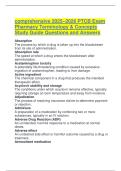
comprehensive 2025–2026 PTCB Exam
Pharmacy Terminology & Concepts
Study Guide Questions and Answers
Absorption
The process by which a drug is taken up into the bloodstream
from its site of administration.
Absorption rate
The speed at which a drug enters the bloodstream after
administration.
Acetaminophen toxicity
A potentially life-threatening condition caused by excessive
ingestion of acetaminophen, leading to liver damage.
Active ingredient
The chemical component in a drug that produces the intended
therapeutic effect.
Acyclovir stability and storage
The conditions under which acyclovir remains effective, typically
requiring storage at room temperature and away from moisture.
Adjudication
The process of resolving insurance claims to determine payment
or rejection.
Admixture
A preparation of a medication by combining two or more
substances, typically in an IV solution.
Adverse Drug Reaction (ADR)
An unintended, harmful response to a medication at normal
doses.
Adverse effect
An undesired side effect or harmful outcome caused by a drug or
treatment.
Aerosolized medication
,A drug delivered in a fine mist, typically via inhalation, for
respiratory conditions.
Aerosolized medication precautions
Safety measures taken to prevent exposure to unintended
individuals during aerosolized drug administration.
Aggregate inventory
The total amount of stock or medication available in a pharmacy
or facility.
Alkalosis
A condition characterized by an excessively high pH in the body
due to reduced hydrogen ion concentration.
Alligation
A mathematical method used to calculate the proportions of two
solutions with different concentrations to achieve a desired
concentration.
Ampule
A sealed glass container holding a single dose of a sterile liquid
medication.
Anabolic steroid
A synthetic drug that mimics testosterone to promote muscle
growth and enhance physical performance.
Anaphylaxis
A severe, potentially life-threatening allergic reaction requiring
immediate medical attention.
Antacid-drug interactions
The effect of antacids on the absorption or activity of other drugs,
often reducing efficacy.
Antagonist
A substance that blocks or reduces the effect of a receptor or
another drug.
Antibiotic
A medication used to treat bacterial infections by killing or
inhibiting bacterial growth.
Anticoagulant
A drug that prevents blood clots by inhibiting clotting factors.
,Antidepressant withdrawal syndrome
A collection of symptoms that occur when stopping or reducing
antidepressant medications abruptly.
Antiemetic
A drug used to prevent or treat nausea and vomiting.
Antihistamine
A medication that blocks histamine receptors to relieve allergic
reactions or cold symptoms.
Antipsychotic depot injections
Long-acting antipsychotic medications administered via
intramuscular injection for sustained release.
Antipyretic
A drug that reduces fever.
Aseptic processing
A sterile preparation method to prevent contamination of
medications during manufacturing or compounding.
Aseptic technique
A set of procedures to maintain sterility and prevent
contamination during medication preparation.
Automated dispensing system
A computerized system that stores and dispenses medications to
improve accuracy and efficiency.
Automated inventory system
A computerized system that tracks and manages pharmacy
inventory levels in real time.
Automatic stop orders in hospitals
A policy requiring discontinuation of certain medications after a
specific period unless renewed by a physician to prevent
prolonged or unnecessary drug use.
Auxiliary label
A small, color-coded label placed on a prescription container to
provide additional instructions or warnings about the medication.
Bactericidal agent
A substance that kills bacteria by disrupting their cell walls or vital
functions.
, Bacteriostatic agent
A drug that inhibits bacterial growth and reproduction, allowing the
immune system to eliminate the infection.
Barcoding in medication safety
A system that uses barcodes on medications to ensure accurate
dispensing, administration, and tracking, reducing errors in
healthcare settings.
Beta-blocker contraindications
Conditions where beta-blockers should not be used, such as
asthma, bradycardia, and severe heart failure due to their effects
on heart rate and airway resistance.
Beyond-use date (BUD)
The date after which a compounded or repackaged medication
should no longer be used due to potential instability or
contamination.
Beyond-use date vs. expiration date
A beyond-use date (BUD) applies to compounded medications
and is based on stability after preparation, while an expiration
date is assigned by manufacturers based on long-term stability
studies.
Bioavailability
The proportion of a drug that enters the bloodstream in an active
form after administration.
Bioequivalence of generic drugs
The requirement that a generic drug demonstrates similar
absorption, distribution, metabolism, and excretion as the brand-
name equivalent.
Biopharmaceutical classification system (BCS)
A system categorizing drugs based on their solubility and
permeability, impacting their absorption and formulation.
Biosimilar drugs
Biologic medications that are highly similar to an already
approved reference biologic, with no clinically meaningful
differences in efficacy and safety.
Black box warning
Pharmacy Terminology & Concepts
Study Guide Questions and Answers
Absorption
The process by which a drug is taken up into the bloodstream
from its site of administration.
Absorption rate
The speed at which a drug enters the bloodstream after
administration.
Acetaminophen toxicity
A potentially life-threatening condition caused by excessive
ingestion of acetaminophen, leading to liver damage.
Active ingredient
The chemical component in a drug that produces the intended
therapeutic effect.
Acyclovir stability and storage
The conditions under which acyclovir remains effective, typically
requiring storage at room temperature and away from moisture.
Adjudication
The process of resolving insurance claims to determine payment
or rejection.
Admixture
A preparation of a medication by combining two or more
substances, typically in an IV solution.
Adverse Drug Reaction (ADR)
An unintended, harmful response to a medication at normal
doses.
Adverse effect
An undesired side effect or harmful outcome caused by a drug or
treatment.
Aerosolized medication
,A drug delivered in a fine mist, typically via inhalation, for
respiratory conditions.
Aerosolized medication precautions
Safety measures taken to prevent exposure to unintended
individuals during aerosolized drug administration.
Aggregate inventory
The total amount of stock or medication available in a pharmacy
or facility.
Alkalosis
A condition characterized by an excessively high pH in the body
due to reduced hydrogen ion concentration.
Alligation
A mathematical method used to calculate the proportions of two
solutions with different concentrations to achieve a desired
concentration.
Ampule
A sealed glass container holding a single dose of a sterile liquid
medication.
Anabolic steroid
A synthetic drug that mimics testosterone to promote muscle
growth and enhance physical performance.
Anaphylaxis
A severe, potentially life-threatening allergic reaction requiring
immediate medical attention.
Antacid-drug interactions
The effect of antacids on the absorption or activity of other drugs,
often reducing efficacy.
Antagonist
A substance that blocks or reduces the effect of a receptor or
another drug.
Antibiotic
A medication used to treat bacterial infections by killing or
inhibiting bacterial growth.
Anticoagulant
A drug that prevents blood clots by inhibiting clotting factors.
,Antidepressant withdrawal syndrome
A collection of symptoms that occur when stopping or reducing
antidepressant medications abruptly.
Antiemetic
A drug used to prevent or treat nausea and vomiting.
Antihistamine
A medication that blocks histamine receptors to relieve allergic
reactions or cold symptoms.
Antipsychotic depot injections
Long-acting antipsychotic medications administered via
intramuscular injection for sustained release.
Antipyretic
A drug that reduces fever.
Aseptic processing
A sterile preparation method to prevent contamination of
medications during manufacturing or compounding.
Aseptic technique
A set of procedures to maintain sterility and prevent
contamination during medication preparation.
Automated dispensing system
A computerized system that stores and dispenses medications to
improve accuracy and efficiency.
Automated inventory system
A computerized system that tracks and manages pharmacy
inventory levels in real time.
Automatic stop orders in hospitals
A policy requiring discontinuation of certain medications after a
specific period unless renewed by a physician to prevent
prolonged or unnecessary drug use.
Auxiliary label
A small, color-coded label placed on a prescription container to
provide additional instructions or warnings about the medication.
Bactericidal agent
A substance that kills bacteria by disrupting their cell walls or vital
functions.
, Bacteriostatic agent
A drug that inhibits bacterial growth and reproduction, allowing the
immune system to eliminate the infection.
Barcoding in medication safety
A system that uses barcodes on medications to ensure accurate
dispensing, administration, and tracking, reducing errors in
healthcare settings.
Beta-blocker contraindications
Conditions where beta-blockers should not be used, such as
asthma, bradycardia, and severe heart failure due to their effects
on heart rate and airway resistance.
Beyond-use date (BUD)
The date after which a compounded or repackaged medication
should no longer be used due to potential instability or
contamination.
Beyond-use date vs. expiration date
A beyond-use date (BUD) applies to compounded medications
and is based on stability after preparation, while an expiration
date is assigned by manufacturers based on long-term stability
studies.
Bioavailability
The proportion of a drug that enters the bloodstream in an active
form after administration.
Bioequivalence of generic drugs
The requirement that a generic drug demonstrates similar
absorption, distribution, metabolism, and excretion as the brand-
name equivalent.
Biopharmaceutical classification system (BCS)
A system categorizing drugs based on their solubility and
permeability, impacting their absorption and formulation.
Biosimilar drugs
Biologic medications that are highly similar to an already
approved reference biologic, with no clinically meaningful
differences in efficacy and safety.
Black box warning