
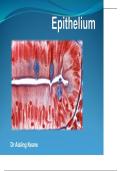
Dr Aisling Keane
, Class objectives
Define epithelium as the tissue which covers and lines
other tissues and which is classified according to the
number of cell layers, shape of cells and surface
specialisations.
Describe the characteristics of epithelia including close
cell-cell contact, “avascularity”, sited on a ‘basement
membrane’ and surface polarization.
Define glands as “specialised” secretory epithelium which
may to subdivided into 2 broad categories, exocrine and
endocrine.
Classify exocrine glands into different sub-types by
applying several morphological criteria.
, Epithelial Tissue – Where is it
found?
Sweat
Epidermis
Oral Sebaceous
Oral Cavity
GI Tract
Cavity
Covering & Glandular
Lining
(examples)
(examples)
Ducts Respiratory
Ducts Salivary
Urinary
Pancreas
There are also epithelial-like tissues
Endothelium – lines the cardiovascular system
Mesothelium – lines internal closed cavities e.g. thoracic and abdominal cavities
These are classified as connective tissues
, Class objectives
Define epithelium as the tissue which covers and lines
other tissues and which is classified according to the
number of cell layers, shape of cells and surface
specialisations.
Describe the characteristics of epithelia including close
cell-cell contact, “avascularity”, sited on a ‘basement
membrane’ and surface polarization.
Define glands as “specialised” secretory epithelium which
may to subdivided into 2 broad categories, exocrine and
endocrine.
Classify exocrine glands into different sub-types by
applying several morphological criteria.
, Epithelial Tissue – Where is it
found?
Sweat
Epidermis
Oral Sebaceous
Oral Cavity
GI Tract
Cavity
Covering & Glandular
Lining
(examples)
(examples)
Ducts Respiratory
Ducts Salivary
Urinary
Pancreas
There are also epithelial-like tissues
Endothelium – lines the cardiovascular system
Mesothelium – lines internal closed cavities e.g. thoracic and abdominal cavities
These are classified as connective tissues


