ESTUDYR
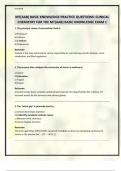
MT(AAB) BASIC KNOWLEDGE PRACTICE QUESTIONS: CLINICAL
CHEMISTRY FOR THE MT(AAB) BASIC KNOWLEDGE EXAM 1
1. The principal cation of extracellular fluid is:
a) Potassium
b) Calcium
✅c) Sodium
d) Magnesium
Rationale:
Sodium is the main extracellular cation responsible for maintaining osmotic balance, nerve
conduction, and fluid regulation.
2. The enzyme that catalyzes the conversion of starch to maltose is:
a) Lipase
✅b) Amylase
c) Trypsin
d) Pepsin
Rationale:
Amylase breaks down complex carbohydrates (starch) into disaccharides like maltose. It’s
secreted mainly by the pancreas and salivary glands.
3. The "anion gap" is primarily used to:
a) Detect electrolyte depletion
✅b) Identify metabolic acidosis causes
c) Measure renal clearance
d) Assess hepatic function
Rationale:
The anion gap helps differentiate causes of metabolic acidosis by calculating unmeasured
anions in the plasma (Na⁺ – *Cl⁻ + HCO₃⁻+).
, ESTUDYR
4. The colorimetric method commonly used to measure glucose involves:
a) Biuret reaction
✅b) Glucose oxidase
c) Jaffe reaction
d) Ninhydrin reaction
Rationale:
The glucose oxidase method specifically measures glucose by converting it to gluconic acid and
hydrogen peroxide, which reacts with a chromogen for color change.
5. A fasting blood glucose level of 130 mg/dL indicates:
a) Normal
b) Impaired fasting glucose
✅c) Diabetes mellitus
d) Hypoglycemia
Rationale:
Fasting glucose ≥126 mg/dL (on two occasions) confirms diabetes mellitus according to ADA
criteria.
6. Which hormone increases blood glucose concentration?
a) Insulin
b) Calcitonin
✅c) Glucagon
d) Somatostatin
Rationale:
Glucagon, secreted by pancreatic alpha cells, promotes glycogenolysis and gluconeogenesis,
raising blood glucose.
7. The Jaffe reaction is used to measure:
✅a) Creatinine
b) Urea
MT(AAB) BASIC KNOWLEDGE PRACTICE QUESTIONS: CLINICAL
CHEMISTRY FOR THE MT(AAB) BASIC KNOWLEDGE EXAM 1
1. The principal cation of extracellular fluid is:
a) Potassium
b) Calcium
✅c) Sodium
d) Magnesium
Rationale:
Sodium is the main extracellular cation responsible for maintaining osmotic balance, nerve
conduction, and fluid regulation.
2. The enzyme that catalyzes the conversion of starch to maltose is:
a) Lipase
✅b) Amylase
c) Trypsin
d) Pepsin
Rationale:
Amylase breaks down complex carbohydrates (starch) into disaccharides like maltose. It’s
secreted mainly by the pancreas and salivary glands.
3. The "anion gap" is primarily used to:
a) Detect electrolyte depletion
✅b) Identify metabolic acidosis causes
c) Measure renal clearance
d) Assess hepatic function
Rationale:
The anion gap helps differentiate causes of metabolic acidosis by calculating unmeasured
anions in the plasma (Na⁺ – *Cl⁻ + HCO₃⁻+).
, ESTUDYR
4. The colorimetric method commonly used to measure glucose involves:
a) Biuret reaction
✅b) Glucose oxidase
c) Jaffe reaction
d) Ninhydrin reaction
Rationale:
The glucose oxidase method specifically measures glucose by converting it to gluconic acid and
hydrogen peroxide, which reacts with a chromogen for color change.
5. A fasting blood glucose level of 130 mg/dL indicates:
a) Normal
b) Impaired fasting glucose
✅c) Diabetes mellitus
d) Hypoglycemia
Rationale:
Fasting glucose ≥126 mg/dL (on two occasions) confirms diabetes mellitus according to ADA
criteria.
6. Which hormone increases blood glucose concentration?
a) Insulin
b) Calcitonin
✅c) Glucagon
d) Somatostatin
Rationale:
Glucagon, secreted by pancreatic alpha cells, promotes glycogenolysis and gluconeogenesis,
raising blood glucose.
7. The Jaffe reaction is used to measure:
✅a) Creatinine
b) Urea