PHSC 211 Chapter 7 Quiz (Fall 2020)– Liberty University (A grade) | Elements of Earth Science
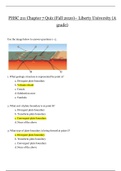
PHSC 211 Chapter 7 Quiz (Fall 2020)– Liberty University (A grade) Use the image below to answer questions 1–5. 1. What geologic structure is represented by point A? a. Divergent plate boundary b. Volcanic island c. Trench d. Subduction zone e. Tombolo 2. What sort of plate boundary is at point B? a. Divergent plate boundary b. Transform plate boundary c. Convergent plate boundary d. None of the above 3. What type of plate boundary is being formed at point C? a. Divergent plate boundary b. Transform plate boundary c. Convergent plate boundary d. None of the above 4. What process is occurring at points D and E? a. Subduction b. Liquefaction c. Lithification d. Divergence e. Carbonization 5. What is the geologic structure located at point D? a. Mid-ocean ridge b. Volcanic island arc c. Trench d. Continental margin e. None of the above 6. Who proposed that all the present continents were once joined together in a single supercontinent called Pangaea? a. Alfred Wegener b. H. B. Baker c. Charles Darwin d. Arthur Holmes e. Harry Hess 7. The scientific community rejected the theory of continental drift because Alfred Wegener could NOT ________________. a. identify a mechanism to move the continents b. disprove competing theories that were not accepted by scientists c. find geologic similarities on the different continents d. all of the above e. None of the above 8. In the 1950s, Harry Hess interpreted this paleomagnetic data of newly formed oceanic crust. He proposed that while new oceanic crust was being formed at the summit of the oceanic ridges, the adjacent oceanic crust was moving laterally away from the ridge. What is this process called? a. Deep-sea trench b. Ocean crust c. Seafloor spreading d. Hot spots e. None of the above 9. With the advent of plate tectonics, it was discovered that new oceanic lithosphere is being created at what location? a. Seafloor spreading b. Deep-sea trenches c. Oceanic ridges d. Continental crust e. Lithosphere Questions 10–14 are based on the online video Historical Development of Plate Tectonics Theory. You need to watch the entire segment in the online activity to answer all of the questions. 10. Geologist Eduard Suess not only noted that the continents fit together, but also discovered a group of identical fossils in South America, Africa, and Australia. What type of fossil was featured? a. Palm b. Fern c. Redwood tree d. Maple tree e. All of the above 11. In the early 1800s, geologist Eduard Suess suggested that all the southern continents, including Antarctica, had once been joined into one large continent. What name did Suess call the one continent? a. Pangaea b. Megacontinent c. Gondwanaland d. Laurasia e. None of the above 12. Alfred Wegener’s own drawings show that all the continents fit together in a jigsaw-like form. What two continents did Alfred Wegener propose “fit together” like a jigsaw puzzle? a. Africa and North America b. South America and North America c. Africa and Australia d. South America and Africa e. Eurasia and Africa 13. Wegener proposed that North America and Eurasia had also once been joined into one large continent called a. Pangaea b. Megacontinent c. Gondwanaland d. Laurasia e. Rodinia 14. In what century did we have new data provided by developing technologies to consider that continents could be on the move? a. The 17th century b. The 18th century c. The 19th century d. The 20th century e. The 21st century 15. How do some rocks store information about Earth’s magnetic field? a. Rocks cannot store information of this sort. b. The crystals of magnetic minerals in a rock align with the orientation of Earth’s magnetic field as it solidifies. c. Crystals of calcite align with the Earth’s magnetic field after lithification. d. None of the above. 16. As liquid basalt cools, one of the minerals that forms is _______________, a black magnetic mineral found in igneous and metamorphic rocks as separate deposits. a. basalt b. magnetite c. cobalt d. silver e. aluminum 17. Which scientist’s study of the magnetism of lava flows in Japan resulted in the discovery that Earth’s magnetic field appears to have undergone reversals over time—that is, that the north and south magnetic poles have reversed their locations? a. Alfred Wegener b. Motonori Matuyama c. Charles Darwin d. Arthur Holmes e. Harry Hess Questions 18–24 are based on the online video Evidence That Earth’s Continents Move. You need to watch the entire segment in the online activity to answer all of the questions. 18. What is the typical rate of seafloor spreading? a. 1–5 centimeters per year b. 6–10 centimeters per year c. 11–15 centimeters per year d. 16–20 centimeters per year e. 21–25 centimeters per year 19. If new crust is indeed being produced at the rifts, where does the additional older crust go? a. Adjacent rift zones b. Subduction zones c. Oceanic crust d. Continental crust e. Seafloor spreading 20. Most of the Earth’s volcanoes are located in the ________________ around the Pacific Rim just beyond the oceanic trenches, where magma, which is less dense than the surrounding rock, rises to the surface and erupts. a. Ring of Ice b. Ring of Water c. Ring of Fire d. Ring of Soil e. Ring of Steam 21. Tensional forces (pull-apart forces) generated in the lithosphere immediately above the rising portion of a convection cell result in the rifting of the lithosphere and ultimately the formation of what type of plate boundary? a. Convergent b. Transform c. Divergent d. Oceanic crust e. Hot spot 22. Compressional forces (forces colliding with each other) generated in the lithosphere above the adjacent downgoing portion of the convection cell result in the formation of a deep-sea trench that eventually develops into what type of plate boundary? a. Convergent b. Transform c. Divergent d. Oceanic crust e. Hot spot 23. The Hawaiian island chain was formed by what geologic process? a. Hot-spot volcanism b. Convergence of lithospheric plates c. Divergence of lithospheric plates d. Earthquakes e. Tsunami 24. The plane of earthquakes along the upper surface of a subducted plate is known as the _______. a. subduction zone b. Wadati–Benioff zone c. accumulation zone d. zone of earthquakes e. seismic zone 25. Name and describe three differences between divergent and convergent plate boundaries. The first difference is that a divergent plate boundary happens when two tectonic plates move away from each other and a convergent plate boundary happens when they come together. The second difference is that divergent plate boundaries create ridges and convergent plate boundaries create trenches. A third difference is that convergent plate boundaries have a lack of volcanic activity while divergent does have volcanic activity.
Written for
Document information
- Uploaded on
- January 10, 2021
- Number of pages
- 7
- Written in
- 2020/2021
- Type
- Exam (elaborations)
- Contains
- Questions & answers
Subjects
- phsc 211 chapter 7 quiz
-
phsc 211 chapter 7 quiz fall 2020– liberty university a grade
-
phsc 211 chapter 7 quiz fall 2020
-
phsc 211 chapter 7 quiz – liberty university a grade
-
chapter 7 quiz fal

Document also available in package deal