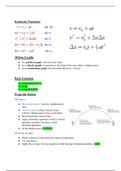
Kinematic Equations
Motion Graphs
● In a position graph, velocity is the slope
● In a velocity graph, acceleration is the slope & the area under is displacement
● In an acceleration graph, the area under the line is velocity
Basic Formulas
● Acceleration=Δv/Δt
● V=d/t
● Vavg=V1+V2/2
Projectile Motion
The basics:
● Horizontal motion: velocity, displacement,
time
● Vertical motion: initial velocity, final
velocity, displacement, time, acceleration
● Horizontal time=vertical time
● Apply kinematic equations to fill in vertical
quantities and then use those to find
horizonal quantities
● At the highest point, t=-Voy/-g
Involving an angle:
● Break it down by horizontal and vertical components
● Use kinematics
● Apply the average velocity equation to find missing horizontal quantities (v=d/t)
, ● If up to the right, sine is for vertical and cosine for horizontal
● Horizontal range: Voy^2xsin2(-)/g where (-) is theta
Forces
Newton’s Laws
1. If a center of mass is at rest, it’ll remain at rest unless acted upon by a net force (a
moving center of mass will maintain a constant velocity unless acted upon by a net force)
2. The acceleration of an object/system is equal to the net force acting upon it divided by its
mass (a=fnet/m)
3. Every action has an equal and opposite reaction (action-reaction requires 2 forces from 2
objects acting on each other)
Equilibrium
● Static Equilibrium: occurs when the net force on a MOTIONLESS object/system is 0
● Dynamic Equilibrium: occurs when the net force on a MOVING object/system is 0 (no
acceleration though, must have a constant velocity)
● If it’s not moving or at a constant rate, all forces are balanced
Normal Force & Friction
● Normal force acts perpendicular to the surface applying it (Fg=mg)
● Friction force acts parallel to the surface applying it (s stops it from moving, k slows it)
o Static friction (Fs): acts on motionless object; magnitude/direction will
always be whatever keeps the object from moving (Fs<Ms x Fn); static
friction will oppose the applied force until it reaches the max (then kin)
o Kinetic friction (Fk): acts on moving objects once the static friction
threshold has been passed; direction is always opposite the direction the
object is moving (Fk=Mk x Fn) where M is the coefficient of friction
o Sine makes it slide, cosine keeps it close (cos into the ramp, sine down it)
, Atwood Machines
● Two masses hanging from a massless string with a massless/frictionless pulley
● Tension is consistent in the string and accelerations are always equal
● Considered a system (python method!), gravity is all that will accelerate it
● Fnet=ma=Tg-T=ma-T which means T=mg-ma
● If m1+m2m the system is in equilibrium (d or s) but if not, it accelerates
● Newton’s third law: a=Fnet/m
● The downwards force of one block minus the net force would give you the force of
tension
*if an object is sliding or traveled a distance down (like on a ramp), the velocity at the bottom
can be found with v=root of 2gh
*if going down a frictionless ramp, Mk=h/x
Mechanical Energy
Motion Graphs
● In a position graph, velocity is the slope
● In a velocity graph, acceleration is the slope & the area under is displacement
● In an acceleration graph, the area under the line is velocity
Basic Formulas
● Acceleration=Δv/Δt
● V=d/t
● Vavg=V1+V2/2
Projectile Motion
The basics:
● Horizontal motion: velocity, displacement,
time
● Vertical motion: initial velocity, final
velocity, displacement, time, acceleration
● Horizontal time=vertical time
● Apply kinematic equations to fill in vertical
quantities and then use those to find
horizonal quantities
● At the highest point, t=-Voy/-g
Involving an angle:
● Break it down by horizontal and vertical components
● Use kinematics
● Apply the average velocity equation to find missing horizontal quantities (v=d/t)
, ● If up to the right, sine is for vertical and cosine for horizontal
● Horizontal range: Voy^2xsin2(-)/g where (-) is theta
Forces
Newton’s Laws
1. If a center of mass is at rest, it’ll remain at rest unless acted upon by a net force (a
moving center of mass will maintain a constant velocity unless acted upon by a net force)
2. The acceleration of an object/system is equal to the net force acting upon it divided by its
mass (a=fnet/m)
3. Every action has an equal and opposite reaction (action-reaction requires 2 forces from 2
objects acting on each other)
Equilibrium
● Static Equilibrium: occurs when the net force on a MOTIONLESS object/system is 0
● Dynamic Equilibrium: occurs when the net force on a MOVING object/system is 0 (no
acceleration though, must have a constant velocity)
● If it’s not moving or at a constant rate, all forces are balanced
Normal Force & Friction
● Normal force acts perpendicular to the surface applying it (Fg=mg)
● Friction force acts parallel to the surface applying it (s stops it from moving, k slows it)
o Static friction (Fs): acts on motionless object; magnitude/direction will
always be whatever keeps the object from moving (Fs<Ms x Fn); static
friction will oppose the applied force until it reaches the max (then kin)
o Kinetic friction (Fk): acts on moving objects once the static friction
threshold has been passed; direction is always opposite the direction the
object is moving (Fk=Mk x Fn) where M is the coefficient of friction
o Sine makes it slide, cosine keeps it close (cos into the ramp, sine down it)
, Atwood Machines
● Two masses hanging from a massless string with a massless/frictionless pulley
● Tension is consistent in the string and accelerations are always equal
● Considered a system (python method!), gravity is all that will accelerate it
● Fnet=ma=Tg-T=ma-T which means T=mg-ma
● If m1+m2m the system is in equilibrium (d or s) but if not, it accelerates
● Newton’s third law: a=Fnet/m
● The downwards force of one block minus the net force would give you the force of
tension
*if an object is sliding or traveled a distance down (like on a ramp), the velocity at the bottom
can be found with v=root of 2gh
*if going down a frictionless ramp, Mk=h/x
Mechanical Energy