PSYCH NOTES
CHAPTER FOURTEEN
CHAPTER FOURTEEN: ABNORMAL PSYCH
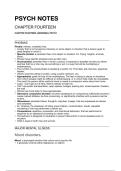
PHOBIAS
Phobia: intense, unrealistic fear.
- anxiety that is so focused so intensely on some object or situation that a person goes to
great lengths to avoid it.
- Speci c phobia: a persistent fear of an object or situation. Ex. Flying, heights, animals,
blood.
- Women have speci c phobias twice as often men.
- Social phobia: persistent fear in which a person is exposed to possible scrutiny by others
and fear that he or she may do something or act in a way that will be humiliating or
embarrassing.
- The number one social phobia is speaking in public. Ex. First date, job interview, speeches,
theater.
- Others would be eating in public, using a public restroom, etc.
- Agoraphobia: greek for fear of the marketplace. The fear of being in places or situations
from which escape might be di cult or embarrassing, or in which help might be unavailable.
The result the person either restricts travel or needs a companion when away from home.
- Logic: I can’t get out of here, there’s nobody to help me,
- Can’t use public transportation, open spaces, bridges, parking lots, closed spaces, theaters,
the mall.
- Women are more likely to have agoraphobia.
- Obsessive compulsive disorder: recurrent obsessions or compulsions su ciently severe to
cause marked distress, be time consuming, or signi cantly interfere with a persons normal
routine.
- Obsessions: persistent ideas, thoughts, impulses, images, that are expressed as intense
and senseless.
- Ex. Violence, the obsession of killing ones children, contamination, doubt, repeated
wondering if one has performed a certain act.
- Compulsions: repetitive, purposeful, and intentional behaviors, that are performed in
response to an obsession according to certain rules.
- The behavior is designed to neutralize or prevent discomfort or some dreaded event or
situation.
- OCD is equal in both men and women.
MAJOR MENTAL ILLNESS
Mood disorders.
Mood: a prolonged emotion that colors one’s psychic life.
- it generally involves either depression or elation.
fi fi ffi fi ffi
CHAPTER FOURTEEN
CHAPTER FOURTEEN: ABNORMAL PSYCH
PHOBIAS
Phobia: intense, unrealistic fear.
- anxiety that is so focused so intensely on some object or situation that a person goes to
great lengths to avoid it.
- Speci c phobia: a persistent fear of an object or situation. Ex. Flying, heights, animals,
blood.
- Women have speci c phobias twice as often men.
- Social phobia: persistent fear in which a person is exposed to possible scrutiny by others
and fear that he or she may do something or act in a way that will be humiliating or
embarrassing.
- The number one social phobia is speaking in public. Ex. First date, job interview, speeches,
theater.
- Others would be eating in public, using a public restroom, etc.
- Agoraphobia: greek for fear of the marketplace. The fear of being in places or situations
from which escape might be di cult or embarrassing, or in which help might be unavailable.
The result the person either restricts travel or needs a companion when away from home.
- Logic: I can’t get out of here, there’s nobody to help me,
- Can’t use public transportation, open spaces, bridges, parking lots, closed spaces, theaters,
the mall.
- Women are more likely to have agoraphobia.
- Obsessive compulsive disorder: recurrent obsessions or compulsions su ciently severe to
cause marked distress, be time consuming, or signi cantly interfere with a persons normal
routine.
- Obsessions: persistent ideas, thoughts, impulses, images, that are expressed as intense
and senseless.
- Ex. Violence, the obsession of killing ones children, contamination, doubt, repeated
wondering if one has performed a certain act.
- Compulsions: repetitive, purposeful, and intentional behaviors, that are performed in
response to an obsession according to certain rules.
- The behavior is designed to neutralize or prevent discomfort or some dreaded event or
situation.
- OCD is equal in both men and women.
MAJOR MENTAL ILLNESS
Mood disorders.
Mood: a prolonged emotion that colors one’s psychic life.
- it generally involves either depression or elation.
fi fi ffi fi ffi