Chapter 15: Nervous coordination and muscles
15.1 Neurons and nervous coordination
Principles of coordination:
Hormonal system Nervous system
Communication by hormone Communication by nerve impulses
Transmission by the blood system Transmission by neurons
Transmission is slow Transmission is fast
Hormones travel to all parts of the Nerve impulses travel to specific
body but only target cells respond parts of the body
Response is widespread Response is localised
Response is slow Response is fast
Response is often long-lasting Response is short-lived
Effect is permeable and irreversible Effect is temporary and reversible
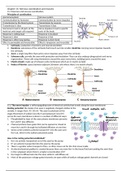
1. Cell body: production of proteins and neurotransmitters
2. Dendrons: extensions of the cell body that branch out into smaller dendrites carrying nerve impulses towards
the cell body.
3. Axon: a single long fibre that carries nerve impulses away from the cell body
4. Schwann cells: provide the axon with protection and insulation: They can also undergo phagocytosis and nerve
regeneration. These cells wrap themselves around the axon many times, building layers around the axon.
5. Myelin sheath: made up of Schwann cells membranes which are in myelin (a lipid)
6. Nodes of Ranvier: space between adjacent Schwann cells where there’s no myelin sheath.
15.2 The nerve impulse: a self-propagating wave of electrical activity that travels along the axon membranes
Resting potential: the inside of an axon is negatively charged relative to the
outside. It ranges from -92 -50 mV. The axon is polarized at this
stage.Movement of sodium ions (Na+) and potassium ions (K+)
across the axon membrane is done in a number of different ways:
1. Phospholipid by layer of the axon plasma membrane prevents
Na+ and K+ plus diffusion
2. Channel proteins have gates that can be opened or closed to
move Na+ and K+ through by facilitated diffusion at one time
3. Some carrier proteins actively transport K+ into the axon and
Na+ out, which is the sodium potassium pump
How is the resting potential established?
1. Na+ are actively transported out of the axon by the pump
2. K+ are actively transported into the axon by the pump
3. There’s a greater active transport of Na+, so 3Na+ move out for 2K+ that move inside.
4. An electrochemical gradient is created because there are more Na+ in the tissue fluid surrounding the axon than
in the cytoplasm where there’s a higher concentration of K+
5. Na+ begin to diffuse back into the axon while K+ will diffuse out
6. Most of the potassium voltage gated channels are open while all sodium voltage gated channels are closed
, Chapter 15: Nervous coordination and muscles
Action potential: the stimulus needs to exceed the threshold to
cause a temporary reversal of the charges from -65 mV to +45
mV, which depolarizes the axon membrane
1. Some potassium voltage gated channels are open while the
sodium voltage gated channels are closed
2. Energy of the stimulus causes sodium voltage gated channels
to open which allows Na+ to diffuse into the axon along the
electrochemical gradient. been positively charged it
reverses the potential difference
3. More sodium channels open leading to a greater influx of
Na+ by diffusion
4. Once the action potential reaches +40 mV the sodium
voltage gated channels close and the potassium voltage
gated channels open
5. More K+ enters the axon which repolarizes the axon
6. This causes an overshoot of the gradient and the potassium
voltage gated channels close allowing the sodium potassium
pump to resume. When resting potential of -65 mV is
reestablished the axon is said to be re-polarized
15.3 Passage of an action potential
As one region of the axon produces an action potential and becomes depolarized, it acts as a stimulus for the
depolarization of the next region of the axon. Action potentials are a traveling wave of depolarization
Passage of the action potential along an unmyelinated axon:
1. Resting potential: High concentration of Na on the outside and
high concentration of K on the inside; the axon is polarized
2. Stimulus causes the influx of Na+ hence reversal of charge. The
membrane is depolarized creating an action potential
3. Localized electrical currents established by the influx of Na+ cause the
opening of Na+ voltage gated channels resulting in depolarization. The
new region that follows will open K+ channels and close Na+ channels. K+
ions leave the axon by diffusion allowing the depolarization wave to move
along
4. The region that follows depolarization, the action potential returns to
its original state, meaning it has been re-polarized
5. Repolarization: Na+ are actively transported out returning the axon
Passage of an action potential into it resting potential
along a myelinated axon:
Fatty sheath of myelin acts as an electrical insulator, preventing action
potentials from forming. Action potentials occur at the nodes of Ranvier:
15.1 Neurons and nervous coordination
Principles of coordination:
Hormonal system Nervous system
Communication by hormone Communication by nerve impulses
Transmission by the blood system Transmission by neurons
Transmission is slow Transmission is fast
Hormones travel to all parts of the Nerve impulses travel to specific
body but only target cells respond parts of the body
Response is widespread Response is localised
Response is slow Response is fast
Response is often long-lasting Response is short-lived
Effect is permeable and irreversible Effect is temporary and reversible
1. Cell body: production of proteins and neurotransmitters
2. Dendrons: extensions of the cell body that branch out into smaller dendrites carrying nerve impulses towards
the cell body.
3. Axon: a single long fibre that carries nerve impulses away from the cell body
4. Schwann cells: provide the axon with protection and insulation: They can also undergo phagocytosis and nerve
regeneration. These cells wrap themselves around the axon many times, building layers around the axon.
5. Myelin sheath: made up of Schwann cells membranes which are in myelin (a lipid)
6. Nodes of Ranvier: space between adjacent Schwann cells where there’s no myelin sheath.
15.2 The nerve impulse: a self-propagating wave of electrical activity that travels along the axon membranes
Resting potential: the inside of an axon is negatively charged relative to the
outside. It ranges from -92 -50 mV. The axon is polarized at this
stage.Movement of sodium ions (Na+) and potassium ions (K+)
across the axon membrane is done in a number of different ways:
1. Phospholipid by layer of the axon plasma membrane prevents
Na+ and K+ plus diffusion
2. Channel proteins have gates that can be opened or closed to
move Na+ and K+ through by facilitated diffusion at one time
3. Some carrier proteins actively transport K+ into the axon and
Na+ out, which is the sodium potassium pump
How is the resting potential established?
1. Na+ are actively transported out of the axon by the pump
2. K+ are actively transported into the axon by the pump
3. There’s a greater active transport of Na+, so 3Na+ move out for 2K+ that move inside.
4. An electrochemical gradient is created because there are more Na+ in the tissue fluid surrounding the axon than
in the cytoplasm where there’s a higher concentration of K+
5. Na+ begin to diffuse back into the axon while K+ will diffuse out
6. Most of the potassium voltage gated channels are open while all sodium voltage gated channels are closed
, Chapter 15: Nervous coordination and muscles
Action potential: the stimulus needs to exceed the threshold to
cause a temporary reversal of the charges from -65 mV to +45
mV, which depolarizes the axon membrane
1. Some potassium voltage gated channels are open while the
sodium voltage gated channels are closed
2. Energy of the stimulus causes sodium voltage gated channels
to open which allows Na+ to diffuse into the axon along the
electrochemical gradient. been positively charged it
reverses the potential difference
3. More sodium channels open leading to a greater influx of
Na+ by diffusion
4. Once the action potential reaches +40 mV the sodium
voltage gated channels close and the potassium voltage
gated channels open
5. More K+ enters the axon which repolarizes the axon
6. This causes an overshoot of the gradient and the potassium
voltage gated channels close allowing the sodium potassium
pump to resume. When resting potential of -65 mV is
reestablished the axon is said to be re-polarized
15.3 Passage of an action potential
As one region of the axon produces an action potential and becomes depolarized, it acts as a stimulus for the
depolarization of the next region of the axon. Action potentials are a traveling wave of depolarization
Passage of the action potential along an unmyelinated axon:
1. Resting potential: High concentration of Na on the outside and
high concentration of K on the inside; the axon is polarized
2. Stimulus causes the influx of Na+ hence reversal of charge. The
membrane is depolarized creating an action potential
3. Localized electrical currents established by the influx of Na+ cause the
opening of Na+ voltage gated channels resulting in depolarization. The
new region that follows will open K+ channels and close Na+ channels. K+
ions leave the axon by diffusion allowing the depolarization wave to move
along
4. The region that follows depolarization, the action potential returns to
its original state, meaning it has been re-polarized
5. Repolarization: Na+ are actively transported out returning the axon
Passage of an action potential into it resting potential
along a myelinated axon:
Fatty sheath of myelin acts as an electrical insulator, preventing action
potentials from forming. Action potentials occur at the nodes of Ranvier: