

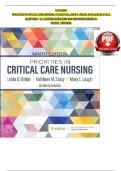
TEST BANK b b
PRIORITIES IN CRITICAL CARE NURSING, 9TH EDITION, LINDA D. URDEN, KATHLEEN M. STACY,
b b b b b b b b b b b b b
CHAPTERS 1 - 27, COVERED QUESTIONS AND ANSWERS GRADED A+
b b b b b b b b b b b
NEWEST VERSION.
b
,TABLEOFCONTENTS
UNIT ONE: FOUNDATIONS INCRITICAL CARE NURSING
b b b z b
1. Caring fortheCritically Ill Patient
b b b b b
2. EthicalandLegal Issues
b b z
3. Facilitating Care Transitions z b
UNITTWO:COMMONPROBLEMSINCRITICALCARE
b b b b
4. PsychosocialandSpiritual Considerations b b z
5. NutritionalAlterationsandManagement b b b
6. TheOlderAdult
b b
7. PainandPainManagement
b b b
8. SedationandDeliriumManagement
b b b
9. PalliativeandEnd-of-LifeCare b b b
UNITTHREE:CARDIOVASCULARALTERATIONS
b b b
10. Cardiovascular Clinical Assessment and Diagnostic Procedures b z b b z
11. Cardiovascular Disorders b
12. CardiovascularTherapeuticManagement b b
UNITFOUR:PULMONARYALTERATIONS
b b b
13. PulmonaryClinicalAssessmentandDiagnosticProcedures b b b b
14. PulmonaryDisorders b
15. PulmonaryTherapeuticManagement b b
UNITFIVE:NEUROLOGICAL ALTERATIONS
b b z
16. NeurologicalClinicalAssessmentandDiagnosticProcedures b b b b
17. NeurologicDisordersandTherapeuticManagement b b b b
UNITSIX:KIDNEYALTERATIONS
b b b
18. KidneyClinicalAssessmentandDiagnosticProcedures
b b b b b
19. KidneyDisordersandTherapeuticManagement
b b b b
UNITSEVEN:GASTROINTESTINALALTERATIONS
b b b
20. Gastrointestinal ClinicalAssessmentandDiagnosticProcedures z b b b
21. GastrointestinalDisordersandTherapeuticManagement b b b b
UNIT EIGHT: ENDOCRINE ALTERATIONS
b b b
22. Endocrine ClinicalAssessmentandDiagnosticProcedures
z b b b
23. Endocrine DisordersandTherapeuticManagement z b b b
UNITNINE:MULTISYSTEM ALTERATIONS
b b b
24. Trauma
25. Burns
26. Shock,Sepsis,andMultipleOrganDysfunctionSyndrome
b b b b b b
27. HematologicalandOncologicalEmergencies b b b
,Chapter01:CriticalCareNursingPracticeUr den:
b b b b b b
Critical Care Nursing, 9th
b b b b
MULTIPLE
CHOICE
b
1. DuringWorldWarII,whattypeofwardsweredevelopedtocareforcriticallyinjure d
b b b b b b b b b b
patients?
b
a. Intensivecare b
b. Triage
c. Shock
d. Postoperative
ANS: C z
DuringWorldWarII,shock wardswereestablished tocareforcriticallyinjuredpatients.Triagew ards
b b b b z b b z b b b b b b b b
establishtheorderinwhicha patient isseenortreatedupon arrivalto ahospital.Postoperati vewards
b b b b b b z z b b b b z b z b b b b
weredevelopedin1900andlaterevolved intointensivecareunits.
b b b b b b b z b b
PTS: 1 DIF: CognitiveLevel:Remembering
b b b
REF:p.1OBJ: Nursing ProcessStep:N/A b b b b b z b b
TOP:CriticalCareNursingPracticeMSC:NCLEX:Safeand b b b b b b b
Effective CareEnvironment
b z b
2. Whattypeofpractitionerhasabroaddepthofspecialtyknowledgeandexpertiseandmana ges
b b b b b b b b b b b b b b
complexclinicalandsystemissues?
b b b b b
a. Registered nurses b
b. Advancedpracticenurses b b
c. Clinical nurse leaders b b
d. Intensivists
ANS: B z
Advanced practice nurses (APNs) have a broad depth of knowledge and expertise in theirspecial ty
b b b b b b b b b b b b b b
area and manage complex clinical and systems issues. Intensivists are medical practitioners wh o
b b b z b b z b b b b b b b
manage the critical ill patient. Registered nurses (RNs) are generally direct care providers. Clini cal
b b b b b b b b b b b b b b b
nurseleaders(CNLs)generallydonotmanagesystemissues.
b b b b b b b b b
PTS: 1 DIF: CognitiveLevel:Remembering
b b b
REF:p.2OBJ: NursingProcessStep:N/A b b b b b b b b
TOP:CriticalCareNursingPracticeMSC:NCLEX:Safeand b b b b b b b
Effective CareEnvironment
b z b
3. What type of practitioner is instrumental in ensuring care that is evidence based andthat sa
b b b b z b b b b z b z z z
fetyprogramsareinplace?
b b b b b
a. Clinical nurse speci b b
alist b. Advanced practi
b z b z
cenursec.
b b b
Registered nurses b
d.Nursepractitioners
b b
ANS: A z
, Clinical nurse specialists (CNSs) serve in specialty roles that use their clinical, teaching, research, l
b b b b b b b b b b b b b b
eadership, and consultative abilities. They are instrumental in ensuring that careis evidence based and
b z b z b b z b b b b b b b
thatsafetyprogramsareinplace.Advancedpracticenurses(APNs)have
b b b b b b b b b b
a broad depth of knowledge and expertise in their specialty area and manage complex clinical a nd
z b b b b b b z b b z b b b b b
systems issues. Registered nurses are generally direct care providers. Nursepractitioners (N Ps)
b b b b b z b z b b z b
managedirect clinicalcareofgroupsofpatients.
b b z b b b b b
PTS: 1 DIF: CognitiveLevel:Remembering
b b b
REF:p.2OBJ: NursingProcessStep:N/A b b b b b b b b
TOP:CriticalCareNursingPracticeMSC:NCLEX:Safe and b b b b b b z
bEffective CareEnvironment z b
4. Whichprofessional organization administers criticalcare certification examsforregist
b b b z b z b b
berednurses? b
a. StateBoardofRegisteredNurses b b b b
b. National Association of Clinical NurseSpecialist b z b b
c. Society of Critical CareMedicine b b b b
d. American Association of Critical-CareNurses b b b
ANS: D z
AmericanAssociationofCritical- b b b
Care Nurses (AACN) administers certification exams for registered nurses. The State Board of
b b b b b b b b b b b b
Registered Nurses (SBON) does not administercertification exams. National Association of Cl
b b b b b b b b b z b
inical Nurse Specialists (NACNS) does not administer certification exams. Society of Critical C
b b b b b b z b b b b z b
are Medicine(SCCM)doesnot administernursingcertificationexamsforregisterednurses.
b z b b b z b b b b b b
PTS: 1 DIF: CognitiveLevel:Remembering
b b b
REF:p.3OBJ: NursingProcessStep:N/A b b b b b b b b
TOP:CriticalCareNursingPracticeMSC:NCLEX:Safe and b b b b b b z
bEffective CareEnvironment z b
5. Emphasisisonhumanintegrityandstresses thetheorythatthebody,mind,andspirit areint
b b b b b b z b b b b b b b z b
berdependent andinseparable.Thisstatement describeswhichmethodologyofcare? z b b b z b b b b
a. Holistic care z
b. Individualized care b
c. Cultural care b
d. Interdisciplinarycare b
ANS: A z
Holistic care focuses on human integrity and stresses that the body, mind, and spirit are interdepen
b b b b b b b b b b b b b b z
dent and inseparable. Individualized care recognizes the uniqueness of each patient’s preferences,
b z b b b z b z b b b b
condition, and physiologicandpsychosocial status.Cultural diversityin
b b z b b b b b
healthcareisnota newtopic,but it isgainingemphasisandimportanceastheworldbecomesmo
b b b b z b b z z b b b b b b b b b
re accessibletoallastheresult ofincreasingtechnologiesandinterfaceswithplacesandpeoples.I
b z b b b b b z b b b b b b b b
nterdisciplinarycare iscareamongavarietyofhealthcare professionalswiththe patient’shealth as
b b z b b b b b b b z b b z b b
the common goal.
b b b
PTS: 1 DIF: CognitiveLevel:Remembering
b b b
REF:p.4OBJ: NursingProcessStep:N/A b b b b b b b b
TOP:CriticalCareNursingPracticeMSC:NCLEX:Safeand b b b b b b b
bEffective CareEnvironment z b
PRIORITIES IN CRITICAL CARE NURSING, 9TH EDITION, LINDA D. URDEN, KATHLEEN M. STACY,
b b b b b b b b b b b b b
CHAPTERS 1 - 27, COVERED QUESTIONS AND ANSWERS GRADED A+
b b b b b b b b b b b
NEWEST VERSION.
b
,TABLEOFCONTENTS
UNIT ONE: FOUNDATIONS INCRITICAL CARE NURSING
b b b z b
1. Caring fortheCritically Ill Patient
b b b b b
2. EthicalandLegal Issues
b b z
3. Facilitating Care Transitions z b
UNITTWO:COMMONPROBLEMSINCRITICALCARE
b b b b
4. PsychosocialandSpiritual Considerations b b z
5. NutritionalAlterationsandManagement b b b
6. TheOlderAdult
b b
7. PainandPainManagement
b b b
8. SedationandDeliriumManagement
b b b
9. PalliativeandEnd-of-LifeCare b b b
UNITTHREE:CARDIOVASCULARALTERATIONS
b b b
10. Cardiovascular Clinical Assessment and Diagnostic Procedures b z b b z
11. Cardiovascular Disorders b
12. CardiovascularTherapeuticManagement b b
UNITFOUR:PULMONARYALTERATIONS
b b b
13. PulmonaryClinicalAssessmentandDiagnosticProcedures b b b b
14. PulmonaryDisorders b
15. PulmonaryTherapeuticManagement b b
UNITFIVE:NEUROLOGICAL ALTERATIONS
b b z
16. NeurologicalClinicalAssessmentandDiagnosticProcedures b b b b
17. NeurologicDisordersandTherapeuticManagement b b b b
UNITSIX:KIDNEYALTERATIONS
b b b
18. KidneyClinicalAssessmentandDiagnosticProcedures
b b b b b
19. KidneyDisordersandTherapeuticManagement
b b b b
UNITSEVEN:GASTROINTESTINALALTERATIONS
b b b
20. Gastrointestinal ClinicalAssessmentandDiagnosticProcedures z b b b
21. GastrointestinalDisordersandTherapeuticManagement b b b b
UNIT EIGHT: ENDOCRINE ALTERATIONS
b b b
22. Endocrine ClinicalAssessmentandDiagnosticProcedures
z b b b
23. Endocrine DisordersandTherapeuticManagement z b b b
UNITNINE:MULTISYSTEM ALTERATIONS
b b b
24. Trauma
25. Burns
26. Shock,Sepsis,andMultipleOrganDysfunctionSyndrome
b b b b b b
27. HematologicalandOncologicalEmergencies b b b
,Chapter01:CriticalCareNursingPracticeUr den:
b b b b b b
Critical Care Nursing, 9th
b b b b
MULTIPLE
CHOICE
b
1. DuringWorldWarII,whattypeofwardsweredevelopedtocareforcriticallyinjure d
b b b b b b b b b b
patients?
b
a. Intensivecare b
b. Triage
c. Shock
d. Postoperative
ANS: C z
DuringWorldWarII,shock wardswereestablished tocareforcriticallyinjuredpatients.Triagew ards
b b b b z b b z b b b b b b b b
establishtheorderinwhicha patient isseenortreatedupon arrivalto ahospital.Postoperati vewards
b b b b b b z z b b b b z b z b b b b
weredevelopedin1900andlaterevolved intointensivecareunits.
b b b b b b b z b b
PTS: 1 DIF: CognitiveLevel:Remembering
b b b
REF:p.1OBJ: Nursing ProcessStep:N/A b b b b b z b b
TOP:CriticalCareNursingPracticeMSC:NCLEX:Safeand b b b b b b b
Effective CareEnvironment
b z b
2. Whattypeofpractitionerhasabroaddepthofspecialtyknowledgeandexpertiseandmana ges
b b b b b b b b b b b b b b
complexclinicalandsystemissues?
b b b b b
a. Registered nurses b
b. Advancedpracticenurses b b
c. Clinical nurse leaders b b
d. Intensivists
ANS: B z
Advanced practice nurses (APNs) have a broad depth of knowledge and expertise in theirspecial ty
b b b b b b b b b b b b b b
area and manage complex clinical and systems issues. Intensivists are medical practitioners wh o
b b b z b b z b b b b b b b
manage the critical ill patient. Registered nurses (RNs) are generally direct care providers. Clini cal
b b b b b b b b b b b b b b b
nurseleaders(CNLs)generallydonotmanagesystemissues.
b b b b b b b b b
PTS: 1 DIF: CognitiveLevel:Remembering
b b b
REF:p.2OBJ: NursingProcessStep:N/A b b b b b b b b
TOP:CriticalCareNursingPracticeMSC:NCLEX:Safeand b b b b b b b
Effective CareEnvironment
b z b
3. What type of practitioner is instrumental in ensuring care that is evidence based andthat sa
b b b b z b b b b z b z z z
fetyprogramsareinplace?
b b b b b
a. Clinical nurse speci b b
alist b. Advanced practi
b z b z
cenursec.
b b b
Registered nurses b
d.Nursepractitioners
b b
ANS: A z
, Clinical nurse specialists (CNSs) serve in specialty roles that use their clinical, teaching, research, l
b b b b b b b b b b b b b b
eadership, and consultative abilities. They are instrumental in ensuring that careis evidence based and
b z b z b b z b b b b b b b
thatsafetyprogramsareinplace.Advancedpracticenurses(APNs)have
b b b b b b b b b b
a broad depth of knowledge and expertise in their specialty area and manage complex clinical a nd
z b b b b b b z b b z b b b b b
systems issues. Registered nurses are generally direct care providers. Nursepractitioners (N Ps)
b b b b b z b z b b z b
managedirect clinicalcareofgroupsofpatients.
b b z b b b b b
PTS: 1 DIF: CognitiveLevel:Remembering
b b b
REF:p.2OBJ: NursingProcessStep:N/A b b b b b b b b
TOP:CriticalCareNursingPracticeMSC:NCLEX:Safe and b b b b b b z
bEffective CareEnvironment z b
4. Whichprofessional organization administers criticalcare certification examsforregist
b b b z b z b b
berednurses? b
a. StateBoardofRegisteredNurses b b b b
b. National Association of Clinical NurseSpecialist b z b b
c. Society of Critical CareMedicine b b b b
d. American Association of Critical-CareNurses b b b
ANS: D z
AmericanAssociationofCritical- b b b
Care Nurses (AACN) administers certification exams for registered nurses. The State Board of
b b b b b b b b b b b b
Registered Nurses (SBON) does not administercertification exams. National Association of Cl
b b b b b b b b b z b
inical Nurse Specialists (NACNS) does not administer certification exams. Society of Critical C
b b b b b b z b b b b z b
are Medicine(SCCM)doesnot administernursingcertificationexamsforregisterednurses.
b z b b b z b b b b b b
PTS: 1 DIF: CognitiveLevel:Remembering
b b b
REF:p.3OBJ: NursingProcessStep:N/A b b b b b b b b
TOP:CriticalCareNursingPracticeMSC:NCLEX:Safe and b b b b b b z
bEffective CareEnvironment z b
5. Emphasisisonhumanintegrityandstresses thetheorythatthebody,mind,andspirit areint
b b b b b b z b b b b b b b z b
berdependent andinseparable.Thisstatement describeswhichmethodologyofcare? z b b b z b b b b
a. Holistic care z
b. Individualized care b
c. Cultural care b
d. Interdisciplinarycare b
ANS: A z
Holistic care focuses on human integrity and stresses that the body, mind, and spirit are interdepen
b b b b b b b b b b b b b b z
dent and inseparable. Individualized care recognizes the uniqueness of each patient’s preferences,
b z b b b z b z b b b b
condition, and physiologicandpsychosocial status.Cultural diversityin
b b z b b b b b
healthcareisnota newtopic,but it isgainingemphasisandimportanceastheworldbecomesmo
b b b b z b b z z b b b b b b b b b
re accessibletoallastheresult ofincreasingtechnologiesandinterfaceswithplacesandpeoples.I
b z b b b b b z b b b b b b b b
nterdisciplinarycare iscareamongavarietyofhealthcare professionalswiththe patient’shealth as
b b z b b b b b b b z b b z b b
the common goal.
b b b
PTS: 1 DIF: CognitiveLevel:Remembering
b b b
REF:p.4OBJ: NursingProcessStep:N/A b b b b b b b b
TOP:CriticalCareNursingPracticeMSC:NCLEX:Safeand b b b b b b b
bEffective CareEnvironment z b


