PSYU3399 APS Ethical Standards and National
Practice for Mental Health workforce Exam
Questions With Correct Answers
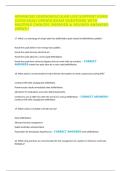
In |the |APS |code |of |ethics, |using |plain |language |to |fully |inform |clients |regarding |psychological |
services |they |intended |to |provide |is |what |key |ethical |principle? |- |CORRECT |ANSWER✔✔-A.3 |
Informed |Consent
In |the |APS |code |of |ethics, |after |attempting |to |gain |consent, |preparing |and |proceeding |to |
collect |client |information |is |which |key |ethical |principle? |- |CORRECT |ANSWER✔✔-Collection |of |
client |information
Psychologists |do |not |refuse |any |reasonable |request |from |clients, |or |former |clients, |to |access |
client |information, |for |which |the |psychologists |have |professional |responsibility |- |CORRECT |
ANSWER✔✔-Release |of |Client |information
Which |key |ethical |principle |states |that |psychologists |must |take |reasonable |steps |to |protect |the
|confidentiality |of |information |after |they |leave |a |specific |work |setting, |or |cease |to |provide |
psychological |services? |- |CORRECT |ANSWER✔✔-
Which |key |ethical |principle |states |that |information |may |be |released |if |there |is |a |specific |risk |of
|harm |to |a |person |or |persons? |- |CORRECT |ANSWER✔✔-Disclosure
in |the |APS, |which |ethical |principle |states |that |no |behaviours |should |be |perceived |as |coercive |
or |demeaning? |- |CORRECT |ANSWER✔✔-Respect
Which |APS |ethical |principle |states |that |no |personal |information |from |supervisees |or |trainees |
is |permitted? |- |CORRECT |ANSWER✔✔-Privacy
Practice for Mental Health workforce Exam
Questions With Correct Answers
In |the |APS |code |of |ethics, |using |plain |language |to |fully |inform |clients |regarding |psychological |
services |they |intended |to |provide |is |what |key |ethical |principle? |- |CORRECT |ANSWER✔✔-A.3 |
Informed |Consent
In |the |APS |code |of |ethics, |after |attempting |to |gain |consent, |preparing |and |proceeding |to |
collect |client |information |is |which |key |ethical |principle? |- |CORRECT |ANSWER✔✔-Collection |of |
client |information
Psychologists |do |not |refuse |any |reasonable |request |from |clients, |or |former |clients, |to |access |
client |information, |for |which |the |psychologists |have |professional |responsibility |- |CORRECT |
ANSWER✔✔-Release |of |Client |information
Which |key |ethical |principle |states |that |psychologists |must |take |reasonable |steps |to |protect |the
|confidentiality |of |information |after |they |leave |a |specific |work |setting, |or |cease |to |provide |
psychological |services? |- |CORRECT |ANSWER✔✔-
Which |key |ethical |principle |states |that |information |may |be |released |if |there |is |a |specific |risk |of
|harm |to |a |person |or |persons? |- |CORRECT |ANSWER✔✔-Disclosure
in |the |APS, |which |ethical |principle |states |that |no |behaviours |should |be |perceived |as |coercive |
or |demeaning? |- |CORRECT |ANSWER✔✔-Respect
Which |APS |ethical |principle |states |that |no |personal |information |from |supervisees |or |trainees |
is |permitted? |- |CORRECT |ANSWER✔✔-Privacy