

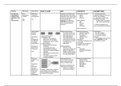
Question The theory The authors WHAT & HOW WHY CONCEPTS ASSUMPTIONS
Q1: How can Inter- Williamson, Frequency, Uncertainty and Governance structure: 1. Bounded rationality
organizations Organization Transaction Asset Specificity incur higher - Market Cognitive limitations of the mind
organize their Theories cost approach transaction costs. Actors want - Hybrid and the time available
interaction with to minimize transaction costs. - Hierarchy 2. Opportunism (misbehave)
the TCT TCT As long as they can Self-interest with guile
environment? RDC economize on transaction Asset specificity: - Problem when: uncertainty
costs, they will select more - Site high, asset specificity high
hierarchical governance - Physical
structures. - Human 3. Efficient transacting as a
- Dedicated source of competitive advantage
Vertical integration
Jeffrey Pfeffer Manage dependencies: Interlocking behaviors Organizations:
& Gerald - To acquire control over - Inclusion is partially 1. are open systems
Salancik resources that minimize - Boundary of an 2. are not self-sufficient
1. Environmental-action their dependence on organization 3. do not have all those
The Design 2. Managerial roles other organizations - Control is never resources
and - Symbolic role (buffering) - To acquire control over absolute: 4. must mobilize resources from
management - Responsive role (bridging) resources that maximize The ability to other organizations in their
of externally - Discretionary: tries to change the dependence of other 1. Empower individuals to act environment to survive
Controlled environment organizations on on its behalf
Organizations: 3. External designs themselves. 2. regulate use, access and
- Scanning the environment allocation of resources
A Resource (buffering) General strategies:
Dependence - Loosing dependencies - Buffering: using Terms:
Perspective (diversification of activities) resources to protect core - Enactment
- Coping with conflicting external system to stay stable - Autonomy-dependency
RDT demands - Bridging: starting a joint dilemma
- (differentiation and using slack venture, making network
resources) ties, appointing leaders
- The chief executive position
(multiple managers)
Fink et al. Asset specificity and Relational exchange norms:
(2006): TCT & environmental uncertainty - Relational focus
RDT clearly impact customer - Restraint on power use
choice of relational type - Solidarity
Transaction - Role integrity
cost Formation of relational Inter- - Mutuality
economics, Organizational exchange: - Flexibility
resource - Hybrid or the relational
dependence Example: Higher levels of resource governance structure
theory, and concentration lower uncertainty
customer– levels, resulting in a lower likelihood
supplier of relational tie formation.
relationships
, Q2: How do Goal Setting Lathan & Lock What: - Specific goals allow for - Task complexity: 1. An employee is committed
organization set Theory (2007) - More specific goals lead to less fooling yourself challenging goals lead to (effort & persistence)
goals? more performance - Higher goals lead to better performance 2. Goal setting is mostly
GST - Higher level goals increase more effort and especially for simple conscious and distribution is
performance persistence tasks rational
They all How: - Reaching a high goal - Better feedback will 3. Personal attributes do not
introduced an - Goals energizes people feel good about yourself increase performance influence effect of goals
element of - Goals lead to persistence Where: - Set-self goals affect 4. New goals will be set at a
social - Goals direct attention - Hierarchical situations performance more than higher level
interaction into - Goals lead people to search for Who: assigned goals
the analysis suitable task strategies - Individual actor - Making goals public
When: (individual/ team/ increase performance
- Mostly short term, specific organization)
bounded
Thompson & The degree to which the Organizations need some kind The other way around:
McEwen environment has control over goals: of resources that is out there Organizations influences the
(1958) and that is basically where the environment (monopoly)
RDT talks about - Goals setters as sellers
Goal setting of their vision
as interaction - Choice of interaction to
process realize goals
How:
- Competition: rivalry
- Bargaining: negotiations/
compromise
- Co-optation: outsider
participation (interlock/
advisors)
- Coalition: work together, strive
for common goals
Sitkin et al. What: Def.: Performance goals that Create an internal crisis (get When: Conclusion: the organizations
are seemingly impossible given the people out of their comfort Focus on past performances most likely to benefit from
The paradox organizations capabilities (extreme zone) and slack resources stretch goals are least likely to
of stretch difficult and novel) Strong past performance use them (more inertia, less
goals Focus on DC increase performance willingness to take risks) and
Strong slack resources organization that likely to least
How (would this work): increase performance benefit are most likely to use
- Cognitive : attention, openness, them (more willingness to take
flexibility risks)
- Affective: energy, optimism
- Behavior: searching, exploring,
experimenting new knowledge
Q1: How can Inter- Williamson, Frequency, Uncertainty and Governance structure: 1. Bounded rationality
organizations Organization Transaction Asset Specificity incur higher - Market Cognitive limitations of the mind
organize their Theories cost approach transaction costs. Actors want - Hybrid and the time available
interaction with to minimize transaction costs. - Hierarchy 2. Opportunism (misbehave)
the TCT TCT As long as they can Self-interest with guile
environment? RDC economize on transaction Asset specificity: - Problem when: uncertainty
costs, they will select more - Site high, asset specificity high
hierarchical governance - Physical
structures. - Human 3. Efficient transacting as a
- Dedicated source of competitive advantage
Vertical integration
Jeffrey Pfeffer Manage dependencies: Interlocking behaviors Organizations:
& Gerald - To acquire control over - Inclusion is partially 1. are open systems
Salancik resources that minimize - Boundary of an 2. are not self-sufficient
1. Environmental-action their dependence on organization 3. do not have all those
The Design 2. Managerial roles other organizations - Control is never resources
and - Symbolic role (buffering) - To acquire control over absolute: 4. must mobilize resources from
management - Responsive role (bridging) resources that maximize The ability to other organizations in their
of externally - Discretionary: tries to change the dependence of other 1. Empower individuals to act environment to survive
Controlled environment organizations on on its behalf
Organizations: 3. External designs themselves. 2. regulate use, access and
- Scanning the environment allocation of resources
A Resource (buffering) General strategies:
Dependence - Loosing dependencies - Buffering: using Terms:
Perspective (diversification of activities) resources to protect core - Enactment
- Coping with conflicting external system to stay stable - Autonomy-dependency
RDT demands - Bridging: starting a joint dilemma
- (differentiation and using slack venture, making network
resources) ties, appointing leaders
- The chief executive position
(multiple managers)
Fink et al. Asset specificity and Relational exchange norms:
(2006): TCT & environmental uncertainty - Relational focus
RDT clearly impact customer - Restraint on power use
choice of relational type - Solidarity
Transaction - Role integrity
cost Formation of relational Inter- - Mutuality
economics, Organizational exchange: - Flexibility
resource - Hybrid or the relational
dependence Example: Higher levels of resource governance structure
theory, and concentration lower uncertainty
customer– levels, resulting in a lower likelihood
supplier of relational tie formation.
relationships
, Q2: How do Goal Setting Lathan & Lock What: - Specific goals allow for - Task complexity: 1. An employee is committed
organization set Theory (2007) - More specific goals lead to less fooling yourself challenging goals lead to (effort & persistence)
goals? more performance - Higher goals lead to better performance 2. Goal setting is mostly
GST - Higher level goals increase more effort and especially for simple conscious and distribution is
performance persistence tasks rational
They all How: - Reaching a high goal - Better feedback will 3. Personal attributes do not
introduced an - Goals energizes people feel good about yourself increase performance influence effect of goals
element of - Goals lead to persistence Where: - Set-self goals affect 4. New goals will be set at a
social - Goals direct attention - Hierarchical situations performance more than higher level
interaction into - Goals lead people to search for Who: assigned goals
the analysis suitable task strategies - Individual actor - Making goals public
When: (individual/ team/ increase performance
- Mostly short term, specific organization)
bounded
Thompson & The degree to which the Organizations need some kind The other way around:
McEwen environment has control over goals: of resources that is out there Organizations influences the
(1958) and that is basically where the environment (monopoly)
RDT talks about - Goals setters as sellers
Goal setting of their vision
as interaction - Choice of interaction to
process realize goals
How:
- Competition: rivalry
- Bargaining: negotiations/
compromise
- Co-optation: outsider
participation (interlock/
advisors)
- Coalition: work together, strive
for common goals
Sitkin et al. What: Def.: Performance goals that Create an internal crisis (get When: Conclusion: the organizations
are seemingly impossible given the people out of their comfort Focus on past performances most likely to benefit from
The paradox organizations capabilities (extreme zone) and slack resources stretch goals are least likely to
of stretch difficult and novel) Strong past performance use them (more inertia, less
goals Focus on DC increase performance willingness to take risks) and
Strong slack resources organization that likely to least
How (would this work): increase performance benefit are most likely to use
- Cognitive : attention, openness, them (more willingness to take
flexibility risks)
- Affective: energy, optimism
- Behavior: searching, exploring,
experimenting new knowledge


