1 1
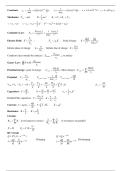
Constants: εo = = 8.85 ×10 −12 Nm
C2
2 , k= = 9.0 ×10 9 Nm 2
, e = 1.6 ×10⁻¹⁹ C, c = 3 × 10 8 m / s
4πk 4πε o C2
1
Mechanics: Fnet = ma K = mv 2 Ki + Ui = K f + U f
2
1
v = v 0 + at x − x 0 = v 0 t + at 2 끫룆 2 − 끫룆0 2 = 2 ( − 0 )
2
k | q1 q 2 | 1 | q1 q 2 |
Coulomb’s Law: F12 = =
r 2
4πε o r 2
Fq kq q
Electric Field: E = o
; Fq = q 0 E Point Charge: E= =
q
o
o , r2 4πε 0 r 2
σ 2kλ
Infinite plane of charge: , Infinite line of charge: E =
E=
2ε 0 r
σ surface
Conductor (just outside the surface): E surface = , ⊥ to surface
ε0
Q
Gauss’ Law: ∫∫ E • dA = enclosed
ε0
kQ1Q2 kQi Q j
Potential energy: a pair of charge: U pair =
r12
, More charges: U total = ∑
pairs rij
UA 1Q kQ
Potential: VA = V po int = Vmetal =
4πε 0 r
ch arg e sphere
q0 , R
UA UB ∆U W AB B dV
V AB = V A − V B = −∆V = − =− = = ∫ E ⋅ ds Es = −
q q q q A ds
Q 2 2 1
Capacitors: C = , =2 = 2
= 2
uE = ε 0 E 2
V 2
Kε 0 A V σ
Parallel Plate capacitors: C = , E= =
d d ε0
dQ
Current: I = nqAv d = , I = ∫ J ⋅ dA , E = ρJ
dt
V L
Resistance: R = , R = ρ
I A
Circuits:
n n
1 1
Req = ∑ R j (n resistances in series) , =∑ (n resistances in parallel)
j =1 Req j =1 R j
V2
P = IV PR = I 2 R =
R
RC Circuit
Q = CV0 (1 − e − t / RC ) Q = Q0 e − t / RC
dQ V0 −t / RC Charging dQ Q Discharging
I= = ( )e I= = ( 0 )e −t / RC
dt R dt RC
,Electric Charge
,Charge: the conclusion first
1. Modern name for two types of charge are
positive charge and negative charge
2. Benjamin Franklin set up convention that a glass
rod rubbed with silk is positively charged
3. By convention, electrons have negative charge
and protons have positive charge
, Atoms and Electricity:
1. Atoms consist of small, dense
nucleus surrounded by
electron cloud
2. Charge is an inherent property
of electrons and protons
3. Electrons and protons have
charges of opposite sign but
equal magnitude
4. This amount of charge is the
fundamental unit of charge,
represented by
e=1.6 x 10⁻¹⁹ Coulomb (C)
Constants: εo = = 8.85 ×10 −12 Nm
C2
2 , k= = 9.0 ×10 9 Nm 2
, e = 1.6 ×10⁻¹⁹ C, c = 3 × 10 8 m / s
4πk 4πε o C2
1
Mechanics: Fnet = ma K = mv 2 Ki + Ui = K f + U f
2
1
v = v 0 + at x − x 0 = v 0 t + at 2 끫룆 2 − 끫룆0 2 = 2 ( − 0 )
2
k | q1 q 2 | 1 | q1 q 2 |
Coulomb’s Law: F12 = =
r 2
4πε o r 2
Fq kq q
Electric Field: E = o
; Fq = q 0 E Point Charge: E= =
q
o
o , r2 4πε 0 r 2
σ 2kλ
Infinite plane of charge: , Infinite line of charge: E =
E=
2ε 0 r
σ surface
Conductor (just outside the surface): E surface = , ⊥ to surface
ε0
Q
Gauss’ Law: ∫∫ E • dA = enclosed
ε0
kQ1Q2 kQi Q j
Potential energy: a pair of charge: U pair =
r12
, More charges: U total = ∑
pairs rij
UA 1Q kQ
Potential: VA = V po int = Vmetal =
4πε 0 r
ch arg e sphere
q0 , R
UA UB ∆U W AB B dV
V AB = V A − V B = −∆V = − =− = = ∫ E ⋅ ds Es = −
q q q q A ds
Q 2 2 1
Capacitors: C = , =2 = 2
= 2
uE = ε 0 E 2
V 2
Kε 0 A V σ
Parallel Plate capacitors: C = , E= =
d d ε0
dQ
Current: I = nqAv d = , I = ∫ J ⋅ dA , E = ρJ
dt
V L
Resistance: R = , R = ρ
I A
Circuits:
n n
1 1
Req = ∑ R j (n resistances in series) , =∑ (n resistances in parallel)
j =1 Req j =1 R j
V2
P = IV PR = I 2 R =
R
RC Circuit
Q = CV0 (1 − e − t / RC ) Q = Q0 e − t / RC
dQ V0 −t / RC Charging dQ Q Discharging
I= = ( )e I= = ( 0 )e −t / RC
dt R dt RC
,Electric Charge
,Charge: the conclusion first
1. Modern name for two types of charge are
positive charge and negative charge
2. Benjamin Franklin set up convention that a glass
rod rubbed with silk is positively charged
3. By convention, electrons have negative charge
and protons have positive charge
, Atoms and Electricity:
1. Atoms consist of small, dense
nucleus surrounded by
electron cloud
2. Charge is an inherent property
of electrons and protons
3. Electrons and protons have
charges of opposite sign but
equal magnitude
4. This amount of charge is the
fundamental unit of charge,
represented by
e=1.6 x 10⁻¹⁹ Coulomb (C)