
Case 1
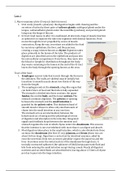
1. Macro-anatomy of the GI-tract (a little bit micro)
1. Oral cavity (mouth + pharynx): the digestion begins with chewing and the
secretion of saliva by three pairs of salivary glands: sublingual glands under the
tongue, submandibular glands under the mandible (jawbone), and parotid glands
lying near the hinge of the jaw.
2. GI tract: food moves in after it is swallowed. At intervals, rings of muscle function
as sphincters to separate the tube into segments with distinct functions. Food
moves through the tract propelled by waves of muscle
contraction. Along the way, secretions are added to the food
by secretory epithelium, the liver, and the pancreas,
creating a soupy mixture known as chyme. Digestion takes
place primarily in the lumen of the tube. The products of
digestion are absorbed across the epithelium and pass into
the extracellular compartment. From there, they move into
the blood or lymph for distribution throughout the body.
Any waste remaining in the lumen at the end of the GI tract
leaves the body through the opening known as the anus.
Tract of the food:
1. Esophagus: narrow tube that travels through the thorax to
the abdomen. The walls are skeletal muscle initially but
transition to smooth muscle about two-thirds of the way
down the length.
2. The esophagus ends at the stomach, a bag-like organ that
can hold 2 liters of food and fluid when fully expanded.
The stomach is divided into three sections: the upper
fundus, the central body, and the lower antrum. The
stomach continues digestion. The pylorus or opening
between the stomach and the small intestine is
guarded by the pyloric valve. This thickened band of
smooth muscle relaxes to allow only small amounts of
chyme into the small intestine at any one time.
The stomach acts as an intermediary between the
behavioural act of eating and the physiological events
of digestion and absorption in the intestine. Integrated
signals and feedback loops between the intestine and
stomach regulate the rate at which chyme enters the duodenum. This ensures
that the intestine is not overwhelmed with more than it can digest and absorb.
3. Most digestion takes place in the small intestine, which is also divided into three
sections: the duodenum (the first 25 cm), jejunum, and ileum (those two are
about 260 cm long). Digestion is carried out by intestinal enzymes, aided by
exocrine secretions from two accessory glandular organs: the pancreas and the
liver. Secretions enter the initial section of the duodenum through ducts. A
tonically contracted sphincter (the sphincter of Oddi) keeps pancreatic fluid and
bile from entering the small intestine except during a meal. Nearly all digested
nutrients and secreted fluids are absorbed here, leaving about 1.5 liters of chyme
per day to pass into the large intestine.
1. Macro-anatomy of the GI-tract (a little bit micro)
1. Oral cavity (mouth + pharynx): the digestion begins with chewing and the
secretion of saliva by three pairs of salivary glands: sublingual glands under the
tongue, submandibular glands under the mandible (jawbone), and parotid glands
lying near the hinge of the jaw.
2. GI tract: food moves in after it is swallowed. At intervals, rings of muscle function
as sphincters to separate the tube into segments with distinct functions. Food
moves through the tract propelled by waves of muscle
contraction. Along the way, secretions are added to the food
by secretory epithelium, the liver, and the pancreas,
creating a soupy mixture known as chyme. Digestion takes
place primarily in the lumen of the tube. The products of
digestion are absorbed across the epithelium and pass into
the extracellular compartment. From there, they move into
the blood or lymph for distribution throughout the body.
Any waste remaining in the lumen at the end of the GI tract
leaves the body through the opening known as the anus.
Tract of the food:
1. Esophagus: narrow tube that travels through the thorax to
the abdomen. The walls are skeletal muscle initially but
transition to smooth muscle about two-thirds of the way
down the length.
2. The esophagus ends at the stomach, a bag-like organ that
can hold 2 liters of food and fluid when fully expanded.
The stomach is divided into three sections: the upper
fundus, the central body, and the lower antrum. The
stomach continues digestion. The pylorus or opening
between the stomach and the small intestine is
guarded by the pyloric valve. This thickened band of
smooth muscle relaxes to allow only small amounts of
chyme into the small intestine at any one time.
The stomach acts as an intermediary between the
behavioural act of eating and the physiological events
of digestion and absorption in the intestine. Integrated
signals and feedback loops between the intestine and
stomach regulate the rate at which chyme enters the duodenum. This ensures
that the intestine is not overwhelmed with more than it can digest and absorb.
3. Most digestion takes place in the small intestine, which is also divided into three
sections: the duodenum (the first 25 cm), jejunum, and ileum (those two are
about 260 cm long). Digestion is carried out by intestinal enzymes, aided by
exocrine secretions from two accessory glandular organs: the pancreas and the
liver. Secretions enter the initial section of the duodenum through ducts. A
tonically contracted sphincter (the sphincter of Oddi) keeps pancreatic fluid and
bile from entering the small intestine except during a meal. Nearly all digested
nutrients and secreted fluids are absorbed here, leaving about 1.5 liters of chyme
per day to pass into the large intestine.


