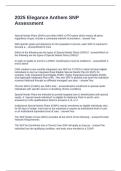
2025 Elegance Anthem SNP
Assessment
Special Needs Plans (SNPs) are either HMO or PPO plans which means all plans,
regardless of type, include a contracted network of providers. - answerTrue
With specific goals and objectives for the population it serves, each SNP is required to
develop a: - answerModel of Care
Which of the following are the types of Special Needs Plans (SNPs)? - answerWhich of
the following are the types of Special Needs Plans (SNPs)?
In order to qualify to enroll in a DSNP, beneficiaries must be entitled to: - answerBoth A
and B above
CMS created a new monthly integrated care SEP for CY2025 to allow full dual eligible
individuals to elect an integrated Dual Eligible Special Needs Plan (D-SNP); for
example, Fully Integrated Dual Eligible (FIDE), Highly Integrated Dual Eligible (HIDE),
and Applicable Integrated Plan (AIP). This new SEP is allowed only when the individual
receives Medicaid through an affiliated managed care plan. - answerTrue
Chronic SNPs (CSNPs) are SNPs that: - answerRestrict enrollment to special needs
individuals with specific severe or disabling chronic conditions
Special Needs Plans are intended to provide targeted care to beneficiaries with special
needs. A "special needs individual" is eligible for Medicare Parts A and B, and: -
answerAny of the qualifications listed in answers A, B, or C
Institutional Special Needs Plans (ISNPs) restrict enrollment to eligible individuals who,
for 90 days or longer, have had or are expected to require an institutional level of care,
or an institutional equivalent level of care. - answerTrue
The SNP Model of Care (MOC) includes all but which of the following: - answerProvider
Network Requirements
The SEP for Enrollment into a Chronic Care SNP will apply as long as: - answerThe
individual has the qualifying condition, and ends once enrolled in a CSNP
Assessment
Special Needs Plans (SNPs) are either HMO or PPO plans which means all plans,
regardless of type, include a contracted network of providers. - answerTrue
With specific goals and objectives for the population it serves, each SNP is required to
develop a: - answerModel of Care
Which of the following are the types of Special Needs Plans (SNPs)? - answerWhich of
the following are the types of Special Needs Plans (SNPs)?
In order to qualify to enroll in a DSNP, beneficiaries must be entitled to: - answerBoth A
and B above
CMS created a new monthly integrated care SEP for CY2025 to allow full dual eligible
individuals to elect an integrated Dual Eligible Special Needs Plan (D-SNP); for
example, Fully Integrated Dual Eligible (FIDE), Highly Integrated Dual Eligible (HIDE),
and Applicable Integrated Plan (AIP). This new SEP is allowed only when the individual
receives Medicaid through an affiliated managed care plan. - answerTrue
Chronic SNPs (CSNPs) are SNPs that: - answerRestrict enrollment to special needs
individuals with specific severe or disabling chronic conditions
Special Needs Plans are intended to provide targeted care to beneficiaries with special
needs. A "special needs individual" is eligible for Medicare Parts A and B, and: -
answerAny of the qualifications listed in answers A, B, or C
Institutional Special Needs Plans (ISNPs) restrict enrollment to eligible individuals who,
for 90 days or longer, have had or are expected to require an institutional level of care,
or an institutional equivalent level of care. - answerTrue
The SNP Model of Care (MOC) includes all but which of the following: - answerProvider
Network Requirements
The SEP for Enrollment into a Chronic Care SNP will apply as long as: - answerThe
individual has the qualifying condition, and ends once enrolled in a CSNP