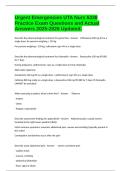
Urgent Emergencies UTA Nurs 5338
Practice Exam Questions and Actual
Answers 2025-2026 Updated.
Describe the pharmacological treatment for gonorrhea - Answer Ceftriaxone 500 mg IM as a
single dose, for persons weighing < 150 kg
For persons weighing > 150 kg, ceftriaxone 1gm IM as a single dose
Describe the pharmacological treatment for chlamydia - Answer Doxycycline 100 mg PO BID
for 7 days
During pregnancy, azithromycin 1 gm as a single dose to treat chlamydia
Alternative regimens:
Gentamicin 240 mg IM as a single dose + azithromycin 2 gm PO as a single dose
Cefixime 800 mg orally as a single dose + doxycycline 100 mg PO BID for 7 days (if chlamydia
CANNOT be excluded)
When assessing a patient, what is done first? - Answer - Observe
- Inspect
- Listen
- Palpate, respectively
Describe assessment findings for appendicitis - Answer Abdominal pain, usually severe;
localized to the right lower quadrant (RLQ)
Most common symptoms: anorexia, abdominal pain, nausea and vomiting (typically present in
this order)
Constipation and diarrhea occur after the pain
Describe acute abdominal pain - Answer - severe, persistent pain
- sudden onset
- nausea, vomiting
- abdominal distention
- fever, signs of shock
, How is sepsis handled in the primary care setting? - Answer refer patient to the ED
Describe treatment for an abscess - Answer I&D
Describe assessment findings for cellulitis - Answer Erythema
Warmth
Edema
Pain
Fever
Lymphadenopathy
Fissuring, scaling or maceration in toe webs may be source of colonization (treat with antifungal
agents such as econazole, naftifine)
History of recurrent abscesses
How is a puncture wound from an animal bite treated? - Answer - typically not sutured closed
- treat with Augmentin
Describe assessment findings for bacterial vaginosis - Answer Most women with BV are
asymptomatic
Fishy or musty vaginal odor, more prominent after sexual intercourse and menses
Thin, homogenous discharge
No redness or edema
Normal bimanual exam
Describe the diagnostic study for bacterial vaginosis - Answer Amsel's criteria specify that
diagnosis of BV requires three or more of the following clinical signs and symptoms:
- Homogenous, thin, gray-white discharge coating the vaginal wall
- Vaginal pH >4.5
- Positive whiff test: amine (fishy) odor after application of 10% KOH on vaginal discharge
sample
- Presence of more than 20% epithelial cells (clue cells) on saline microscopy: microscopic
evaluation of vaginal discharge on glass slide with normal saline shows few WBCs, and epithelial
cells are obscured with coccobacilli.
Practice Exam Questions and Actual
Answers 2025-2026 Updated.
Describe the pharmacological treatment for gonorrhea - Answer Ceftriaxone 500 mg IM as a
single dose, for persons weighing < 150 kg
For persons weighing > 150 kg, ceftriaxone 1gm IM as a single dose
Describe the pharmacological treatment for chlamydia - Answer Doxycycline 100 mg PO BID
for 7 days
During pregnancy, azithromycin 1 gm as a single dose to treat chlamydia
Alternative regimens:
Gentamicin 240 mg IM as a single dose + azithromycin 2 gm PO as a single dose
Cefixime 800 mg orally as a single dose + doxycycline 100 mg PO BID for 7 days (if chlamydia
CANNOT be excluded)
When assessing a patient, what is done first? - Answer - Observe
- Inspect
- Listen
- Palpate, respectively
Describe assessment findings for appendicitis - Answer Abdominal pain, usually severe;
localized to the right lower quadrant (RLQ)
Most common symptoms: anorexia, abdominal pain, nausea and vomiting (typically present in
this order)
Constipation and diarrhea occur after the pain
Describe acute abdominal pain - Answer - severe, persistent pain
- sudden onset
- nausea, vomiting
- abdominal distention
- fever, signs of shock
, How is sepsis handled in the primary care setting? - Answer refer patient to the ED
Describe treatment for an abscess - Answer I&D
Describe assessment findings for cellulitis - Answer Erythema
Warmth
Edema
Pain
Fever
Lymphadenopathy
Fissuring, scaling or maceration in toe webs may be source of colonization (treat with antifungal
agents such as econazole, naftifine)
History of recurrent abscesses
How is a puncture wound from an animal bite treated? - Answer - typically not sutured closed
- treat with Augmentin
Describe assessment findings for bacterial vaginosis - Answer Most women with BV are
asymptomatic
Fishy or musty vaginal odor, more prominent after sexual intercourse and menses
Thin, homogenous discharge
No redness or edema
Normal bimanual exam
Describe the diagnostic study for bacterial vaginosis - Answer Amsel's criteria specify that
diagnosis of BV requires three or more of the following clinical signs and symptoms:
- Homogenous, thin, gray-white discharge coating the vaginal wall
- Vaginal pH >4.5
- Positive whiff test: amine (fishy) odor after application of 10% KOH on vaginal discharge
sample
- Presence of more than 20% epithelial cells (clue cells) on saline microscopy: microscopic
evaluation of vaginal discharge on glass slide with normal saline shows few WBCs, and epithelial
cells are obscured with coccobacilli.