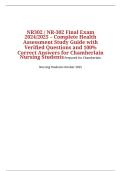
NR302 / NR-302 Final Exam
2024/2025 – Complete Health
Assessment Study Guide with
Verified Questions and 100%
Correct Answers for Chamberlain
Nursing Students Prepared for Chamberlain
Nursing Students October 2025
, 1 Introduction
This study guide is a comprehensive resource tailored for Chamberlain Nurs-
ing students preparing for the NR302 Health Assessment final exam. It focuses
on essential concepts, techniques, and clinical applications, with a streamlined
approach to reduce extraneous content. The guide includes over 250 questions,
incorporating 100 additional relevant questions to enhance coverage of critical
topics such as the nursing process, vital signs, physical examination, and system-
specific assessments. Each question is paired with a concise, verified answer to
facilitate effective study and retention. Use this guide to prepare for multiple-
choice, short-answer, and scenario-based questions.
2 Fundamentals of Health Assessment
Q1: What condition requires immediate intervention during a patient en-
counter?
A1: Rapid, labored breathing preventing speech or unresponsiveness.
Q2: Which findings are not considered urgent during an initial assessment?
A2: Patient clutching abdomen, toddler clinging to parent, or reported pain
without distress signs.
Q3: How should nurses ensure privacy with physical patient records?
A3: Secure records in storage, close charts when entering rooms, lock draw-
ers, and shield from view.
Q4: What is the priority action if a UAP is found unconscious during an as-
sessment?
A4: Assess the UAP immediately.
Q5: When is data collection part of the health assessment process?
A5: During complete assessments, medication administration, or partner
interviews; not from casual observations or notes.
Q6: What is the primary goal of a rapid screening assessment?
A6: To evaluate urgency using consciousness, breathing, and posture.
Q7: What is the purpose of a complete health assessment?
A7: To create a comprehensive baseline with detailed history and physical
exam.
Q8: What is the focus of a problem-centered assessment?
A8: To collect data on specific complaints or abnormal findings.
Q9: What does a follow-up assessment aim to achieve?
A9: To monitor treatment outcomes, conducted as needed.
Q10: What is the role of an emergency assessment?
A10: To gather critical data in life-threatening situations using the ABCDE
framework.
1
, Q11: Which assessment is appropriate for an unresponsive patient with sta-
ble vitals?
A11: Rapid assessment.
Q12: Where does post-hip replacement safety fall in Maslow’s hierarchy?
A12: Safety needs.
Q13: Which nursing process phase involves collecting allergy and medica-
tion history?
A13: Assessment.
Q14: In which phase is data analyzed for health alterations?
A14: Diagnosis.
Q15: Which phase involves prioritizing patient needs and setting goals?
A15: Planning.
Q16: Which phase focuses on executing prioritized interventions?
A16: Implementation.
Q17: What structures are visible during a fundoscopic exam?
A17: Optic disc, blood vessels, macula, and retinal background.
Q18: What indicates a positive consensual light reflex?
A18: Both pupils constrict simultaneously when light is shone in one.
Q19: What eye condition is associated with aging lens changes?
A19: Cataract.
Q20: What eye symptom signals an emergency?
A20: Sudden loss or change in vision.
Q21: Which tool is used to test visual acuity?
A21: Snellen chart.
Q22: What does the cover-uncover test evaluate?
A22: Extraocular muscle weakness.
Q23: How should an ophthalmoscope be used for a patient’s left eye?
A23: Remove glasses; examiner uses left eye to approach patient’s left eye.
Q24: Which cranial nerves control eye movement?
A24: III (oculomotor), IV (trochlear), VI (abducens).
Q25: What is a hallmark sign of conjunctivitis?
A25: Redness of the conjunctiva.
Q26: What is the normal peripheral vision angle?
A26: Approximately 90 degrees.
Q27: What happens to pupils when light is shone in the right eye of a patient
blind in the left eye?
A27: Both pupils constrict.
Q28: What causes an interrupted red reflex during fundoscopy?
A28: Opacity in the cornea or lens.
2
2024/2025 – Complete Health
Assessment Study Guide with
Verified Questions and 100%
Correct Answers for Chamberlain
Nursing Students Prepared for Chamberlain
Nursing Students October 2025
, 1 Introduction
This study guide is a comprehensive resource tailored for Chamberlain Nurs-
ing students preparing for the NR302 Health Assessment final exam. It focuses
on essential concepts, techniques, and clinical applications, with a streamlined
approach to reduce extraneous content. The guide includes over 250 questions,
incorporating 100 additional relevant questions to enhance coverage of critical
topics such as the nursing process, vital signs, physical examination, and system-
specific assessments. Each question is paired with a concise, verified answer to
facilitate effective study and retention. Use this guide to prepare for multiple-
choice, short-answer, and scenario-based questions.
2 Fundamentals of Health Assessment
Q1: What condition requires immediate intervention during a patient en-
counter?
A1: Rapid, labored breathing preventing speech or unresponsiveness.
Q2: Which findings are not considered urgent during an initial assessment?
A2: Patient clutching abdomen, toddler clinging to parent, or reported pain
without distress signs.
Q3: How should nurses ensure privacy with physical patient records?
A3: Secure records in storage, close charts when entering rooms, lock draw-
ers, and shield from view.
Q4: What is the priority action if a UAP is found unconscious during an as-
sessment?
A4: Assess the UAP immediately.
Q5: When is data collection part of the health assessment process?
A5: During complete assessments, medication administration, or partner
interviews; not from casual observations or notes.
Q6: What is the primary goal of a rapid screening assessment?
A6: To evaluate urgency using consciousness, breathing, and posture.
Q7: What is the purpose of a complete health assessment?
A7: To create a comprehensive baseline with detailed history and physical
exam.
Q8: What is the focus of a problem-centered assessment?
A8: To collect data on specific complaints or abnormal findings.
Q9: What does a follow-up assessment aim to achieve?
A9: To monitor treatment outcomes, conducted as needed.
Q10: What is the role of an emergency assessment?
A10: To gather critical data in life-threatening situations using the ABCDE
framework.
1
, Q11: Which assessment is appropriate for an unresponsive patient with sta-
ble vitals?
A11: Rapid assessment.
Q12: Where does post-hip replacement safety fall in Maslow’s hierarchy?
A12: Safety needs.
Q13: Which nursing process phase involves collecting allergy and medica-
tion history?
A13: Assessment.
Q14: In which phase is data analyzed for health alterations?
A14: Diagnosis.
Q15: Which phase involves prioritizing patient needs and setting goals?
A15: Planning.
Q16: Which phase focuses on executing prioritized interventions?
A16: Implementation.
Q17: What structures are visible during a fundoscopic exam?
A17: Optic disc, blood vessels, macula, and retinal background.
Q18: What indicates a positive consensual light reflex?
A18: Both pupils constrict simultaneously when light is shone in one.
Q19: What eye condition is associated with aging lens changes?
A19: Cataract.
Q20: What eye symptom signals an emergency?
A20: Sudden loss or change in vision.
Q21: Which tool is used to test visual acuity?
A21: Snellen chart.
Q22: What does the cover-uncover test evaluate?
A22: Extraocular muscle weakness.
Q23: How should an ophthalmoscope be used for a patient’s left eye?
A23: Remove glasses; examiner uses left eye to approach patient’s left eye.
Q24: Which cranial nerves control eye movement?
A24: III (oculomotor), IV (trochlear), VI (abducens).
Q25: What is a hallmark sign of conjunctivitis?
A25: Redness of the conjunctiva.
Q26: What is the normal peripheral vision angle?
A26: Approximately 90 degrees.
Q27: What happens to pupils when light is shone in the right eye of a patient
blind in the left eye?
A27: Both pupils constrict.
Q28: What causes an interrupted red reflex during fundoscopy?
A28: Opacity in the cornea or lens.
2