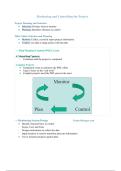
Monitoring and Controlling the Project
Project Planning and Selection
● Selection: Dictates what to monitor
● Planning: Identifies elements to control
M&C follow Selection and Planning
● Monitor: Collect, record & report project information
● Control: Use data to align project with the plan
→ Plan-Monitor-Control (PMC) Cycle
A “closed loop” process
- Continues until the project is completed
Complex Projects
● Temptation exists to minimize the PMC effort
● Urge to focus on the “real work”
● Complex projects need the PMC process the most
→ Monitoring System Design ProjectManager.com
● Identify characteristics to control
- Scope, Cost, and Time
- Design mechanisms to collect the data
- Input/Analysis is used to transform data into information
● Use to measure progress against plan
, In order to sufficiently monitor and control the different elements of the project, you need to
identify upfront what data needs to be collected and reported upon…
→ Data Collection and Reporting Questions to consider:
● How should the data be collected?
● Should special forms/templates be used?
● When should the data be collected?
● Should data be collected before/after milestones?
● Should time/cost be collected at the same time?
● What type of data should be collected? Time, cost, resource usage, etc.
● How should we track progress?
→ Routine Reporting
● Information dissemination
- Customize information for difference audiences
- Ensure timing allows for corrective action
● “Routine” performance reports
- Project status reports (since the last time)
- Time/Cost reports
- Variance reports
Reporting Benefits:
1. Ensures common understanding amongst stakeholders
2. Establish & maintain a communication network
3. Communicate changes to a project
4. Fosters transparency and visibility
5. Improves motivation
→ Exception Report
● Used for unexpected situations and decisions
● Typically, an “issue” that is out of tolerance
● Team members need to be made aware, and the change itself documented
→ Meetings
● Regular
● Highly formalized and structured sessions
● Informal/off-the-cuff gatherings
Project Planning and Selection
● Selection: Dictates what to monitor
● Planning: Identifies elements to control
M&C follow Selection and Planning
● Monitor: Collect, record & report project information
● Control: Use data to align project with the plan
→ Plan-Monitor-Control (PMC) Cycle
A “closed loop” process
- Continues until the project is completed
Complex Projects
● Temptation exists to minimize the PMC effort
● Urge to focus on the “real work”
● Complex projects need the PMC process the most
→ Monitoring System Design ProjectManager.com
● Identify characteristics to control
- Scope, Cost, and Time
- Design mechanisms to collect the data
- Input/Analysis is used to transform data into information
● Use to measure progress against plan
, In order to sufficiently monitor and control the different elements of the project, you need to
identify upfront what data needs to be collected and reported upon…
→ Data Collection and Reporting Questions to consider:
● How should the data be collected?
● Should special forms/templates be used?
● When should the data be collected?
● Should data be collected before/after milestones?
● Should time/cost be collected at the same time?
● What type of data should be collected? Time, cost, resource usage, etc.
● How should we track progress?
→ Routine Reporting
● Information dissemination
- Customize information for difference audiences
- Ensure timing allows for corrective action
● “Routine” performance reports
- Project status reports (since the last time)
- Time/Cost reports
- Variance reports
Reporting Benefits:
1. Ensures common understanding amongst stakeholders
2. Establish & maintain a communication network
3. Communicate changes to a project
4. Fosters transparency and visibility
5. Improves motivation
→ Exception Report
● Used for unexpected situations and decisions
● Typically, an “issue” that is out of tolerance
● Team members need to be made aware, and the change itself documented
→ Meetings
● Regular
● Highly formalized and structured sessions
● Informal/off-the-cuff gatherings