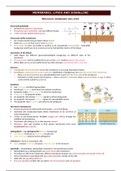
MEMBRANES, LIPIDS AND SIGNALLING
BIOLOGICAL MEMBRANES AND LIPIDS
Glycerophospholipids
Derived from glycerol-3-phosphate
Phosphate head, hydrophilic, can have different heads
2 fatty acid tails and phosphate group
Movement within membranes
No covalent bonds between lipids, bilayer is fluid
Lipids can rotate on their axis or move laterally
Don’t easily flip from one leaflet to another as its energetically unfavourable - hydrophilic
headgroup would have to be moved across the hydrophobic interior of the bilayer
Asymmetry of the bilayer
Lipid bilayer has different glycerophospholipid headgroups on different sides of the
membrane
Phosphoinositol and its modified forms are on the inside ready to signal to the cytosol
When lipids are on correct leaflet they’ll stay there because spontaneous flip is very slow
Enzymes
Translocase: flip phospholipids across the membrane in an energy dependent fashion
Scramblase: randomise the normal membrane distribution of headgroups and undo the work of the translocases
o Allow aminophospholipids (e.g. phosphatidylserine) to get from the inner side of the membrane
o Switched on under special circumstances - when a platelet is activated, when a sperm fertilises an egg, or when
a cell commits suicide by apoptosis
Apoptosis
1. Cell shrinkage and DNA fragmentation
2. Membrane blebbing- protrusion from plasma membrane
3. Apoptotic bodies, blebs break off to form the membranes
4. Phagocytosis of apoptotic bodies
5. An apoptotic cell releases ‘find me’ signals to attract phagocytes
6. An apoptotic cell exposes ‘eat me’ signals (PS: phosphatidyl serine)
7. The apoptotic cell is engulfed and eaten by the phagocyte
Structural consequences
Kinked phospholipid chains pack more loosely - more fluid bilayer
Saturated and unsaturated lipids allows membranes to be semifluid at
room temperature
Solidify at cold temperatures- frostbite- oxygen can’t diffuse through the
solidified cell membranes
Outermost cells being to die as they become starved
Reindeers- don’t get frostbite as their plasma membranes have more
unsaturated fatty acid tails
Sphingolipids – e.g. sphingomyelin (choline head group)
Sphingosine molecule as backbone, not glycerol
Fatty acid chain attached to the sphingosine
Cholesterol - sterol in mammalian cells
Rigid, compact fused ring structure, aliphatic chain in the structure
Lipid Rafts – phospholipid, sphingolipid, cholesterol, transmembrane protein
Sphingolipids (e.g. sphingomyelin) can pack closely with cholesterol
Formation of rafts in the membrane, different membrane proteins are anchored inside and outside of the raft
Some cholesterol is associated with glycerophospholipids outside of the rafts
Lipid rafts are signalling platforms
Excess or depletion of lipid rafts can affect cell communication and cell signalling
, Membranes can form caveolae and invaginate (a way viruses can be internalized)
Diseases linked to lipid raft alterations
Neuronal Autoimmune
Smith-Lemli-Opitz syndrome Lupis erythematosus
Huntington Rheumatoid arthritis
Alzheimer’s
Niemman-Pick Type C
Glycolipids
Gangliosides are a family of sphingolipids, abundant in the brain, have a sugar group attached to sphingosine
Hydrophilic sugar group of gangliosides exposed on the outer part of the plasma membrane
Sugars added to glycoproteins and gangliosides in the ER
Vesicles from the ER travel to the Golgi so more sugar residues are added (branched antenna structure)
Exocytosis or remain in the membrane
Glycolipids are reinternalized during endocytosis and trimmed at lysosomes
Lysosomes- sites of degradation in cells, trimming back sugar trees on glycolipids
Glycolipids- ABO antigen in RBCs, the branched glycan attachment to the lipid is recognition site for immune system
o Binding of antibodies induces blood agglutination
Ganglioside deficiency causes inflammation and neurodegeneration
SER: site of lipid synthesis
ER and Golgi sites of sugar addition
Plasma membrane: fusion of secretary vesicles
Neutral lipids
Amphipathic – cholesterol, phospholipids, glycerolipids can form membranes
Triglycerides and cholesterol esters don’t form membranes, pack inside structures (e.g. lipoproteins are transported
into the blood)
Lipid storage droplets- cholesterol esters/ triacylglycerols are deposited in the cell, stored in the liver after a meal for
release as lipoproteins
Hepatitis Type C: A capsid (Core) and a non structural protein (NS5A) are targeted to LDs. HCV particles assemble at
LDs. Disturbance of LD targeting suppresses HCV.
Neutral lipid storage disease (Chanarin–Dorfman syndrome, CDS): deposition of TAGs in different tissues but not in
adipose tissue
Lipodystrophy: Loss of adipose tissue
Cholesterol ester droplets in the adrenal gland are store of cholesterol for steroid hormone production
Hepatosteatosis: liver takes in more lipids in the diet than it needs for releasing lipoproteins large lipid droplets
accumulate in the tissue
Liposomes – flexible structures (LEGO system)
Vesicles that can be produced artificially- loaded with dyes, RNA, drugs, DNA
Naturally occurring liposomes can be measured in the bloods (miRNA containing vesicles)
From remains of cells or exosomal particles
Used in diagnostics and surgery
Diagnostic = fluorescent dye + mrt dye
Therapeutic = targeted drug delivery
MEMBRANE PROTEINS AND CARBOHYDRATES
Alzheimer’s disease
Dementia: serious deterioration in mental functions, such as memory, language, orientation and judgement
Alzheimer’s – most common cause of dementia
Symptoms caused by: nerve cells in the brain dying & connections between nerve cells degenerating
Loss of short term memory, progressive dementia
Pathological brain lesions - senile plaques consisting of amyloid (A) peptide
A peptide is proteolytically cleaved from the membrane-bound amyloid precursor protein (APP)
Drugs to temporarily relieve symptoms: cholinesterase inhibitors (Aricept, Exelon, Reminyl), NMDA receptor
antagonist (Ebixa), antipsychotic drugs
Clinical features
Amnesia- short term memory
BIOLOGICAL MEMBRANES AND LIPIDS
Glycerophospholipids
Derived from glycerol-3-phosphate
Phosphate head, hydrophilic, can have different heads
2 fatty acid tails and phosphate group
Movement within membranes
No covalent bonds between lipids, bilayer is fluid
Lipids can rotate on their axis or move laterally
Don’t easily flip from one leaflet to another as its energetically unfavourable - hydrophilic
headgroup would have to be moved across the hydrophobic interior of the bilayer
Asymmetry of the bilayer
Lipid bilayer has different glycerophospholipid headgroups on different sides of the
membrane
Phosphoinositol and its modified forms are on the inside ready to signal to the cytosol
When lipids are on correct leaflet they’ll stay there because spontaneous flip is very slow
Enzymes
Translocase: flip phospholipids across the membrane in an energy dependent fashion
Scramblase: randomise the normal membrane distribution of headgroups and undo the work of the translocases
o Allow aminophospholipids (e.g. phosphatidylserine) to get from the inner side of the membrane
o Switched on under special circumstances - when a platelet is activated, when a sperm fertilises an egg, or when
a cell commits suicide by apoptosis
Apoptosis
1. Cell shrinkage and DNA fragmentation
2. Membrane blebbing- protrusion from plasma membrane
3. Apoptotic bodies, blebs break off to form the membranes
4. Phagocytosis of apoptotic bodies
5. An apoptotic cell releases ‘find me’ signals to attract phagocytes
6. An apoptotic cell exposes ‘eat me’ signals (PS: phosphatidyl serine)
7. The apoptotic cell is engulfed and eaten by the phagocyte
Structural consequences
Kinked phospholipid chains pack more loosely - more fluid bilayer
Saturated and unsaturated lipids allows membranes to be semifluid at
room temperature
Solidify at cold temperatures- frostbite- oxygen can’t diffuse through the
solidified cell membranes
Outermost cells being to die as they become starved
Reindeers- don’t get frostbite as their plasma membranes have more
unsaturated fatty acid tails
Sphingolipids – e.g. sphingomyelin (choline head group)
Sphingosine molecule as backbone, not glycerol
Fatty acid chain attached to the sphingosine
Cholesterol - sterol in mammalian cells
Rigid, compact fused ring structure, aliphatic chain in the structure
Lipid Rafts – phospholipid, sphingolipid, cholesterol, transmembrane protein
Sphingolipids (e.g. sphingomyelin) can pack closely with cholesterol
Formation of rafts in the membrane, different membrane proteins are anchored inside and outside of the raft
Some cholesterol is associated with glycerophospholipids outside of the rafts
Lipid rafts are signalling platforms
Excess or depletion of lipid rafts can affect cell communication and cell signalling
, Membranes can form caveolae and invaginate (a way viruses can be internalized)
Diseases linked to lipid raft alterations
Neuronal Autoimmune
Smith-Lemli-Opitz syndrome Lupis erythematosus
Huntington Rheumatoid arthritis
Alzheimer’s
Niemman-Pick Type C
Glycolipids
Gangliosides are a family of sphingolipids, abundant in the brain, have a sugar group attached to sphingosine
Hydrophilic sugar group of gangliosides exposed on the outer part of the plasma membrane
Sugars added to glycoproteins and gangliosides in the ER
Vesicles from the ER travel to the Golgi so more sugar residues are added (branched antenna structure)
Exocytosis or remain in the membrane
Glycolipids are reinternalized during endocytosis and trimmed at lysosomes
Lysosomes- sites of degradation in cells, trimming back sugar trees on glycolipids
Glycolipids- ABO antigen in RBCs, the branched glycan attachment to the lipid is recognition site for immune system
o Binding of antibodies induces blood agglutination
Ganglioside deficiency causes inflammation and neurodegeneration
SER: site of lipid synthesis
ER and Golgi sites of sugar addition
Plasma membrane: fusion of secretary vesicles
Neutral lipids
Amphipathic – cholesterol, phospholipids, glycerolipids can form membranes
Triglycerides and cholesterol esters don’t form membranes, pack inside structures (e.g. lipoproteins are transported
into the blood)
Lipid storage droplets- cholesterol esters/ triacylglycerols are deposited in the cell, stored in the liver after a meal for
release as lipoproteins
Hepatitis Type C: A capsid (Core) and a non structural protein (NS5A) are targeted to LDs. HCV particles assemble at
LDs. Disturbance of LD targeting suppresses HCV.
Neutral lipid storage disease (Chanarin–Dorfman syndrome, CDS): deposition of TAGs in different tissues but not in
adipose tissue
Lipodystrophy: Loss of adipose tissue
Cholesterol ester droplets in the adrenal gland are store of cholesterol for steroid hormone production
Hepatosteatosis: liver takes in more lipids in the diet than it needs for releasing lipoproteins large lipid droplets
accumulate in the tissue
Liposomes – flexible structures (LEGO system)
Vesicles that can be produced artificially- loaded with dyes, RNA, drugs, DNA
Naturally occurring liposomes can be measured in the bloods (miRNA containing vesicles)
From remains of cells or exosomal particles
Used in diagnostics and surgery
Diagnostic = fluorescent dye + mrt dye
Therapeutic = targeted drug delivery
MEMBRANE PROTEINS AND CARBOHYDRATES
Alzheimer’s disease
Dementia: serious deterioration in mental functions, such as memory, language, orientation and judgement
Alzheimer’s – most common cause of dementia
Symptoms caused by: nerve cells in the brain dying & connections between nerve cells degenerating
Loss of short term memory, progressive dementia
Pathological brain lesions - senile plaques consisting of amyloid (A) peptide
A peptide is proteolytically cleaved from the membrane-bound amyloid precursor protein (APP)
Drugs to temporarily relieve symptoms: cholinesterase inhibitors (Aricept, Exelon, Reminyl), NMDA receptor
antagonist (Ebixa), antipsychotic drugs
Clinical features
Amnesia- short term memory