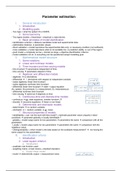
Parameter estimation
I. General introduction
1. Introduction
2. Modelling goals
- Two type = what the system IS or DOES.
3. Some taxonomy
- Two types models = theoretical + empirical (= data-driven).
4. Basic principles of model identification
- identification criterion = distance candidate model and experimental data.
- optimization distance à parameter values.
- direct validation = model reproduce the experimental data only à necessary condition (not sufficient).
cross validation = model reproduce what is not available too à prediction ability à out of the region.
- good model = complexity as low + domain as large + objective identification criterion.
- model validation not ok à everything can be questioned except modelling goal.
II. Mathematical model structure
1. Some notations
2. Linear and nonlinear models
3. Time-invariant and time-varying models
- time invariant à parameters independent of time.
- time varying à parameters depend of time.
4. Algebraic and differential models
- algebraic à no derivatives.
- differential à ∃ derivatives with respect to independent variable.
- scalar algebraic linear time-invariant
- scalar algebraic nonlinear time invariant
- differential linear time-invariant à state + output equation
(A= system, B=command, C= measurement, D= instantaneous)
- differential nonlinear time-invariant
- time varying à same but θ depends on time.
5. Continuous-time and discrete-time models
- continuous à ex: state equations, transfer function LTI
- discrete à recursive equations à linear or non linear
6. Deterministic and stochastic models
- deterministic à no random variable.
- stochastic à∃ random variable à ex: noise.
7. Structural properties of models
- identifiability = can I do the work with this model? = estimate parameter value uniquely in ideal
conditions à parameter globally or locally identifiable ?
globally = model output same for two parameters à parameters the same à comparison with all the
parameters.
Locally = model output same for two parameters à parameters the same à comparison with the
neighbour value.
- Distinguishability = which model is the best based on the available measurement? à not having the
same output for two parameters.
III. Identification criteria
1. Introduction
2. Least square criterion
a. Introduction
- quadratic cost function used.
- weighting matrix à best choice = standard deviation.
b. Scalar linear model
- model à deterministic output + measurement noise
I. General introduction
1. Introduction
2. Modelling goals
- Two type = what the system IS or DOES.
3. Some taxonomy
- Two types models = theoretical + empirical (= data-driven).
4. Basic principles of model identification
- identification criterion = distance candidate model and experimental data.
- optimization distance à parameter values.
- direct validation = model reproduce the experimental data only à necessary condition (not sufficient).
cross validation = model reproduce what is not available too à prediction ability à out of the region.
- good model = complexity as low + domain as large + objective identification criterion.
- model validation not ok à everything can be questioned except modelling goal.
II. Mathematical model structure
1. Some notations
2. Linear and nonlinear models
3. Time-invariant and time-varying models
- time invariant à parameters independent of time.
- time varying à parameters depend of time.
4. Algebraic and differential models
- algebraic à no derivatives.
- differential à ∃ derivatives with respect to independent variable.
- scalar algebraic linear time-invariant
- scalar algebraic nonlinear time invariant
- differential linear time-invariant à state + output equation
(A= system, B=command, C= measurement, D= instantaneous)
- differential nonlinear time-invariant
- time varying à same but θ depends on time.
5. Continuous-time and discrete-time models
- continuous à ex: state equations, transfer function LTI
- discrete à recursive equations à linear or non linear
6. Deterministic and stochastic models
- deterministic à no random variable.
- stochastic à∃ random variable à ex: noise.
7. Structural properties of models
- identifiability = can I do the work with this model? = estimate parameter value uniquely in ideal
conditions à parameter globally or locally identifiable ?
globally = model output same for two parameters à parameters the same à comparison with all the
parameters.
Locally = model output same for two parameters à parameters the same à comparison with the
neighbour value.
- Distinguishability = which model is the best based on the available measurement? à not having the
same output for two parameters.
III. Identification criteria
1. Introduction
2. Least square criterion
a. Introduction
- quadratic cost function used.
- weighting matrix à best choice = standard deviation.
b. Scalar linear model
- model à deterministic output + measurement noise