

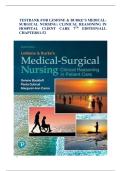
TESTBANK FOR LEMONE & BURKE’S MEDICAL-
b b b b b
SURGICAL NURSING: CLINICAL REASONING IN
b b b b b
HOSPITAL CLIENT CARE 7TH EDITION/ALL
b b b b b
CHAPTERS1-52
b b
,Chapter1 b
1. Thecaregiver iscaring forfourHospital clientsona medical–surgicalunit. Which
b b b b b b b b b b b b
Hospital client should the caregiver see initially?
b b b b b b b
1. AHospital client admitted withhepatitisAwho hashad severe diarrhea for
b b b b b b b b b b b b
thelast 24 hours
b b b b
2. AHospital client admittedwithpneumonia who ishassmallamounts
b b b b b b b b b b
ofyellow productive sputum
b b b b
3. AHospital client admitted with fever ofunknownorigin(FUO) who
b b b b b b b b b b
hasbeen without fever for the last 48 hours
b b b b b b b b b
4. A Hospital client admitted with a wound infection whose WBC is 8,500
b b b b b b b b b b b
bmm3ACCURATE ANSWER:-1
b b
Reasoning:->>>Thecaregiver must decidewhichHospital client should beseenontheinitial b b b b b b b b b b b b
roundsofthe day. The caregiver must remember thatthe first
b b b b b b b b b b b
Hospital client to be seenshould be the Hospital client who needs the attentionofthe
b b b b b b b b b b b b b b b
caregiver initially. A Hospital client with hepatitis A does experience diarrhea,but
b b b b b b b b b b b b
diarrhea for the last 24 hours could cause the Hospital client to have a problem with
b b b b b b b b b b b b b b b b
dehydration and experience a stateof fluid volume deficit.
b b b b b b b b b
CognitiveLevel:Application b b
Hospital clientNeeds:Safe,EffectiveCareEnvironment
b b b b b b
Nursing Process: Planning
b b b
2. The caregiver is preparing to administer influenza vaccines to a mass drive-throughclinic.
b b b b b b b b b b b b b
Whichstatement bya Hospital client would indicate further questioning priortogiving the
b b b b b b b b b b b b b b
Hospital client the influenza vaccine?
b b b b b
1. “Iamallergic to horsehair.” b b b b b
2. “I tryto get myvaccine everyyear.” b b b b b b b
3. “Iamnot allergicto anythingexcept eggs.”
b b b b b b b
4. “Myhusband hadasevereallergicreactionafterhereceived hisinfluenza b b b b b b b b b b b
vaccine.”
b
ACCURATE ANSWER:-3 b
Reasoning:->>>Influenza vaccines are recommended for person at high risk for serious b b b b b b b b b b
sequelae of influenza. The caregiver should be aware that Hospital client with a
b b b b b b b b b b b b b
sensitivity to eggs should not receive the vaccine. Vaccines prepared from chickenor
b b b b b b b b b b b b b
duck embryos are contraindicated inHospital clients who are allergic to eggs.
b b b b b b b b b b b b
CognitiveLevel:Application b b
,Hospital clientNeeds:Safe,EffectiveCareEnvironment
b b b b b b
Nursing Process: Assessment
b b b
3. The caregiver is caring for four Hospital clients on a medical–surgical unit. The secretary
b b b b b b b b b b b b b
gives the caregiver the morning labs. Which of the following labs would require that the
b b b b b b b b b b b b b b b
caregiver call the physician and inform the healthcare provider about the Hospital client’s
b b b b b b b b b b b b b
abnormalities?
b
1. b WBC14,600 mm3 b b
2. Serumprotein6.9g/dL b b b
3. I&D(incision and drainage) showing no growthforthe last 24hours
b b b b b b b b b b b b b
4. Albumin4.2g/dL b b
ACCURATE ANSWER:-1
b b
Reasoning:->>>When the caregiver is caring for several Hospital clients, all of the labs b b b b b b b b b b b b
should be checked frequently throughout the shift to assess for any abnormalities. TheWBC
b b b b b b b b b b b b b b
in option 1 is abnormal. (Normal WBC 4,000–10,000 mm3.) All of the other lab results are
b b b b b b b b b b b b b b b b
within acceptable range; therefore, the results should not be called in to thephysician.
b b b b b b b b b b b b b b
Cognitive Level: Application b b
Hospital client Needs:
b b b
Physiologic IntegrityNursing
b b b
Process:
b
Assessment
4. The caregiver is orienting a new graduate. The caregiver is reinforcing the
b b b b b b b b b b b
importance of standard precautions. Which of the following observations bythe
b b b b b b b b b b b
caregiver wouldrequire further educationregardingstandard precautions?
b b b b b b b b
1. Thegraduatecaregiver understandstowashhandswhenentering and b b b b b b b b b
exiting the Hospital client’s room.
b b b b b
2. Thegraduatecaregiver wearsgloveswhenserving breakfasttrays to b b b b b b b b b
various Hospital clients.b b b
3. Thegraduatecaregiver wearsagown,gloves, andgoggleswhensuctioning a b b b b b b b b b b b
Hospital client. b b
4. Thegraduate caregiver leaves allsupplies intheroomofaHospital b b b b b b b b b b b
client who is in contact isolation.
b b b b b b
ACCURATE ANSWER:-2 b
Reasoning:->>>The caregiver must have an understanding of standard precautions. b b b b b b b b
Prevention is the most important measure to prevent nosocomial infections.
b b b b b b b b b b
Standard precautionswerepublished in 1996that provideguidelines
b b b b b b b b b
for the handling of blood and other body fluids. These guidelines are used with all
b b b b b b b b b b b b b b
, Hospital clients, regardless ofwhether theyhave a known infectious disease. Standard
b b b b b b b b b b b b
precautions are used
b b b
by all healthcare workers who have direct contact with Hospital clients or with their
b b b b b b b b b b b b b
body fluids. It is not necessary for the caregiver to wear gloves while delivering food
b b b b b b b b b b b b b b b
trays tothe Hospital client, because there is not contact withthe Hospital client.
b b b b b b b b b b b b b b
CognitiveLevel:Application b b
Hospital clientNeeds:Safe,EffectiveCareEnvironment
b b b b b b
Nursing Process: Evaluation
b b b
5. Theadmitting department alertsthecaregiver onamedical–surgicalunit thata Hospital
b b b b b b b b b b b b
client with active tuberculosis (TB) is being admitted to the unit. Which type of isolation is
b b b b b b b b b b b b b b b b
appropriate based onthe Hospital client’s diagnosis?
b b b b b b b
1. Standardprecautions b
2. Airborneprecautions b
3. Dropletprecautions b
4. Contact precautions b
ACCURATE ANSWER:-2
b b
Reasoning:->>>In addition to handwashing and standard precautions, the nature and spread of b b b b b b b b b b b
some infectious diseases require that special techniques be used to protect uninfected Hospital
b b b b b b b b b b b b b
clients and workers. The Hospital client with pulmonary tuberculosis will be placed in airborne
b b b b b b b b b b b b b b
precautions. The Hospital client should be placed in a private room with special ventilationthat
b b b b b b b b b b b b b b b
does not allow air to circulateto generalhealthcenter ventilation;a maskor specialfilter
b b b b b b b b b b b b b b b b
respirators will be used for everyone entering the room.
b b b b b b b b b
CognitiveLevel:Application b b
Hospital clientNeeds:Safe,EffectiveCareEnvironment
b b b b b b
Nursing Process: Assessment
b b b
6. A Hospital client is receiving IV vancomycin for the treatment of Clostridium
b b b b b b b b b b b
difficile.The caregiver understands that the Hospital client who develops flushing,
b b b b b b b b b b b
tachycardia, and hypotensionduring the infusionof vancomycin indicates:
b b b b b b b b b
1. Ototoxicityeffect. b
2. Superinfection.
3. Redmansyndrome. b b
4. Hives.
ACCURATE ANSWER:-3 b
Reasoning:->>>Vancomycininhibitscellwallsynthesis,and isusedforseriousinfections.It b b b b b b b b b b b
is only effective against gram-positive bacteria, especially Staphylococcus aureus and
b b b b b b b b b
b b b b b
SURGICAL NURSING: CLINICAL REASONING IN
b b b b b
HOSPITAL CLIENT CARE 7TH EDITION/ALL
b b b b b
CHAPTERS1-52
b b
,Chapter1 b
1. Thecaregiver iscaring forfourHospital clientsona medical–surgicalunit. Which
b b b b b b b b b b b b
Hospital client should the caregiver see initially?
b b b b b b b
1. AHospital client admitted withhepatitisAwho hashad severe diarrhea for
b b b b b b b b b b b b
thelast 24 hours
b b b b
2. AHospital client admittedwithpneumonia who ishassmallamounts
b b b b b b b b b b
ofyellow productive sputum
b b b b
3. AHospital client admitted with fever ofunknownorigin(FUO) who
b b b b b b b b b b
hasbeen without fever for the last 48 hours
b b b b b b b b b
4. A Hospital client admitted with a wound infection whose WBC is 8,500
b b b b b b b b b b b
bmm3ACCURATE ANSWER:-1
b b
Reasoning:->>>Thecaregiver must decidewhichHospital client should beseenontheinitial b b b b b b b b b b b b
roundsofthe day. The caregiver must remember thatthe first
b b b b b b b b b b b
Hospital client to be seenshould be the Hospital client who needs the attentionofthe
b b b b b b b b b b b b b b b
caregiver initially. A Hospital client with hepatitis A does experience diarrhea,but
b b b b b b b b b b b b
diarrhea for the last 24 hours could cause the Hospital client to have a problem with
b b b b b b b b b b b b b b b b
dehydration and experience a stateof fluid volume deficit.
b b b b b b b b b
CognitiveLevel:Application b b
Hospital clientNeeds:Safe,EffectiveCareEnvironment
b b b b b b
Nursing Process: Planning
b b b
2. The caregiver is preparing to administer influenza vaccines to a mass drive-throughclinic.
b b b b b b b b b b b b b
Whichstatement bya Hospital client would indicate further questioning priortogiving the
b b b b b b b b b b b b b b
Hospital client the influenza vaccine?
b b b b b
1. “Iamallergic to horsehair.” b b b b b
2. “I tryto get myvaccine everyyear.” b b b b b b b
3. “Iamnot allergicto anythingexcept eggs.”
b b b b b b b
4. “Myhusband hadasevereallergicreactionafterhereceived hisinfluenza b b b b b b b b b b b
vaccine.”
b
ACCURATE ANSWER:-3 b
Reasoning:->>>Influenza vaccines are recommended for person at high risk for serious b b b b b b b b b b
sequelae of influenza. The caregiver should be aware that Hospital client with a
b b b b b b b b b b b b b
sensitivity to eggs should not receive the vaccine. Vaccines prepared from chickenor
b b b b b b b b b b b b b
duck embryos are contraindicated inHospital clients who are allergic to eggs.
b b b b b b b b b b b b
CognitiveLevel:Application b b
,Hospital clientNeeds:Safe,EffectiveCareEnvironment
b b b b b b
Nursing Process: Assessment
b b b
3. The caregiver is caring for four Hospital clients on a medical–surgical unit. The secretary
b b b b b b b b b b b b b
gives the caregiver the morning labs. Which of the following labs would require that the
b b b b b b b b b b b b b b b
caregiver call the physician and inform the healthcare provider about the Hospital client’s
b b b b b b b b b b b b b
abnormalities?
b
1. b WBC14,600 mm3 b b
2. Serumprotein6.9g/dL b b b
3. I&D(incision and drainage) showing no growthforthe last 24hours
b b b b b b b b b b b b b
4. Albumin4.2g/dL b b
ACCURATE ANSWER:-1
b b
Reasoning:->>>When the caregiver is caring for several Hospital clients, all of the labs b b b b b b b b b b b b
should be checked frequently throughout the shift to assess for any abnormalities. TheWBC
b b b b b b b b b b b b b b
in option 1 is abnormal. (Normal WBC 4,000–10,000 mm3.) All of the other lab results are
b b b b b b b b b b b b b b b b
within acceptable range; therefore, the results should not be called in to thephysician.
b b b b b b b b b b b b b b
Cognitive Level: Application b b
Hospital client Needs:
b b b
Physiologic IntegrityNursing
b b b
Process:
b
Assessment
4. The caregiver is orienting a new graduate. The caregiver is reinforcing the
b b b b b b b b b b b
importance of standard precautions. Which of the following observations bythe
b b b b b b b b b b b
caregiver wouldrequire further educationregardingstandard precautions?
b b b b b b b b
1. Thegraduatecaregiver understandstowashhandswhenentering and b b b b b b b b b
exiting the Hospital client’s room.
b b b b b
2. Thegraduatecaregiver wearsgloveswhenserving breakfasttrays to b b b b b b b b b
various Hospital clients.b b b
3. Thegraduatecaregiver wearsagown,gloves, andgoggleswhensuctioning a b b b b b b b b b b b
Hospital client. b b
4. Thegraduate caregiver leaves allsupplies intheroomofaHospital b b b b b b b b b b b
client who is in contact isolation.
b b b b b b
ACCURATE ANSWER:-2 b
Reasoning:->>>The caregiver must have an understanding of standard precautions. b b b b b b b b
Prevention is the most important measure to prevent nosocomial infections.
b b b b b b b b b b
Standard precautionswerepublished in 1996that provideguidelines
b b b b b b b b b
for the handling of blood and other body fluids. These guidelines are used with all
b b b b b b b b b b b b b b
, Hospital clients, regardless ofwhether theyhave a known infectious disease. Standard
b b b b b b b b b b b b
precautions are used
b b b
by all healthcare workers who have direct contact with Hospital clients or with their
b b b b b b b b b b b b b
body fluids. It is not necessary for the caregiver to wear gloves while delivering food
b b b b b b b b b b b b b b b
trays tothe Hospital client, because there is not contact withthe Hospital client.
b b b b b b b b b b b b b b
CognitiveLevel:Application b b
Hospital clientNeeds:Safe,EffectiveCareEnvironment
b b b b b b
Nursing Process: Evaluation
b b b
5. Theadmitting department alertsthecaregiver onamedical–surgicalunit thata Hospital
b b b b b b b b b b b b
client with active tuberculosis (TB) is being admitted to the unit. Which type of isolation is
b b b b b b b b b b b b b b b b
appropriate based onthe Hospital client’s diagnosis?
b b b b b b b
1. Standardprecautions b
2. Airborneprecautions b
3. Dropletprecautions b
4. Contact precautions b
ACCURATE ANSWER:-2
b b
Reasoning:->>>In addition to handwashing and standard precautions, the nature and spread of b b b b b b b b b b b
some infectious diseases require that special techniques be used to protect uninfected Hospital
b b b b b b b b b b b b b
clients and workers. The Hospital client with pulmonary tuberculosis will be placed in airborne
b b b b b b b b b b b b b b
precautions. The Hospital client should be placed in a private room with special ventilationthat
b b b b b b b b b b b b b b b
does not allow air to circulateto generalhealthcenter ventilation;a maskor specialfilter
b b b b b b b b b b b b b b b b
respirators will be used for everyone entering the room.
b b b b b b b b b
CognitiveLevel:Application b b
Hospital clientNeeds:Safe,EffectiveCareEnvironment
b b b b b b
Nursing Process: Assessment
b b b
6. A Hospital client is receiving IV vancomycin for the treatment of Clostridium
b b b b b b b b b b b
difficile.The caregiver understands that the Hospital client who develops flushing,
b b b b b b b b b b b
tachycardia, and hypotensionduring the infusionof vancomycin indicates:
b b b b b b b b b
1. Ototoxicityeffect. b
2. Superinfection.
3. Redmansyndrome. b b
4. Hives.
ACCURATE ANSWER:-3 b
Reasoning:->>>Vancomycininhibitscellwallsynthesis,and isusedforseriousinfections.It b b b b b b b b b b b
is only effective against gram-positive bacteria, especially Staphylococcus aureus and
b b b b b b b b b



