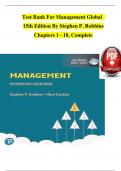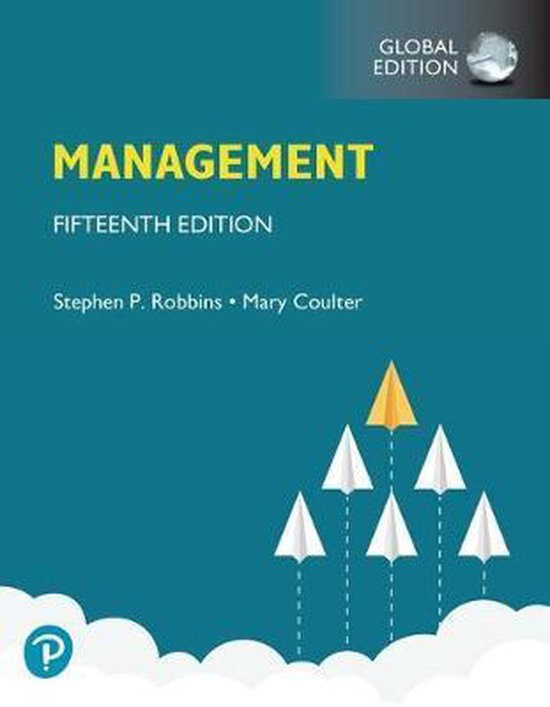
Test Bank For Management Global
15th Edition By Stephen P. Robbins
Chapters 1 - 18, Complete
,Contents
1. Managers and You in the Workplace
2. Making Decisions
3. Influence of the External Environment and the Organization’s Culture
4. Managing in a Global Environment
5. Managing Diversity
6. Managing Social Responsibility and Ethics
7. Managing Change and Disruptive Innovation
8. Foundations of Planning
9. Managing Strategy
10. Entrepreneurial Ventures
11. Designing Organizational Structure
12. Managing Human Resources
13. Managing Groups and Teams
14. Managing Communication
15. Understanding and Managing Individual Behavior
16. Motivating Employees
17. Being an Effective Leader
18. Controlling People and Operations
,Chapter 1 Managers and You in the Workplace
1) Time should be considered a(n) resource.
A) abundant
B) diminishing
C) limited
D) renewabl
e ANSWER:
C Diff: 2
AACSB: Analytical thinking
Learning Obj: LO 1.1: Tell who managers are and where they work; Know how to manage your
time
Classification: Concept
2) One method to become more efficient in managing your time is to .
A) classify each activity or task as A, B, or C
B) schedule more in one day than you can reasonably expect to finish
C) enlist the aid of a management coach to keep you on task
D) shorten deadlines so you will be pressed to complete tasks
early ANSWER: A
Diff: 2
AACSB: Application of knowledge
Learning Obj: LO 1.1: Tell who managers are and where they work; Know how to manage your
time
Classification: Concept
3) Technology makes it easier to stay connected but .
A) there is always the risk of security breaches and the theft of information necessary for
good time management practices
B) it raises expectations on the part of those to whom we are connected
C) technology fails, batteries lose power, and their effectiveness wanes
D) it also presents constant distractions, making it difficult to stay on
task ANSWER: D
Diff: 2
AACSB: Reflective thinking
Learning Obj: LO 1.1: Tell who managers are and where they work; Know how to manage your
time
Classification: Critical thinking
, 4) In today's fworkplace, .
A) women fare fmore flikely fthan fmen fto fbe fpromoted finto fmanagement
B) many femployees fperform fwork fthat fin fthe fpast fwas fconsidered fmanagerial factivities
C) women ftend fto fbe fmore feffective fsupervisors fthan fmen
D) most forganizations fhave feliminated fthe ftitle fof
fmanager f ANSWER: f B
Diff: f2
AACSB: f Reflective fthinking
Learning fObj: fLO f1.1: fTell fwho fmanagers fare fand fwhere fthey fwork; fKnow fhow fto fmanage
fyour f time
Classification: f Concept
5) Because fthis fis fher ffirst fjob, fMelanie fwas funclear fabout fwhat fmanagers factually
fdo. f Fortunately fher ftraining fmaterials fexplained fthat fa fmanager's fjob ffocuses fon.
A) performing fclerical fduties
B) personal fachievement
C) helping fothers faccomplish ftheir fwork fgoals
D) supervising fgroups frather fthan findividual
femployees f ANSWER: f C
Diff: f2
AACSB: f Analytical fthinking; fApplication fof fknowledge
Learning fObj: fLO f1.1: fTell fwho fmanagers fare fand fwhere fthey fwork; fKnow fhow fto fmanage
fyour f time
Classification: f Application
6) An findividual fwho fworks fwith fand fthrough fother fpeople fby fcoordinating ftheir fwork
factivities f in forder fto faccomplish forganizational fgoals fis .
A) an fassembly fline fworker
B) a flaborer
C) a fmanager
D) a
fsalesperson
f ANSWER: f f fC
fDiff: f1
AACSB: f Reflective fthinking
Learning fObj: fLO f1.1: fTell fwho fmanagers fare fand fwhere fthey fwork; fKnow fhow fto fmanage
fyour f time
Classification: f Concept
15th Edition By Stephen P. Robbins
Chapters 1 - 18, Complete
,Contents
1. Managers and You in the Workplace
2. Making Decisions
3. Influence of the External Environment and the Organization’s Culture
4. Managing in a Global Environment
5. Managing Diversity
6. Managing Social Responsibility and Ethics
7. Managing Change and Disruptive Innovation
8. Foundations of Planning
9. Managing Strategy
10. Entrepreneurial Ventures
11. Designing Organizational Structure
12. Managing Human Resources
13. Managing Groups and Teams
14. Managing Communication
15. Understanding and Managing Individual Behavior
16. Motivating Employees
17. Being an Effective Leader
18. Controlling People and Operations
,Chapter 1 Managers and You in the Workplace
1) Time should be considered a(n) resource.
A) abundant
B) diminishing
C) limited
D) renewabl
e ANSWER:
C Diff: 2
AACSB: Analytical thinking
Learning Obj: LO 1.1: Tell who managers are and where they work; Know how to manage your
time
Classification: Concept
2) One method to become more efficient in managing your time is to .
A) classify each activity or task as A, B, or C
B) schedule more in one day than you can reasonably expect to finish
C) enlist the aid of a management coach to keep you on task
D) shorten deadlines so you will be pressed to complete tasks
early ANSWER: A
Diff: 2
AACSB: Application of knowledge
Learning Obj: LO 1.1: Tell who managers are and where they work; Know how to manage your
time
Classification: Concept
3) Technology makes it easier to stay connected but .
A) there is always the risk of security breaches and the theft of information necessary for
good time management practices
B) it raises expectations on the part of those to whom we are connected
C) technology fails, batteries lose power, and their effectiveness wanes
D) it also presents constant distractions, making it difficult to stay on
task ANSWER: D
Diff: 2
AACSB: Reflective thinking
Learning Obj: LO 1.1: Tell who managers are and where they work; Know how to manage your
time
Classification: Critical thinking
, 4) In today's fworkplace, .
A) women fare fmore flikely fthan fmen fto fbe fpromoted finto fmanagement
B) many femployees fperform fwork fthat fin fthe fpast fwas fconsidered fmanagerial factivities
C) women ftend fto fbe fmore feffective fsupervisors fthan fmen
D) most forganizations fhave feliminated fthe ftitle fof
fmanager f ANSWER: f B
Diff: f2
AACSB: f Reflective fthinking
Learning fObj: fLO f1.1: fTell fwho fmanagers fare fand fwhere fthey fwork; fKnow fhow fto fmanage
fyour f time
Classification: f Concept
5) Because fthis fis fher ffirst fjob, fMelanie fwas funclear fabout fwhat fmanagers factually
fdo. f Fortunately fher ftraining fmaterials fexplained fthat fa fmanager's fjob ffocuses fon.
A) performing fclerical fduties
B) personal fachievement
C) helping fothers faccomplish ftheir fwork fgoals
D) supervising fgroups frather fthan findividual
femployees f ANSWER: f C
Diff: f2
AACSB: f Analytical fthinking; fApplication fof fknowledge
Learning fObj: fLO f1.1: fTell fwho fmanagers fare fand fwhere fthey fwork; fKnow fhow fto fmanage
fyour f time
Classification: f Application
6) An findividual fwho fworks fwith fand fthrough fother fpeople fby fcoordinating ftheir fwork
factivities f in forder fto faccomplish forganizational fgoals fis .
A) an fassembly fline fworker
B) a flaborer
C) a fmanager
D) a
fsalesperson
f ANSWER: f f fC
fDiff: f1
AACSB: f Reflective fthinking
Learning fObj: fLO f1.1: fTell fwho fmanagers fare fand fwhere fthey fwork; fKnow fhow fto fmanage
fyour f time
Classification: f Concept