NURS 171 UNIT 4 Exam UPDATED
ACTUAL QUESTIONS AND CORRECT
ANSWERS
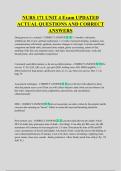
Dying process (s/s, normal) - CORRECT ANSWER 1-3 months: realization,
withdrawal, life review, spiritual exploration. 1-2 weeks: increased sleeping, weakness, less
communication with family, agitation, anorexia, changes in vital signs. Last days and Hours:
congestion and death rattle, decreased urine output, glassy eyes/tearing, edema of feet,
mottling of the feet, non responsiveness, vital signs: decreased blood pressure, weak and
thready pulse, slow and shallow respirations
Commonly used abbreviations vs do not use abbreviations - CORRECT ANSWER Do
not use: U, IU, Q.D., QD, q.o.d., qd, qod, QOD, trailing zeros, MS, MSO4,mgSO4, <, >,
abbreviations for drug names, apothecary units, @, Cc, ug. Ones you can use: Box 5.1 on
page 78
Assessment techniques - CORRECT ANSWER you will start with subjective data (
what the patient says to you) Then you will collect objective data (what you see/observe) In
this order: inspection/observation, palpitations, percussions, and auscultation,
olfaction(smell)
DNR - CORRECT ANSWER do not resuscitate; an order written by the patients health
care provider meaning no "heroic" efforts to restart the heart and breathing should be
performed
Post-mortem care - CORRECT ANSWER care provided after the pt's death. Notify
HCP of death, they pronounce time of death - first thing!. Even after pt's RR cease, the HR
sometimes will continue to beat irregular for 2-3 mins. Document the time of RR and HR
cease, incontinence of bowel and bladder. Ask family if they would like assist with bathing or
care (cultural preferences). If autopsy is not to be done, remove all tubings. Applying clean
gown, linens, close eyes, mouth - family preference. Allow family much time with pt. Pg. 174
skill 10.1
, Capillary refill - CORRECT ANSWER assess circulation, press on nail bed for 3 sec, 5
sec in older. Assess rate of refill and color. Assess for anything that might alter cap refill (nail
polish)
Cheyne-Stokes respirations - CORRECT ANSWER respirations begin to progressively
become shallower again, ending the cycle with a period of apnea. Strong indicator that death
is near
Durable power of attorney - CORRECT ANSWER legal court document that grants the
authority to make health-care decisions and act as a health-care proxy for pt. - should the pt
become disabled. Typically someone they trust (relative, a friend, or even financial institution
such as pt's bank)
Proper documentation in EHR and on paper - CORRECT ANSWER chronological
order, mark though it and write your initials if you make a mistake, if you don't take up the
line make sure you make a line the rest of the way through the rest of the space
Kubler-Ross five stages of grief - CORRECT ANSWER understanding how people
cope with the prospect of dying as part of their life-threatening illness, 5 stages include:
Stage 1: Denial - key phrases: "not me! This isn't happening to me! It can't be happening!"
Stage 2: Anger - key phrases: Why is this happening to ME! Why me? It is not fair!"
Stage 3: Bargaining - key phrases: " I promise I'll be better person if.., Just let me live to see
my children graduate"
Stage 4: Depression - key phrases: "i don't care anymore, I'm so sad; why bother with
anything?"
Stage 5: Acceptance - key phrases: " it's going to be okay, I'm ready for whatever comes."
Apical pulse - CORRECT ANSWER AP is assessed for rate, rhythm, and strength. To
assess, place the diaphragm of the stethoscope directly on the skin over the PMI and listen for
both the S1 and S2 or lubb-dupp. Those sounds will equal one heartbeat. Take pulse for 1
whole min.
S/S of death being near - CORRECT ANSWER Physical changes: vital signs, physical
activity, skin: mottling of feet and legs, respiratory changes, eyes, circulatory changes.....
ACTUAL QUESTIONS AND CORRECT
ANSWERS
Dying process (s/s, normal) - CORRECT ANSWER 1-3 months: realization,
withdrawal, life review, spiritual exploration. 1-2 weeks: increased sleeping, weakness, less
communication with family, agitation, anorexia, changes in vital signs. Last days and Hours:
congestion and death rattle, decreased urine output, glassy eyes/tearing, edema of feet,
mottling of the feet, non responsiveness, vital signs: decreased blood pressure, weak and
thready pulse, slow and shallow respirations
Commonly used abbreviations vs do not use abbreviations - CORRECT ANSWER Do
not use: U, IU, Q.D., QD, q.o.d., qd, qod, QOD, trailing zeros, MS, MSO4,mgSO4, <, >,
abbreviations for drug names, apothecary units, @, Cc, ug. Ones you can use: Box 5.1 on
page 78
Assessment techniques - CORRECT ANSWER you will start with subjective data (
what the patient says to you) Then you will collect objective data (what you see/observe) In
this order: inspection/observation, palpitations, percussions, and auscultation,
olfaction(smell)
DNR - CORRECT ANSWER do not resuscitate; an order written by the patients health
care provider meaning no "heroic" efforts to restart the heart and breathing should be
performed
Post-mortem care - CORRECT ANSWER care provided after the pt's death. Notify
HCP of death, they pronounce time of death - first thing!. Even after pt's RR cease, the HR
sometimes will continue to beat irregular for 2-3 mins. Document the time of RR and HR
cease, incontinence of bowel and bladder. Ask family if they would like assist with bathing or
care (cultural preferences). If autopsy is not to be done, remove all tubings. Applying clean
gown, linens, close eyes, mouth - family preference. Allow family much time with pt. Pg. 174
skill 10.1
, Capillary refill - CORRECT ANSWER assess circulation, press on nail bed for 3 sec, 5
sec in older. Assess rate of refill and color. Assess for anything that might alter cap refill (nail
polish)
Cheyne-Stokes respirations - CORRECT ANSWER respirations begin to progressively
become shallower again, ending the cycle with a period of apnea. Strong indicator that death
is near
Durable power of attorney - CORRECT ANSWER legal court document that grants the
authority to make health-care decisions and act as a health-care proxy for pt. - should the pt
become disabled. Typically someone they trust (relative, a friend, or even financial institution
such as pt's bank)
Proper documentation in EHR and on paper - CORRECT ANSWER chronological
order, mark though it and write your initials if you make a mistake, if you don't take up the
line make sure you make a line the rest of the way through the rest of the space
Kubler-Ross five stages of grief - CORRECT ANSWER understanding how people
cope with the prospect of dying as part of their life-threatening illness, 5 stages include:
Stage 1: Denial - key phrases: "not me! This isn't happening to me! It can't be happening!"
Stage 2: Anger - key phrases: Why is this happening to ME! Why me? It is not fair!"
Stage 3: Bargaining - key phrases: " I promise I'll be better person if.., Just let me live to see
my children graduate"
Stage 4: Depression - key phrases: "i don't care anymore, I'm so sad; why bother with
anything?"
Stage 5: Acceptance - key phrases: " it's going to be okay, I'm ready for whatever comes."
Apical pulse - CORRECT ANSWER AP is assessed for rate, rhythm, and strength. To
assess, place the diaphragm of the stethoscope directly on the skin over the PMI and listen for
both the S1 and S2 or lubb-dupp. Those sounds will equal one heartbeat. Take pulse for 1
whole min.
S/S of death being near - CORRECT ANSWER Physical changes: vital signs, physical
activity, skin: mottling of feet and legs, respiratory changes, eyes, circulatory changes.....